


Origin of the classical complement pathway: Lamprey orthologue of mammalian C1q acts as a lectin
- PMID: 15218103
- PMCID: PMC454176
- DOI: 10.1073/pnas.0402180101
Origin of the classical complement pathway: Lamprey orthologue of mammalian C1q acts as a lectin
Abstract
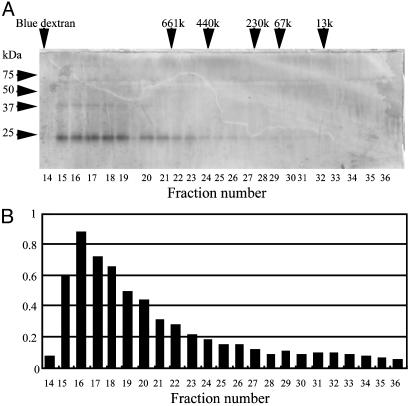
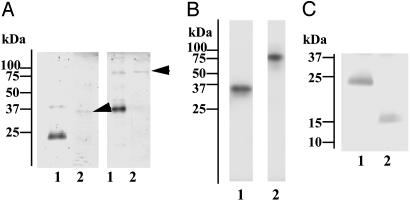
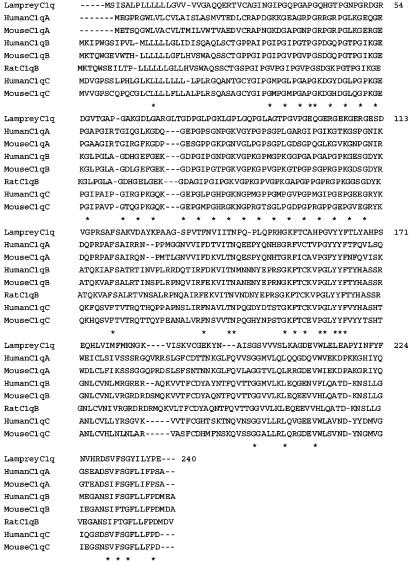
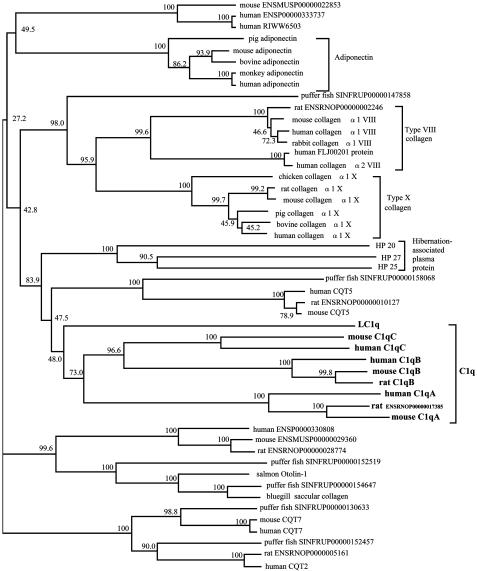
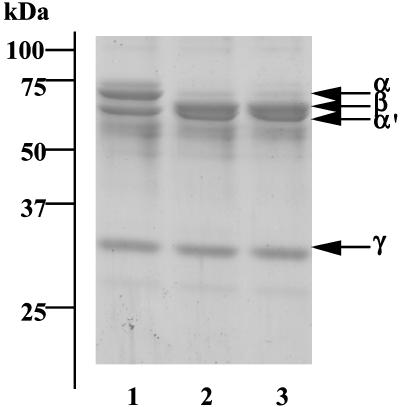
The lectin complement pathway in innate immunity is closely related to the classical complement pathway in adaptive immunity, with respect to the structures and functions of their components. Both pathways are initiated by complexes consisting of collagenous proteins and serine proteases of the mannose-binding lectin (MBL)-associated serine protease (MASP)/C1r/C1s family. It has been speculated that the classical pathway emerged after the lectin pathway, and that the activation mechanism of the latter was partially conserved. The classical and lectin pathways can be traced back to at least cartilaginous fish and ascidian (urochordata), respectively. To elucidate the evolution of the complement system, we isolated and characterized a GlcNAc-binding lectin from sera of lamprey (agnathans), the most primitive vertebrate that lacks the classical pathway. Lamprey GlcNAc-binding lectin was an oligomer consisting of 24-kDa subunits. cDNA and phylogenetic analyses revealed that the lamprey GlcNAc-binding lectin is an orthologue of mammalian C1q, a collagenous subcomponent of the first component involved in binding to immunoglobulins in the classical pathway. Lamprey C1q copurified with MASP-A, a serine protease of the MASP/C1r/C1s family, which exhibited proteolytic activity against lamprey C3. Surface plasmon resonance analysis showed that lamprey C1q specifically bound to GlcNAc, but not various other carbohydrates tested. These results suggest that C1q may have emerged as a lectin and may have functioned as an initial recognition molecule of the complement system in innate immunity before the establishment of adaptive immunity such as immunoglobulins in the cartilaginous fish.
Figures
References
-
- Walport, M. J. (2001) N. Engl. J. Med. 344, 1058-1066. - PubMed
-
- Walport, M. J. (2001) N. Engl. J. Med. 344, 1140-1144. - PubMed
-
- Fujita, T. (2002) Nat. Rev. Immunol. 2, 346-353. - PubMed
-
- Fujita, T., Matsushita, M. & Endo, Y. (2004) Immunol. Rev. 198, 185-202. - PubMed
-
- Turner, M. W. (1996) Immunol. Today 17, 532-540. - PubMed
Publication types
MeSH terms
Substances
Associated data
- Actions
LinkOut - more resources
Full Text Sources
Other Literature Sources
Miscellaneous
