


Block-dependent sedation during epidural anaesthesia is associated with delayed brainstem conduction
- PMID: 15220178
- PMCID: PMC1361808
- DOI: 10.1093/bja/aeh192
Block-dependent sedation during epidural anaesthesia is associated with delayed brainstem conduction
Abstract
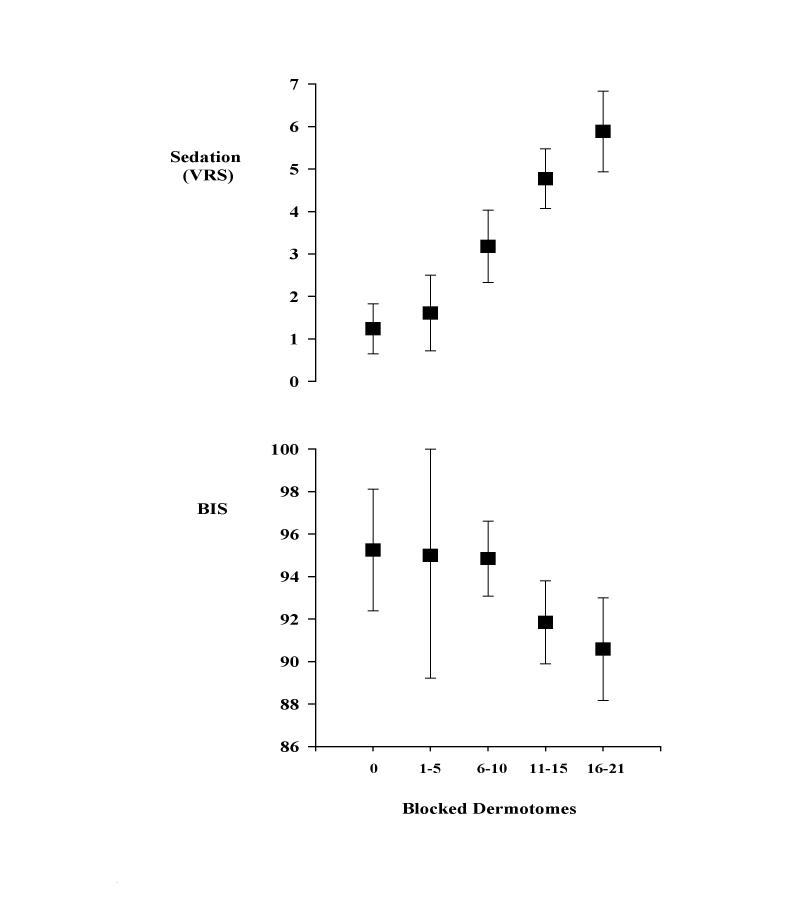
Background: Neuraxial anaesthesia produces a sedative and anaesthetic-sparing effect. Recent evidence suggests that spinal cord anaesthesia modifies reticulo-thalamo-cortical arousal by decreasing afferent sensory transmission. We hypothesized that epidural anaesthesia produces sensory deafferentation-dependent sedation that is associated with impairment of brainstem transmission. We used brainstem auditory evoked potentials (BAEP) to evaluate reticular function in 11 volunteers.
Methods: Epidural anaesthesia was induced with 2-chloroprocaine 2%. Haemodynamic and respiratory responses, sensory block level, sedation depth and BAEP were assessed throughout induction and resolution of epidural anaesthesia. Sedation was evaluated using verbal rating score (VRS), observer's assessment alertness/sedation (OAA/S) score, and bispectral index score (BIS). Prediction probability (PK) was used to associate sensory block with sedation, as well as BIS with other sedation measures. Spearman's rank order correlation was used to associate block level and sedation with the absolute and interpeak BAEP latencies.
Results: Sensory block level significantly predicted VRS (PK=0.747), OAA/S score (PK=0.748) and BIS. BIS predicted VRS and OAA/S score (PK=0.728). The latency of wave III of BAEP significantly correlated with sedation level (rho=0.335, P<0.01) and sensory block (rho=0.394, P<0.01). The other BAEP parameters did not change during epidural anaesthesia. Haemodynamic and respiratory responses remained stable throughout the study.
Conclusions: Sedation during epidural anaesthesia depends on sensory block level and is associated with detectable block-dependent alterations in the brainstem auditory evoked responses. Sensory deafferentation may reduce CNS alertness through mechanisms related to brainstem neural activity.
Figures

References
-
- Tverskoy M, Shifrin V, Finger J, Fleyshman G, Kissin I. Effect of epidural bupivacaine block on midazolam hypnotic requirements. Reg Anesth. 1996;21:209–13. - PubMed
-
- Ben-David B, Vaida S, Gaitini L. The influence of high spinal anesthesia on sensitivity to midazolam sedation. Anesth Analg. 1995;81:525–8. - PubMed
-
- Tverskoy M, Shagal M, Finger J, Kissin I. Subarachnoid bupivacaine blockade decreases midazolam and thiopental hypnotic requirements. J Clin Anesth. 1994;6:487–90. - PubMed
-
- Inagaki Y, Mashimo T, Kuzukawa A, Tsuda Y, Yoshiya I. Epidural lidocaine delays arousal from isoflurane anesthesia. Anesth Analg. 1994;79:368–72. - PubMed
-
- Hodgson PS, Liu SS, Gras TW. Does epidural anesthesia have general anesthetic effects? A prospective, randomized, double-blind, placebo-controlled trial. Anesthesiology. 1999;91:1687–92. - PubMed
Publication types
MeSH terms
Grants and funding
LinkOut - more resources
Full Text Sources
Miscellaneous
