. 2004 Jul 6;101(27):10084-9.
doi: 10.1073/pnas.0402930101. Epub 2004 Jun 28.

Expression of butyrophilin (Btn1a1) in lactating mammary gland is essential for the regulated secretion of milk-lipid droplets

Affiliations

Expression of butyrophilin (Btn1a1) in lactating mammary gland is essential for the regulated secretion of milk-lipid droplets

Sherry L Ogg et al. Proc Natl Acad Sci U S A. .

Abstract

Butyrophilin 1a1 (Btn1a1), which is a member of the Ig superfamily, is highly expressed in the lactating mammary gland and is secreted into milk in association with lipid droplets. To determine the potential function of Btn1a1 in milk secretion, we ablated Btn1a1 in mice and analyzed the lactation phenotype of homozygous (Btn1a1(-/-)) animals. Two mutant mouse lines were generated in which expression of Btn1a1 was either disrupted or eliminated, respectively. The regulated secretion of milk-lipid droplets was severely compromised in both mutant mouse lines in comparison to wild-type animals. Large pools of triacylglycerol accumulated in the cytoplasm of secretory cells, and lipid droplets escaped from the apical surface with disrupted outer membranes. Luminal spaces became engorged with unstable lipid droplets, which coalesced to form large aggregates. The amount of lipid (wt/vol) was elevated, on average by 50%, during the first 10 days of lactation, and the diameter of the droplets was up to seven times larger than the normal diameter. In contrast, there was no significant difference between wild-type and null animals in the relative amounts of skim-milk proteins secreted from Golgi-derived secretory vesicles. Approximately half the pups suckling Btn1a1(-/-) animals died within the first 20 days, and weaning weights for the surviving pups were 60-80% of those suckling wild-type mice. Thus, expression of Btn1a1 is essential for the regulated secretion of milk-lipid droplets. We speculate that Btn1a1 functions either as a structural protein or as a signaling receptor by binding to xanthine dehydrogenase/oxidase.


Figures
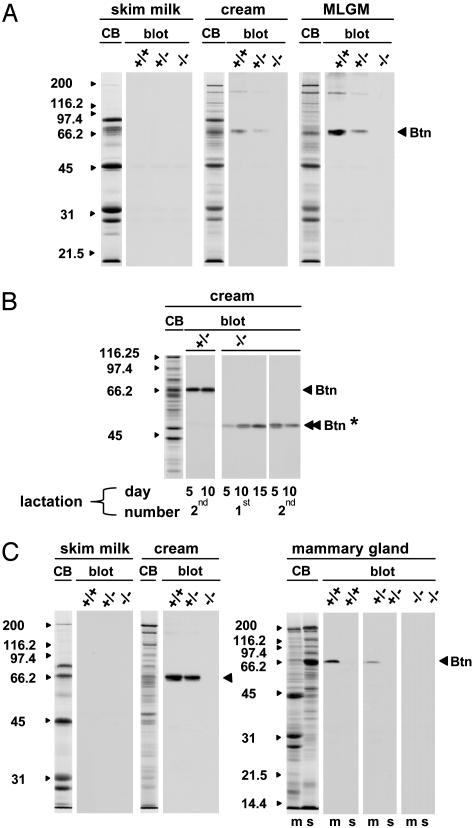
Fig. 1.
Fig. 1.
Analysis of Btn1a1 protein expression by immunoblot in Btn1a1+/+, Btn1a1+/-, and Btn1a1-/- animals. (A) BtnKO1 strain milk samples from day 10 of the first lactation. (B) BtnKO1 strain cream samples from one Btn1a1+/- and one Btn1a1-/- animal analyzed at the lactation stages indicated below the immunoblots. (C) BtnKO2 strain milk and tissue samples from day 10 of the first lactation. Samples were separated in 10% (wt/vol) polyacrylamide gels (30 μg per lane for skim milk and cream fractions, and 40 μg per lane for tissue fractions). CB, Coomassie blue-stained gels representative of each set of samples. Protein profiles were qualitatively similar in all three genotypes, with the exception of Btn1a1 protein in Btn1a1+/- and null mice. The sizes (kDa) of protein standards are indicated to the left of each panel. m, total tissue membrane; s, postmicrosomal supernatant; Btn, Btn1a1 protein; Btn*, fragment of Btn1a1 protein detected in BtnKO1 null mice.
Fig. 2.
Fig. 2.
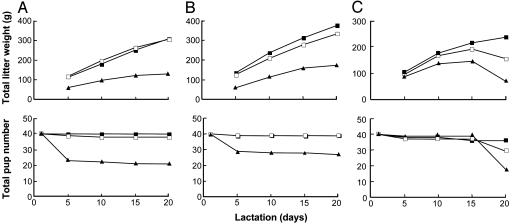
Survival of BtnKO1 and BtnKO2 strain litters. Litters were adjusted to eight pups on day 1 of lactation, and the mothers were either not milked (A and B) or milked (C) with a hand-held vacuum device on days 5, 10, 15, and 20 of lactation (n = 5 animals per genotype). Btn1a1+/+ (filled squares), Btn1a1+/- (open squares), and Btn1a1-/- (filled triangles) are shown.
Fig. 3.
Fig. 3.
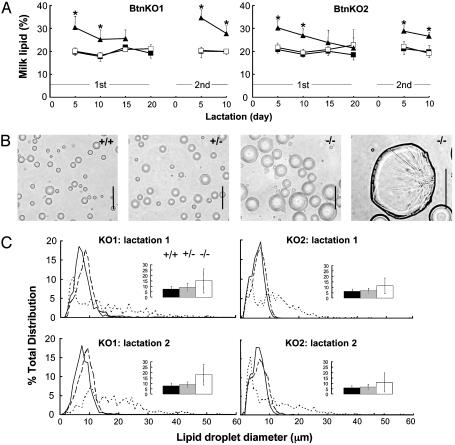
Analysis of lipid in the milk of Btn1a1+/+, Btn1a1+/-, and Btn1a1-/- animals. (A) Amount of milk lipid (%, wt/vol) in the first and first half of the second lactations of BtnKO1 and BtnKO2 strains, as indicated (values, mean ± SD, n = 5 animals per genotype). Btn1a1+/+ (filled squares), Btn1a1+/- (open squares), and Btn1a1-/- (filled triangles) are shown. (B) Phase contrast micrographs of lipid droplets from milk of the three genotypes of BtnKO2 strain mice, as indicated. (Bars: 25 μm.) (C) Profiles of lipid droplet size in milk from the three genotypes on day 10 of the first and second lactations of BtnKO1 and BtnKO2 lines as indicated (average of five lipid samples per genotype). Btn1a1+/+ (solid line), Btn1a1+/- (dashed line), and Btn1a1-/- (dotted line) are shown. (Insets) Mean diameter of lipid droplets from the same samples: Btn1a1+/+ (black bars), Btn1a1+/- (gray bars), and Btn1a1-/- (white bars) are shown (values are mean ± SD, n = 5 samples per genotype). *, Btn1a1-/- values significantly different from Btn1a1+/+ and Btn1a1+/- mice (P < 0.01).
Fig. 4.
Fig. 4.
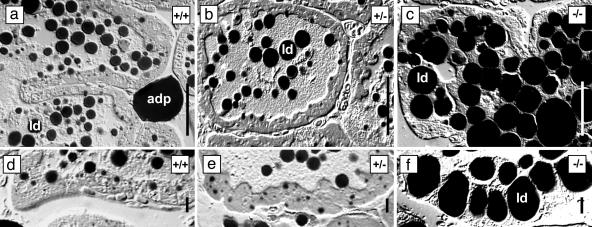
Light micrographs of lactating mammary tissue from Btn1a1+/+, Btn1a1+/-, and Btn1a1-/- BtnKO2 strain mice. Differential interference contrast micrographs are shown. Lipid droplets in milk and tissue (ld) and adipocytes (adp) stain black with OsO4. (Bars: 50 μm in ac; 10 μm in df.)
Fig. 5.
Fig. 5.
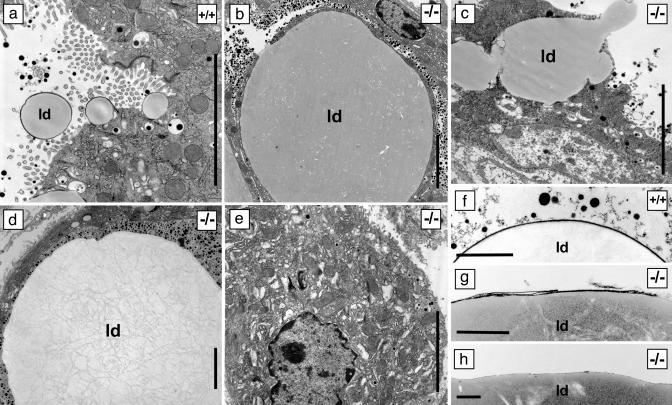
Electron micrographs of lactating mammary tissue from Btn1a1+/+ and Btn1a1-/- BtnKO1 and BtnKO2 strain mice. (c, d, and fh) BtnKO1. (a, b, and e) BtnKO2. (ae) Tissue. (fh) Milk–lipid droplet surface. ld, lipid droplet. (Bars: 5 μm in ae; 1 μm in fh.)

References

    1. Shibui, A., Tsunoda, T., Seki, N., Suzuki, Y., Sugano, S. & Sugane, K. (1999) J. Hum. Genet. 44, 249-252. - PubMed
    1. Stammers, M., Rowen, L., Rhodes, D., Trowsdale, J. & Beck, S. (2000) Immunogenetics 51, 373-382. - PubMed
    1. Rhodes, D. A., Stammers, M., Malcherek, G., Beck, S. & Trowsdale, J. (2001) Genomics 71, 351-362. - PubMed
    1. Ye, T.-Z., Gordon, C. T., Lai, Y.-H., Fujiwara, Y., Peters, L. L., Perkins, A. C. & Chui, D. H. K. (2000) Gene 242, 337-345. - PubMed
    1. Ruddy, D. A., Kronmal, G. S., Lee, V. K., Mintier, G. A., Quintana, L., Domingo, R., Meyer, N. C., Irrinki, A., McClelland, E. E., Fullan, A., et al. (1997) Genome Res. 7, 441-456. - PubMed

Publication types

LinkOut - more resources