. 2004 Jul;186(14):4813-7.
doi: 10.1128/JB.186.14.4813-4817.2004.

Transcriptional analysis of the groES-groEL1, groEL2, and dnaK genes in Corynebacterium glutamicum: characterization of heat shock-induced promoters

Affiliations

Transcriptional analysis of the groES-groEL1, groEL2, and dnaK genes in Corynebacterium glutamicum: characterization of heat shock-induced promoters

Carlos Barreiro et al. J Bacteriol. 2004 Jul.

Retraction in

Abstract

The appropriate conditions to switch on the heat shock promoters in Corynebacterium glutamicum were defined by Northern blot analysis. Transcriptional patterns were characterized for the groEL2 gene and the groES-groEL1 and dnaK operons. Transcriptional start points of these genes were determined by primer extension analysis, allowing the identification of CIRCE and HAIR boxes close to the -10 and -35 regions of the promoters. The presence of both CIRCE and HAIR sequences within a single promoter (P-groEL2) in bacteria is described for the first time. In addition, the dnaK promoter showed -10 and -35 sequences similar to those recognized by SigH of Mycobacterium and SigR of Streptomyces close to a second transcription start region with -10 and -35 boxes typical of promoters for housekeeping genes.


Figures

FIG. 1.
FIG. 1.
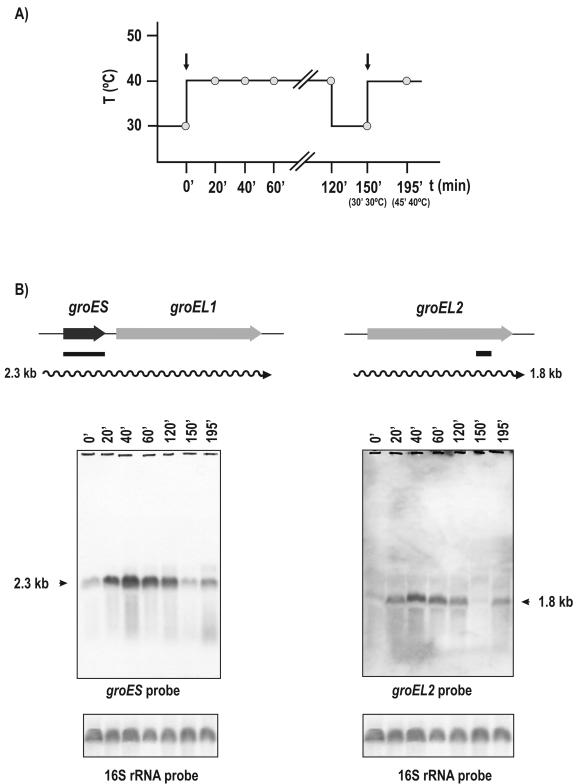
Heat shock induction of groES and groEL genes. (A) Pattern of heat shock induction. Heat shocks were initiated at 0 and 150 min (vertical arrows). The culture was returned to normal temperature at 120 min and kept at 30°C for 30 min. (B) Transcriptional maps and Northern hybridizations of samples taken at the indicated times. The heat shock pattern was as indicated for panel A. The probes are shown by solid lines. The sizes of the hybridizing bands (in kilobases) are indicated by arrowheads on the left and right of the panels. Note that there is a reinduction of expression after the second heat shock. 16S rRNA was hybridized as a control.
FIG. 2.
FIG. 2.
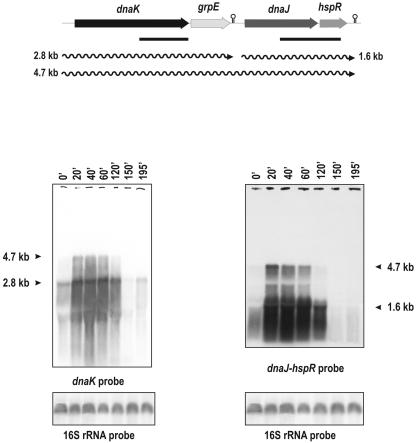
Heat shock induction of dnaK. Transcriptional map and Northern hybridization of RNAs from samples taken at the indicated times. The heat shock pattern was as indicated for Fig. 1A. The probes are indicated by solid lines. The sizes of the hybridizing bands (in kilobases) are indicated by arrows on the left and right of the panels. Putative transcriptional terminators are shown by stem-loop structures. 16S rRNA was hybridized as a control. Observe the heterogeneity present in the smear because of the interference with the rRNAs. The “omega” symbols (palindromes) represent putative terminators found in the 3′ ends of the grpE and hspR genes. The medium used for RNA extraction was TYG (2× TY plus 2% glucose [see the text]).
FIG. 3.
FIG. 3.
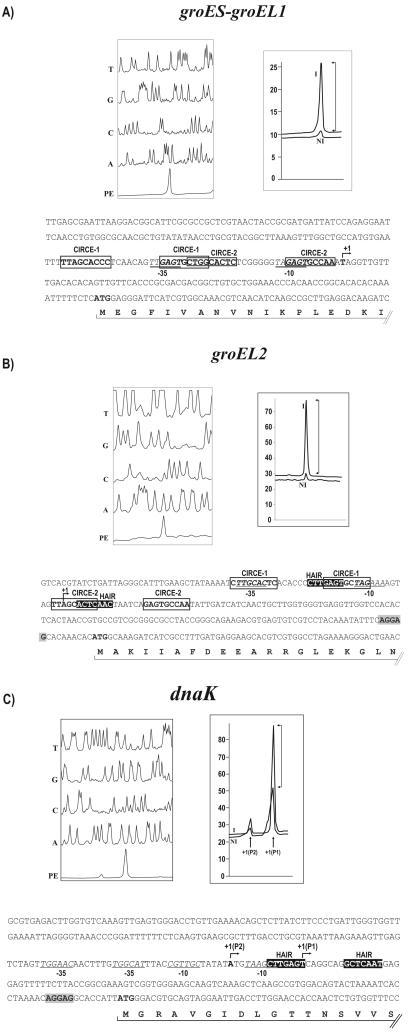
Primer extension analysis. The reaction sequences of the promoter region, T, G, C, and A, were compared with that of the primer extension (PE) reaction product. The peak area (right) is shown for the induced (I) and noninduced (NI) conditions. The transcription start point is indicated by +1 in the nucleotide sequence. The CIRCE sequences are boxed, and the HAIR sequences are in reverse-type letters. Ribosome binding sites are shaded. The −10 and −35 sequences are underlined and in italic letters. (A) Analysis of promoter region of the groES-groEL1 operon. (B) Analysis of the groEL2 promoter region. (C) Analysis of the dnaK promoter. Two products of the primer extension +1(P1) and +1(P2) are indicated. The Fragment Manager Program (Pharmacia Biotech) was used to analyze the reactions.
FIG. 4.
FIG. 4.
Promoter regions of the dnaK gene from C. glutamicum, C. diphtheriae, C. efficiens, M. tuberculosis, and S. coelicolor. The promoter sequences are aligned with the consensus sequence of σR-dependent S. coelicolor promoters and of σH-dependent M. tuberculosis promoters (27). The conserved putative −10 and −35 sequences and the HAIR sequences are in boldface. Positions with identical nucleotides in all sequences are shaded. Gaps were introduced to achieve alignment of homologous regions.

References

    1. Ahmad, S., A. Selvapandiyan, and R. K. Bhatnagar. 2000. Phylogenetic analysis of Gram-positive bacteria based on grpE, encoded by the dnaK operon. Int. J. Syst. Evol. Microbiol. 50:1761-1766. - PubMed
    1. Barreiro, C., E. González-Lavado, and J. F. Martín. 2001. Organization and transcriptional analysis of a six-gene cluster around the rplK-rplA operon of Corynebacterium glutamicum encoding the ribosomal proteins L11 and L1. Appl. Environ. Microbiol. 67:2183-2190. - PMC - PubMed
    1. Cadenas, R. F., J. F. Martín, and J. A. Gil. 1991. Construction and characterization of promoter-probe vectors for Corynebacteria using the kanamycin-resistance reporter gene. Gene 98:117-121. - PubMed
    1. Chastanet, A., J. Fert, and T. Msadek. 2003. Comparative genomics reveal novel heat shock regulatory mechanisms in Staphylococcus aureus and other Gram-positive bacteria. Mol. Microbiol. 47:1061-1073. - PubMed
    1. Grandvalet, C., V. de Crecy-Lagard, and P. Mazodier. 1999. The ClpB ATPase of Streptomyces albus G belongs to the HspR heat shock regulon. Mol. Microbiol. 31:521-532. - PubMed

Publication types

MeSH terms

LinkOut - more resources