


doi: 10.1021/ja049171k.
A small aptamer with strong and specific recognition of the triphosphate of ATP
Affiliations
- PMID: 15237981
- PMCID: PMC4983724
- DOI: 10.1021/ja049171k
Item in Clipboard
A small aptamer with strong and specific recognition of the triphosphate of ATP
J Am Chem Soc.
.
Abstract
We report the in vitro selection of an RNA-based ATP aptamer with the ability to discriminate between adenosine ligands based on their 5' phosphorylation state. Previous selection of ATP aptamers yielded molecules that do not significantly discriminate between ligands at the 5' position. By applying a selective pressure that demands recognition of the 5' triphosphate, we obtained an aptamer that binds to ATP with a Kd of approximately 5 muM, and to AMP with a Kd of approximately 5.5 mM, a difference of 1100-fold. This aptamer demonstrates the ability of small RNAs to interact with negatively charged moieties.
Figures
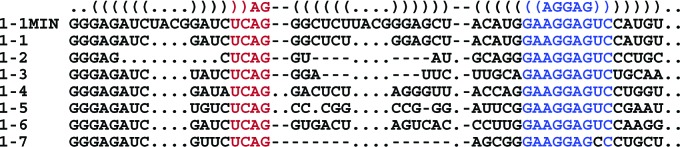
Sequence alignment of class 1 aptamers. Base-paired stems are indicated by parentheses; conserved nucleotides are colored. Dashes are place holders for alignment; dots indicate nonconserved nucleotides.
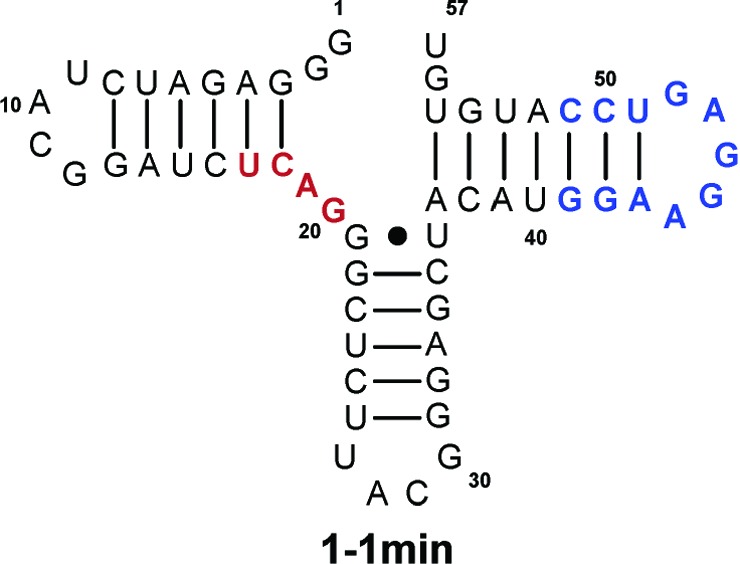
Secondary structure of the 1−1min aptamer. The class 1 conserved stem loop and linkage between two stem loops are highlighted in blue and red, respectively.
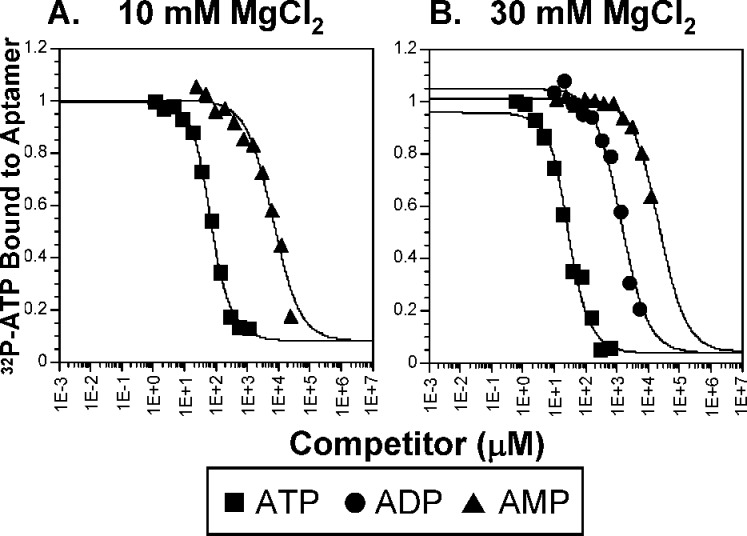
Binding of the 1−1min aptamer to ATP, ADP, and AMP. (a) For each data point, 35 μM 1−1min aptamer was incubated with 0.5 nM γ-32P labeled ATP for 4 h in buffer containing 10 mM MgCl2. (b) For each
data point, 15 μM 1−1min aptamer was treated as in (a) with 30 mM MgCl2
containing buffer. For both (a) and (b), the fraction of labeled ATP bound
to the aptamer was determined and plotted against unlabeled competitor
concentration.
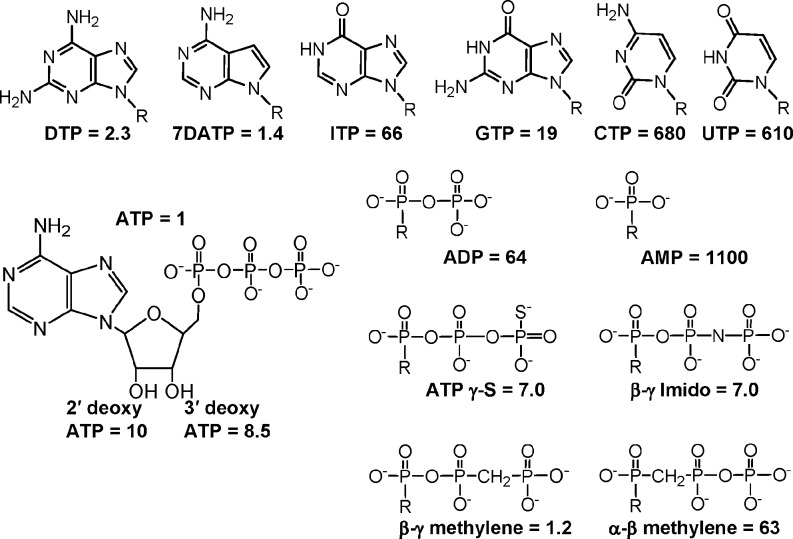
Analysis of 1−1min binding to nucleotides and analogues. Experiments were done as described in Figure 3B, but with the indicated analogue. The numbers indicate theKd value relative to ATP (ATP = 1).
ITP, inosine triphosphate; DTP, 2,6-diaminopurine triphosphate; 7DATP,
7-deazaadenosine triphosphate.
References
Publication types
MeSH terms
Substances
Grants and funding
LinkOut - more resources
Full Text Sources
