


doi: 10.1128/AEM.70.7.4384-4386.2004.
Degradation and turnover of extracellular DNA in marine sediments: ecological and methodological considerations
Affiliations
- PMID: 15240325
- PMCID: PMC444808
- DOI: 10.1128/AEM.70.7.4384-4386.2004
Item in Clipboard
Degradation and turnover of extracellular DNA in marine sediments: ecological and methodological considerations
Appl Environ Microbiol.
2004 Jul.
Abstract
Degradation rates of extracellular DNA determined in marine sediments were much higher than those in the water column. However, due to the high sediment DNA content, turnover times were much shorter in seawater. Results reported here provide new insights into the role of extracellular DNA in P cycling in marine ecosystems.
Figures
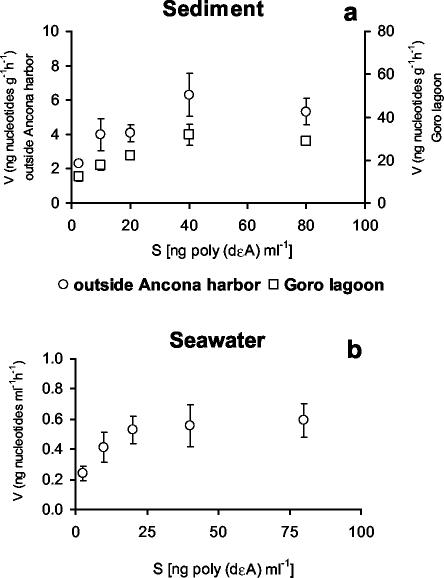
Velocity (V) of poly(dɛA) degradation as a function of substrate concentration in the top 1 cm of sediments collected outside Ancona Harbor and at Goro Lagoon (a) and in surface seawater samples collected outside Ancona Harbor (b). Standard deviations are reported.

Time course analysis of poly(dɛA) degradation in sediment and seawater samples. Data, expressed in relative fluorescence units, refer to time course experiments carried out with the top 1 cm of sediments collected in Ancona Harbor and on surface seawater samples collected outside Ancona Harbor.
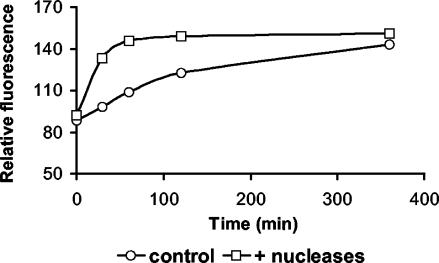
Time course analysis of poly(dɛA) degradation in treated (i.e., with added nucleases) and control (i.e., non-enzymatically treated) sediment samples. Data, expressed in relative fluorescence units, refer to time course experiments carried out with the top 1 cm of sediments collected outside Ancona Harbor.
References
-
- Blackburn, N., U. L. Zweife, and A. Hagstrom. 1996. Cycling of marine dissolved organic matter. II. A model analysis. Aquat. Microb. Ecol. 11:79-90.
-
- Blum, S. A. E., M. G. Lorenz, and W. Wackernagel. 1997. Mechanism of retarded degradation and prokaryotic origin of DNases in non-sterile soils. Syst. Appl. Microbiol. 20:513-521.
-
- Danovaro, R., A. Dell'Anno, A. Pusceddu, and M. Fabiano. 1999. Nucleic acid concentrations (DNA, RNA) in the continental and deep-sea sediments of the eastern Mediterranean: relationships with seasonal varying organic inputs and bacterial dynamics. Deep-Sea Res. Part I 46:1077-1094.
Publication types
MeSH terms
Substances
LinkOut - more resources
Full Text Sources
