. 2004 Jul 13;101(28):10380-5.
doi: 10.1073/pnas.0403954101. Epub 2004 Jul 6.

Cre-lox-regulated conditional RNA interference from transgenes

Affiliations

Cre-lox-regulated conditional RNA interference from transgenes

Andrea Ventura et al. Proc Natl Acad Sci U S A. .

Abstract

We have generated two lentiviral vectors for conditional, Cre-lox-regulated, RNA interference. One vector allows for conditional activation, whereas the other permits conditional inactivation of short hairpin RNA (shRNA) expression. The former is based on a strategy in which the mouse U6 promoter has been modified by including a hybrid between a LoxP site and a TATA box. The ability to efficiently control shRNA expression by using these vectors was shown in cell-based experiments by knocking down p53, nucleophosmin and DNA methyltransferase 1. We also demonstrate the usefulness of this approach to achieve conditional, tissue-specific RNA interference in Cre-expressing transgenic mice. Combined with the growing array of Cre expression strategies, these vectors allow spatial and temporal control of shRNA expression in vivo and should facilitate functional genetic analysis in mammals.


Figures
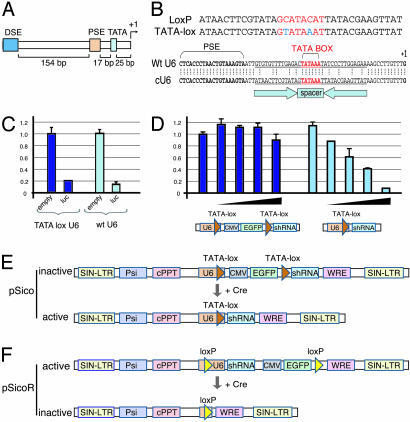
Fig. 1.
Fig. 1.
Generation of pSico and pSicoR. (A) Schematic representation of the mouse U6 promoter. The spacing between the DSE, the PSE, the TATA box, and the transcription start site (+1) is indicated. (B) Comparison between the sequence of a loxP site and a TATAlox site (Upper). Comparison between the sequence of the wild-type mouse U6 promoter and the sequence of the U6 promoter with a TATAlox site replacing the TATA box (Lower). (C) The TATA-lox can replace the TATA box in the U6 promoter. Equal amounts of the wild-type U6 promoter and of the TATAlox U6 promoter (empty or driving the expression of shRNA against the firefly luciferase gene) were transfected in 293T cells together with reporter plasmids expressing firefly luciferase and renilla luciferase. Thirty-six hours later, cells were lysed and the ratio between firefly and renilla luciferase activity was measured. (D) A TATAlox-STOP-TATAlox cassette in the U^ promoter efficiently suppresses shRNA expression. Increasing amounts (0–200 ng) of plasmids containing the indicated version of the U6 promoter were transfected in 293T cells together with reporter plasmids, and luciferase activity was measured as in C. (E) Schematic representation of pSico before and after Cre-mediated recombination. (F) Schematic representation of pSicoR before and after Cre-mediated recombination. SIN-LTR, self-inactivating long terminal repeats; Psi, required for viral RNA packaging; cPPT, central polypurine tract; EGFP: enhanced GFP; WRE, woodchuck regulatory element.
Fig. 2.
Fig. 2.
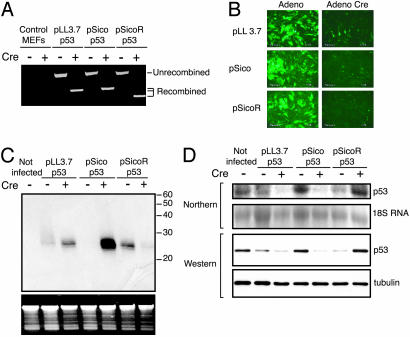
Cre-regulated knockdown of p53. (A) p53R270H/– MEFs infected with the indicated lentiviruses were sorted for GFP positivity and infected with Ad or Ad-Cre. Four days after infection, genomic DNA was extracted, and a PCR was performed to amplify the recombined and unrecombined viral DNA. (B) The same cells were analyzed by epifluorescence microscopy to detect GFP. Similar cell density and identical exposure time was used for all images. (C) Fifteen micrograms of total RNA extracted from the above indicated MEFs was separated on a 15% denaturing polyacrylamide gel, transferred on a nitrocellulose filter, and hybridized to a radi-labeled 19mer corresponding to the sense strand of the p53 shRNA. Equal RNA loading was assessed by ethidium bromide staining of the upper part of the gel (Lower). (D) Northern (Upper) and Western blotting (Lower) showing p53 knock-down in the above indicated cells.
Fig. 3.
Fig. 3.
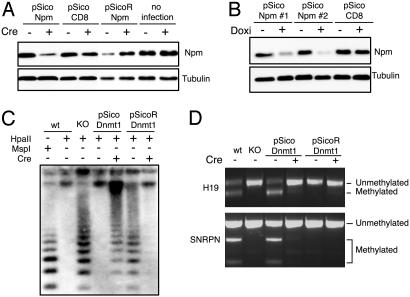
Cre-regulated knockdown of Npm and Dnmt1. (A) Cre-regulated knock-down of Npm. MEFs were infected with the indicated lentiviruses, and GFP-positive cells were sorted and were superinfected with empty Ad or Ad-Cre. One week later, whole-cell lysates were separated by SDS/PAGE, and were subjected to Western blotting against Npm and tubulin. (B) ES cells carrying a doxycycline-inducible Cre (C. Beard and R.J., unpublished data) were infected with the indicated lentiviruses. GFP-positive clones were isolated, passaged two times, and were either left untreated or were incubated with 2 μg/ml doxycycline for 1 week. Immunoblot analysis was performed as in A. (C) Cre-regulated knock-down of Dnmt1 affects cytosine methylation. Methylation analysis of minor satellite DNA. ES cells carrying a doxycycline-inducible Cre transgene were infected with the indicated lentiviruses. Single GFP-positive clones were isolated, expanded, and passaged five times before being either mock-treated or incubated with 2 μg/ml doxycycline. After five more passages, the genomic DNA was extracted and digested with the indicated enzymes and subjected to Southern blot analysis. (D) As in C, but the genomic DNA was treated with sodium bisulfite, subjected to PCR to amplify the indicated imprinted regions, and digested with BstUI.
Fig. 4.
Fig. 4.
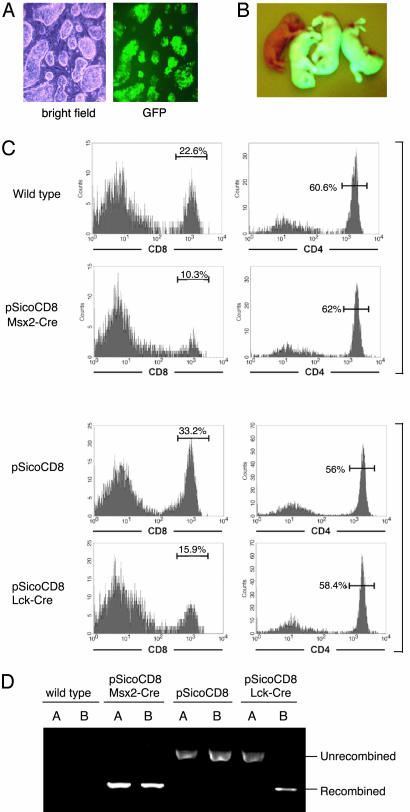
Conditional knockdown of CD8 in transgenic mice. (A) ES cells infected with pSico-CD8 visualized with an inverted fluorescence microscope. (B) A litter of newborns derived from a cross between a pSico-CD8 chimera and an Lck-Cre female. Three pups present bright GFP fluorescence, indicating germ-line transmission of the pSico-CD8 transgene. (C) Knock-down of CD8 in the spleen of Msx2-Cre × pSico-CD8 and Lck-Cre × pSico-CD8 mice. Chimeras from pSico-CD8-infected ES cells were crossed to Msx2-Cre or Lck-Cre animals. The resulting mice were genotyped for the presence of Cre and pSico. Splenocytes from 1- to 3-week old mice with the indicated genotypes were harvested, stained for CD3, CD4, and CD8 expression, and analyzed by flow cytometry. Only CD3+ cells were plotted. One representative example of littermates for each cross is shown.(D) PCR detection of Cre-mediated recombination of pSico-CD8 in genomic DNA extracted from the tail (A) or the thymus (B) of mice with the indicated genotypes.
Fig. 5.
Fig. 5.
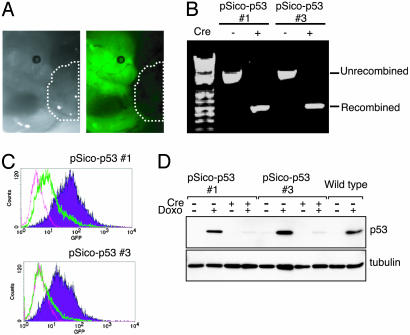
Generation of conditional knockdown embryos by tetraploid complementation. (A) A postnatal day 14.5 embryo derived by tetraploid complementation using the pSico-p53 #1 ES clone. The area enclosed by the dashed line corresponds to the non-ES cell-derived placenta. (B) PCR detection of recombination in MEFs derived from the indicated embryos. Genomic DNA was extracted 4 days after Ad or Ad-Cre infection and subjected to PCR. (C) Histogram overlays showing loss of GFP expression in MEFs derived from pSico-p53#1 (Upper) and pSico-p53#3 (Lower) embryos 4 days after Ad-Cre (green plot) or Ad empty (purple filled plot) infection. Control, GFP-negative MEFs (red plot) are included as reference. (D) MEFs derved from the indicated tetraploid complementation pSico-p53 embryos, or from wild-type embryos, were treated with doxorubicin for 18 h and subjected to Western blot against p53 and β-tubulin.

References

    1. McManus, M. T. & Sharp, P. A. (2002) Nat. Rev. Genet. 3, 737–747. - PubMed
    1. Dykxhoorn, D. M., Novina, C. D. & Sharp, P. A. (2003) Nat. Rev. Mol. Cell Biol. 4, 457–467. - PubMed
    1. Stark, G. R., Kerr, I. M., Williams, B. R., Silverman, R. H. & Schreiber, R. D. (1998) Annu. Rev. Biochem. 67, 227–264. - PubMed
    1. Elbashir, S. M., Harborth, J., Lendeckel, W., Yalcin, A., Weber, K. & Tuschl, T. (2001) Nature 411, 494–498. - PubMed
    1. Brummelkamp, T. R., Bernards, R. & Agami, R. (2002) Science 296, 550–553. - PubMed

Publication types