. 2004 Oct 15;383(Pt 2):259-65.
doi: 10.1042/BJ20040210.

Protein arginine methylation during lytic adenovirus infection

Affiliations

Protein arginine methylation during lytic adenovirus infection

Julia Kzhyshkowska et al. Biochem J. .

Abstract

Arginine methylation of proteins affects major processes in the cell, including transcriptional regulation, mRNA metabolism, signal transduction and protein sorting. Arginine methylation of Ad (adenovirus) E1B 55-kDa-associated protein E1B-AP5 was recently described by us [Kzhyshkowska, Schutt, Liss, Kremmer, Stauber, Wolf and Dobner (2001) Biochem. J. 358, 305-314]. In this first example of protein arginine methylation analysis in Ad-infected cells, we investigated methylation of the E1B-AP5 and the viral L4-100 kDa protein. We demonstrate that E1B-AP5 methylation is enhanced during the course of infection in a cell-type-specific manner. We also show that L4-100 kDa is efficiently methylated in Ad-infected cells. L4-100 kDa formed complex with methyltransferase in vivo during productive infection, and can be methylated by HRMT1L2 (human protein arginine methyltransferase 1) in vitro. Comparative analysis of E1B-AP5 and L4-100 kDa protein methylation in Ad-infected HeLa, MCF-7 and H1299 cells revealed that the profile of protein arginine methylation correlates with the efficiency of Ad proteins production. Our results suggest that protein arginine methylation is an important host-cell function required for efficient Ad replication.


Figures
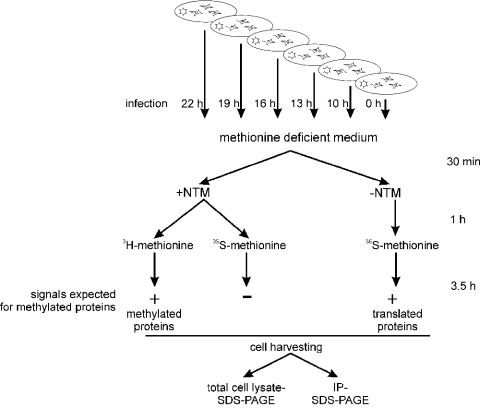
Figure 1
Figure 1. Experimental scheme for analysing protein arginine methylation in productive Ad-infected cells
At various time points after infection (22–10 h) and control, non-infected (0 h) cells were transferred to a methionine-deficient medium in the presence or absence of protein synthesis inhibitors (+NTM or −NTM) as described in the Experimental section. To monitor protein methylation, the methyl-group donor L-[methyl-3H]methionine was added to the NTM-containing medium. Under these conditions, incorporation of 3H into proteins can only occur through post-translational methylation. Inhibition of protein synthesis was confirmed by parallel cell labelling with [35S]methionine in the presence of NTM. In contrast, total protein synthesis was monitored by labelling with [35S]methionine in the absence of NTM. Samples were subsequently analysed by SDS/PAGE of total cell lysates or immunoprecipitates.
Figure 2
Figure 2. Protein methylation in H5wt300-infected HeLa, MCF-7 and H1299 cells
At the indicated time points after infection (hpi), cells were incubated with MEM-lacking methionine and labelled either with L-[methyl-3H]methionine in the presence of +NTM (A, C) or with [35S]methionine but without −NTM (B). Inhibition of protein synthesis was confirmed by parallel cell labelling with [35S]methionine +NTM (lanes C in AC) and cells were harvested 22 h post-infection. (A) Methylation of E1B-AP5 during the time course of infection. E1B-AP5 was immunoprecipitated from total cell extracts using anti-E1B-AP5 mAb 4A11. Samples were analysed by SDS/PAGE followed by autoradiography. The signal was analysed after 7 days of exposure. (B) Total protein synthesis during the time course of infection. Proteins (20 μg of samples) from each time point were separated by SDS/PAGE followed by autoradiography (6 h exposure). (C) Total protein methylation during the time course of infection. Proteins (20 μg of samples) from each time point were separated by SDS/PAGE followed by autoradiography (3 days exposure). Arrows indicate E1B-AP5 120 kDa (A) and methylated L4-100 kDa proteins (C).
Figure 3
Figure 3. Protein steady-state level in HeLa, MCF-7 and H1299 cells infected with H5wt300
Aliquots of lysates (20 μg of samples) used in Figure 2 were separated by PAGE and analysed by Western blotting using the following antibodies: (A) (B6-8) mouse hybridoma supernatant recognizing Ad5 E2A 72 kDa to control the infection efficiency; (B) rat hybridoma supernatant 4A11 anti-E1B-AP5; (C) rat hybridoma supernatant L4-6B10 anti-L4-100 kDa.
Figure 4
Figure 4. Ad5 L4-100 kDa is methylated in H5wt300-infected cells
Cells were labelled with L-[methyl-3H]methionine or [35S]methionine in the presence (+NTM) or absence (−NTM) of NTM as indicated. Total cell extracts were prepared from non-infected cells (0 h) and 16 h post-infection and subjected to IP using anti-L4-100 kDa mAb 2100K-1 (A) or anti-hexon mAb (B). The immunocomplexes were separated by SDS/PAGE and proteins were visualized by autoradiography.
Figure 5
Figure 5. Ad5 L4-100 kDa is methylated by hPRMT1/HRMT1L2 in vitro
HeLa cells, grown in the presence of the methylation inhibitor AdOx, were infected with H5wt300 at a multiplicity of 20 plaque-forming units/cell. Total cell extracts were prepared 16 h post-infection and subjected to IP using anti-L4-100 kDa mAb 2100K-1 (IP α-L4-100 kDa). To inactivate co-precipitated methyltransferase activity half of the precipitate was incubated at 70 °C for 6 min (lanes 3 and 4). GST-hPRMT1 (0.2 μg) was added to the reactions (lanes 2 and 4) and samples were analysed by SDS/PAGE followed by autoradiography. Lanes 5–8 show control reactions where two different fragments of E1B-AP5 fused to GST were used as substrates for GST-hPRMT1 (lanes 6 and 8). GST-AP5-RGG (lanes 7 and 8) contains the RGG domain of E1B-AP5 previously shown to be methylated by GST-hPRMT1 in vitro [24].
Figure 6
Figure 6. Ad5 L4-100 kDa protein synthesis (A) and methylation (B) during the time course of infection
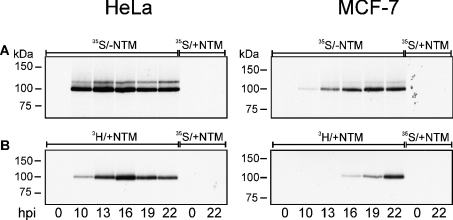
H5wt300-infected HeLa and MCF-7 cells were labelled with L-[methyl-3H]methionine or [35S]methionine in the presence (+NTM) or absence (−NTM) of NTM. At the indicated time points after infection (hpi), total cell extracts were prepared and subjected to IP using anti-L4-100 kDa mAb 2100K-1. The immunocomplexes were separated by SDS/PAGE and L4-100 kDa was visualized by autoradiography [6 h exposure for (A) and 2 days exposure for (B)].

References

    1. Shenk T. Adenoviridae: the viruses and their replication. In: Fields B. N., Knipe D. M., Howley P. M., editors. Virology. New York: Lippincott-Raven; 1996. pp. 2111–2148.
    1. Flint S. J. Nature Publishing Group; 2001. Adenoviruses, Encyclopedia of Life Sciences. Electronic Citation.
    1. Dobner T., Kzhyshkowska J. Nuclear export of adenovirus RNA. Curr. Top. Microbiol. Immunol. 2001;259:25–54. - PubMed
    1. Flint S. J., Gonzalez R. A. Regulation of mRNA production by the adenoviral E1B 55-kDa and E4 Orf6 proteins. Curr. Top. Microbiol. Immunol. 2003;272:287–330. - PubMed
    1. Kleinberger T. Induction of apoptosis by adenovirus E4orf4 protein. Apoptosis. 2000;5:211–215. - PubMed

Publication types

Substances