


Molecular epidemiology of Serratia marcescens in two hospitals in Gdańsk, Poland, over a 5-year period
- PMID: 15243068
- PMCID: PMC446320
- DOI: 10.1128/JCM.42.7.3108-3116.2004
Molecular epidemiology of Serratia marcescens in two hospitals in Gdańsk, Poland, over a 5-year period
Erratum in
- J Clin Microbiol. 2004 Aug;42(8):3914
Abstract
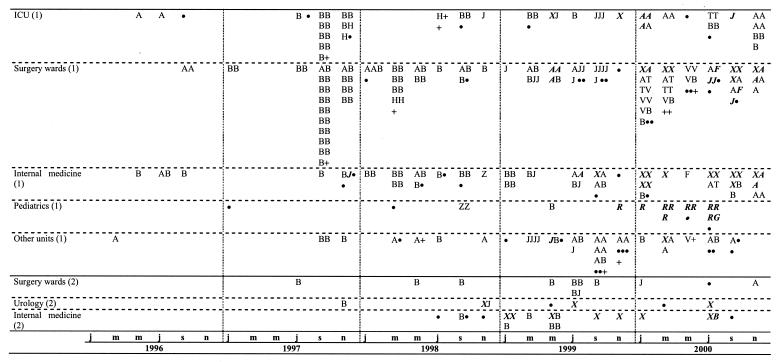
The history of the Serratia marcescens population in two hospitals in Danzig, Poland, over a 5-year period was analyzed in a study that combined MIC evaluation, typing by randomly amplified polymorphic DNA (RAPD) analysis and pulsed-field gel electrophoresis, and analysis of extended-spectrum beta-lactamases (ESBLs). We analyzed 354 isolates collected from 341 patients in two teaching hospitals in Danzig, Poland, from 1996 to 2000. The antimicrobial susceptibility profiles varied greatly, and for resistance to newer beta-lactams, probable AmpC cephalosporinase derepression and ESBL production occurred in about 23 and 19% of the isolates, respectively. RAPD typing, by which 69 types were discerned altogether, revealed a high degree of clonal diversity among the populations. However, the four most prevalent types were highly predominant, grouping approximately 71% of the isolates studied. These clones were observed in the two hospitals and were strong contributors to both outbreaks and the background of endemicity of the S. marcescens infections. Some of the strains that were not so widely spread (12 RAPD types; approximately 14% of the isolates) were responsible for several smaller outbreaks, and the remaining isolates represented unique RAPD types (53 types; approximately 15% of the isolates) and were probably sporadic introductions from other environments. ESBLs were identified in several different clones, and some of these had most likely already been introduced into the hospitals as ESBL producers, whereas the others acquired the ESBL-encoding genes from other enterobacterial strains in these environments. The CTX-M-3 enzyme, which is widely observed in Poland, was the most common ESBL type among the S. marcescens isolates, followed by TEM-47 and SHV-5. The complex epidemiology of ESBLs, especially in 1999 and 2000, must have arisen from the introduction of ESBL producers from other centers, their clonal dissemination, and the constant penetration of the S. marcescens populations with plasmids with ESBL genes. Multiple S. marcescens isolates were obtained from 11 patients, who probably represented both patients with recolonizations and reinfections and patients with recurrences of infections with the evolution of the strain's susceptibility.
Figures
References
-
- Acar, J. F. 1986. Serratia marcescens infections. Infect. Control 7:273-278. - PubMed
-
- Bauernfeind, A., J. M. Casellas, M. Goldberg, M. Holley, R. Jungwirth, P. Mangold, T. Röhnisch, S. Schweighart, and R. Wilhelm. 1992. A new plasmidic cefotaximase from patients infected with Salmonella typhimurium. Infection 20:158-163. - PubMed
-
- Berthelot, P., F. Grattard, C. Amerger, M. C. Frery, F. Lucht, B. Pozzetto, and P. Fargier. 1999. Investigation of a nosocomial outbreak due to Serratia marcescens in a maternity hospital. Infect. Control Hosp. Epidemiol. 20:233-236. - PubMed
Publication types
MeSH terms
Substances
LinkOut - more resources
Full Text Sources
