


ChIP Display: novel method for identification of genomic targets of transcription factors
- PMID: 15252151
- PMCID: PMC484196
- DOI: 10.1093/nar/gnh097
ChIP Display: novel method for identification of genomic targets of transcription factors
Abstract
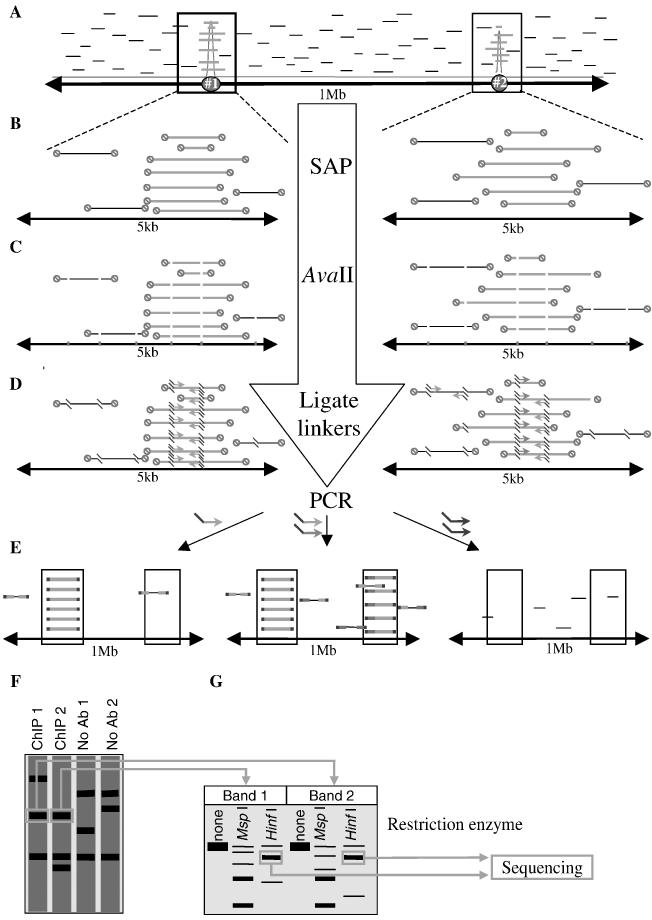
Novel protein-DNA interactions in mammalian cells are traditionally discovered in the course of promoter studies. The genomic era presents opportunities for the reverse; namely, the discovery of novel target genes for transcription factors of interest. Chromatin immunoprecipitation (ChIP) is typically used to test whether a protein binds to a candidate promoter in living cells. We developed a new method, ChIP Display (CD), which allows genome-wide unbiased identification of target genes occupied by transcription factors of interest. Initial CD experiments pursuing target genes for RUNX2, an osteoblast master transcription factor, have already resulted in the identification of four genes that had never been reported as targets of RUNX2. One of them, Osbpl8, was subjected to mRNA and promoter-reporter analyses, which provided functional proof for its regulation by RUNX2. CD will help to assemble the puzzle of interactions between transcription factors and the genome.
Figures


References
-
- Liang P. and Pardee,A.B. (1992) Differential display of eukaryotic messenger RNA by means of the polymerase chain reaction. Science, 257, 967–971. - PubMed
-
- Weinmann A.S. and Farnham,P.J. (2002) Identification of unknown target genes of human transcription factors using chromatin immunoprecipitation. Methods, 26, 37–47. - PubMed
-
- Cawley S., Bekiranov,S., Ng,H.H., Kapranov,P., Sekinger,E.A., Kampa,D., Piccolboni,A., Sementchenko,V., Cheng,J., Williams,A.J. et al. (2004) Unbiased mapping of transcription factor binding sites along human chromosomes 21 and 22 points to widespread regulation of noncoding RNAs. Cell, 116, 499–509. - PubMed
-
- Komori T., Yagi,H., Nomura,S., Yamaguchi,A., Sasaki,K., Deguchi,K., Shimizu,Y., Bronson,R.T., Gao,Y.H., Inada,M. et al. (1997) Targeted disruption of Cbfa1 results in a complete lack of bone formation owing to maturational arrest of osteoblasts. Cell, 89, 755–764. - PubMed
