


Glial modulation of synaptic transmission in the retina
- PMID: 15252816
- PMCID: PMC2322937
- DOI: 10.1002/glia.20030
Glial modulation of synaptic transmission in the retina
Abstract
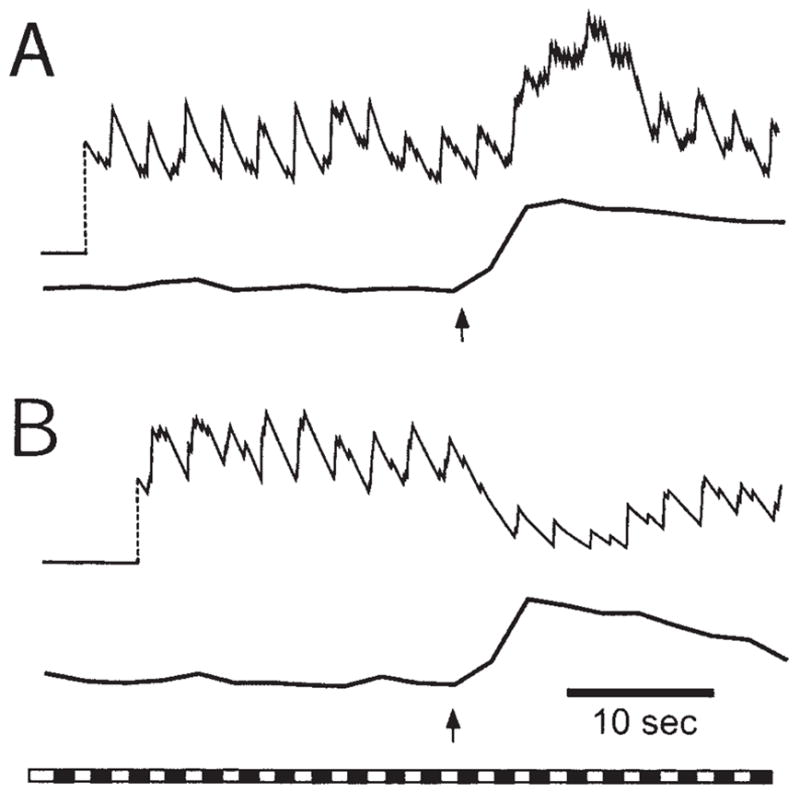
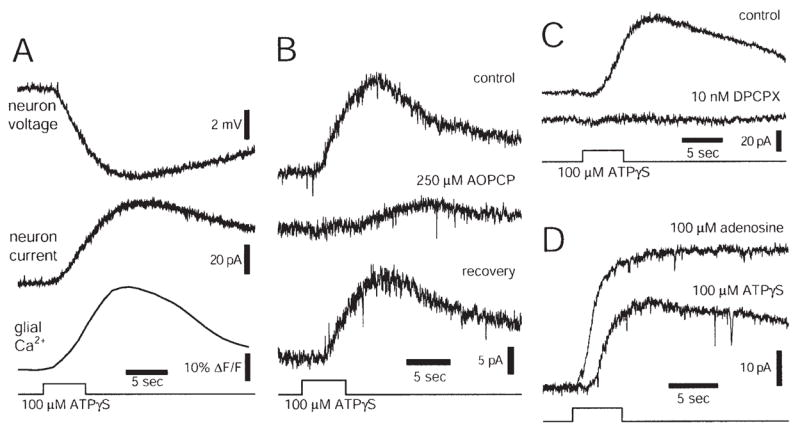
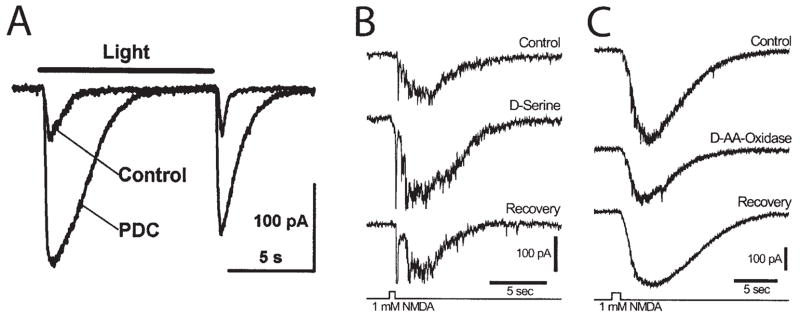
Glial modulation of synaptic transmission and neuronal excitability in the mammalian retina is mediated by several mechanisms. Stimulation of glial cells evokes Ca(2+) waves, which propagate through the network of retinal astrocytes and Müller cells and result in the modulation of the activity of neighboring ganglion cells. Light-evoked spiking is enhanced in some ganglion cells and depressed in others. A facilitation or depression of light-evoked excitatory postsynaptic currents is also seen in ganglion cells following glial stimulation. In addition, stimulation of glial cells evokes a sustained hyperpolarizing current in ganglion cells which is mediated by ATP release from Müller cells and activation of neuronal A(1) adenosine receptors. Recent studies reveal that light-evoked activity in retinal neurons results in an increase in the frequency of Ca(2+) transients in Müller cells. Thus, there is two-way communication between neurons and glial cells, suggesting that glia contribute to information processing in the retina.
Glial modulation of synaptic transmission and neuronal excitability in the mammalian retina is mediated by several mechanisms. Stimulation of glial cells evokes Ca2+ waves, which propagate through the network of retinal astrocytes and Müller cells and result in the modulation of the activity of neighboring ganglion cells. Light-evoked spiking is enhanced in some ganglion cells and depressed in others. A facilitation or depression of light-evoked excitatory postsynaptic currents is also seen in ganglion cells following glial stimulation. In addition, stimulation of glial cells evokes a sustained hyperpolarizing current in ganglion cells which is mediated by ATP release from Müller cells and activation of neuronal A1 adenosine receptors. Recent studies reveal that light-evoked activity in retinal neurons results in an increase in the frequency of Ca2+ transients in Müller cells. Thus, there is two-way communication between neurons and glial cells, suggesting that glia contribute to information processing in the retina.
Copyright 2004 Wiley-Liss, Inc.
Figures


References
-
- Araque A, Parpura V, Sanzgiri RP, Haydon PG. Glutamate-dependent astrocyte modulation of synaptic transmission between cultured hippocampal neurons. Eur J Neurosci. 1998;10:2129–2142. - PubMed
-
- Bloomfield SA. Effect of spike blockade on the receptive-field size of amacrine and ganglion cells in the rabbit retina. J Neurophys. 1996;75:1878–1893. - PubMed
Publication types
MeSH terms
Grants and funding
LinkOut - more resources
Full Text Sources
Miscellaneous
