. 2004 Mar;9(1):99-107.
doi: 10.1379/csc-1r.1.

Heat shock treatment protects against angiotensin II-induced hypertension and inflammation in aorta

Affiliations

Heat shock treatment protects against angiotensin II-induced hypertension and inflammation in aorta

Yu Chen et al. Cell Stress Chaperones. 2004 Mar.

Abstract

Angiotensin II (Ang II) is a potent vasoconstrictor and induces inflammation and end-organ injury through its activation of the proinflammatory transcription factor, nuclear factor-kappaB (NF-kappaB). Heat shock (HS) treatment with subsequent expression of heat shock proteins (Hsps) is an effective strategy for tissue protection against oxidative injuries. Recently, HS and Hsps have been shown to interact with NF-kappaB in tissue injury. In this study, we investigated whether HS could protect against Ang II-induced hypertension and inflammation by inhibiting NF-kappaB. Sprague-Dawley rats were divided into control and HS groups. Control and 24-hour post-heat shocked rats were treated with Ang II. At days 1, 3, 5, 7, 11, and 14 after Ang II administration, systolic blood pressures were measured by tail-cuff plethysmography, and aorta tissues were collected. Aorta NF-kappaB deoxyribonucleic acid-binding activity was measured by electrophoretic mobility shift assay, and NF-kappaB p65 subunit, Hsp70, Hsp27, and interleukin-6 (IL-6) expressions were measured by Western analysis. HS treatment significantly decreased Ang II-induced hypertension. The activation of NF-kappaB in aorta by Ang II was suppressed by HS treatment. The elevated expression of IL-6 induced by Ang II treatment was also decreased by HS treatment. Although Ang II treatment induced an increase in Hsp70 and Hsp27, HS treatment induced a greater elevation of Hsp70 and Hsp27 expression. HS treatment protects against Ang II-induced hypertension and inflammation. This protection may relate to the interaction of Hsps and the NF-kappaB pathway.


Figures
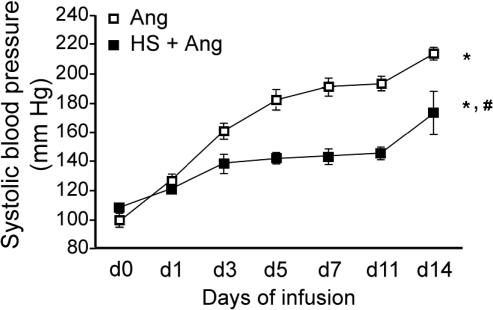
Fig 1.
Fig 1.
Effect of heat shock (HS) treatment on angiotensin II (Ang II)–induced hypertension in rats. HS was administered 24 hours before initiation of Ang II infusion. Systolic blood pressure was measured at days 0, 1, 3, 5, 7, 11, and 14 of Ang II infusion. Data points represent mean ± SEM (n = 6). *P < 0.01, d0 vs d1 to d14 Ang; P < 0.05, d0 vs d1 HS + Ang; P < 0.01, d0 vs d3 to d14 HS + Ang; #P < 0.01, d3 to d14, Ang vs HS + Ang
Fig 2.
Fig 2.
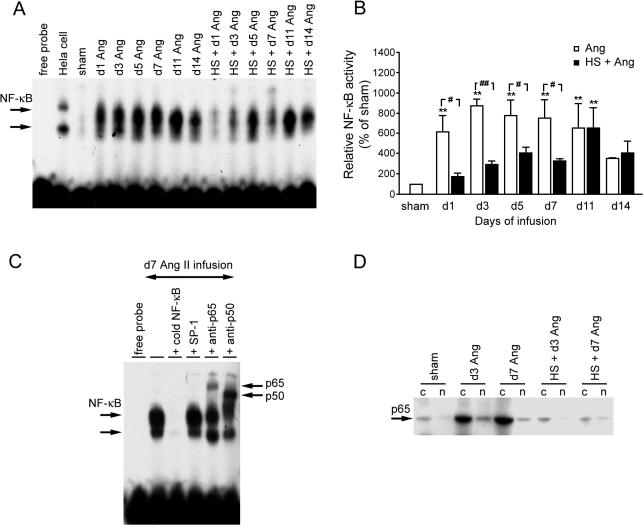
Effect of heat shock (HS) treatment on angiotensin II (Ang II)–induced nuclear factor–κB (NF-κB) activation in rat aorta. (A) Electrophoretic mobility shift assay (EMSA) of NF-κB deoxyribonucleic acid–binding activity. (B) Semiquantitative densitometry of NF-κB activity. (C) Specific NF-κB–binding activity and supershift assay showing identification of p50 and p65 subunits in the NF-κB complex. (D) HS suppressed NF-κB p65 subunit expression and its nuclear translocation, particularly at day 3. **P < 0.01 vs sham; #P < 0.05, ##P < 0.01 Ang vs HS + Ang. Cytoplasmic and nuclear fractions are indicated by c and n, respectively. Data are representative of 3 separate experiments
Fig 3.
Fig 3.
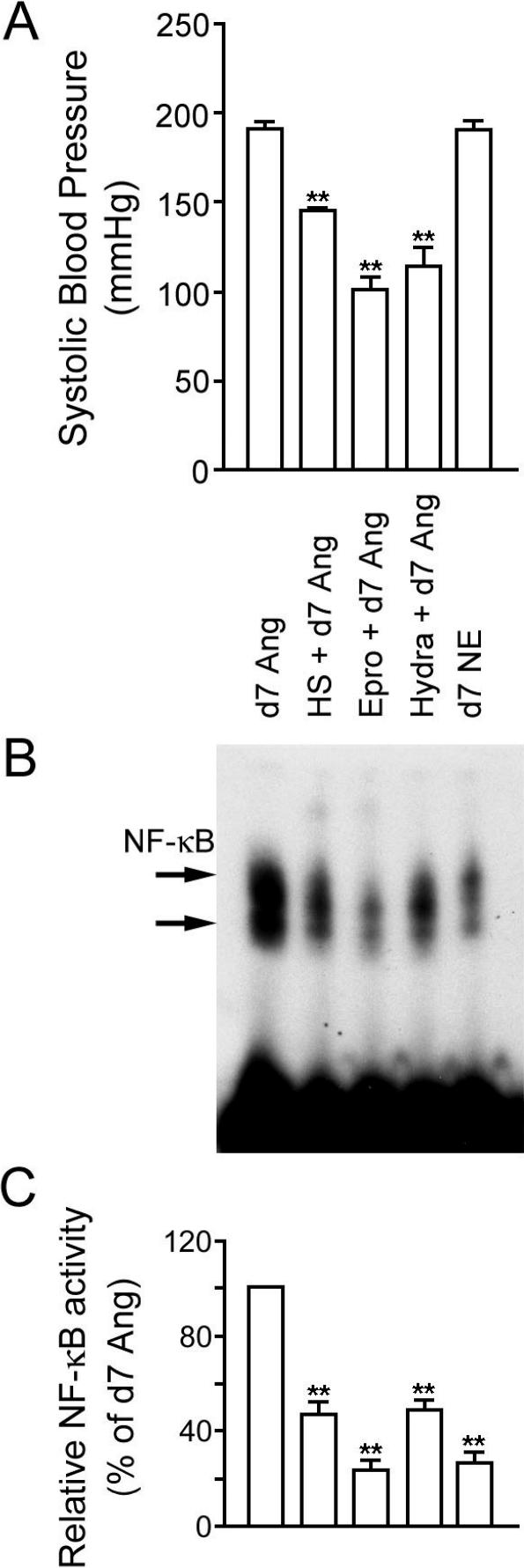
Comparison of blood pressure and nuclear factor–κB (NF-κB) activity after 7 days treatment with angiotensin II (Ang II) (day 7 Ang), heat shock (HS) and 7 days treatment with Ang II (HS + d7 Ang), vasodilator eprosartan and 7 days treatment with Ang II (Epro + d7 Ang), vasodilator hydralazine and 7 days treatment with Ang II (Hydra + d7 Ang), and 7 days treatment with norepinephrine (d7 NE). (A) Systolic blood pressure. **P < 0.01 vs d7 Ang II infused. Each bar represents the data from 6 rats. (B) NF-κB activity in aorta. (C) Semiquantitative densitometry of NF-κB activity in aorta. **P < 0.01 vs d7 Ang II infused. There are also significant differences (P < 0.01) between HS + d7 Ang vs Epro + d7 Ang and d7 NE and between Hydra + d7 Ang vs Epro + d7 Ang and d7 NE. Data are representative of 3 separate experiments
Fig 4.
Fig 4.
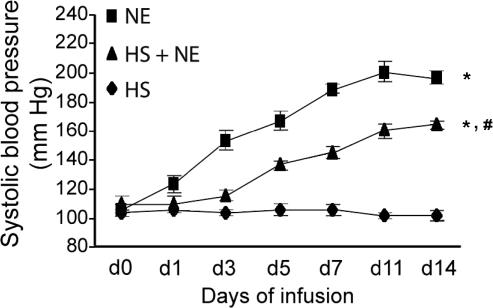
Effect of heat shock (HS) and norepinephrine (NE) on blood pressure in rats. HS was administered 24 hours before implantation of a minipump containing either NE or vehicle (saline). Some rats were anesthetized but not heat shocked before implantation of a minipump containing NE. Systolic blood pressure was measured at days 0, 1, 3, 5, 7, 11, and 14 after minipump implantation. Data points represent mean ± SEM (for HS, n = 6; NE, n = 5; HS + NE, n = 5). *P < 0.01, d1 to d14, NE vs HS; d5 to d14, HS + NE vs HS. #P < 0.05, d1; P < 0.01, d3 to d14, HS + NE vs NE
Fig 5.
Fig 5.
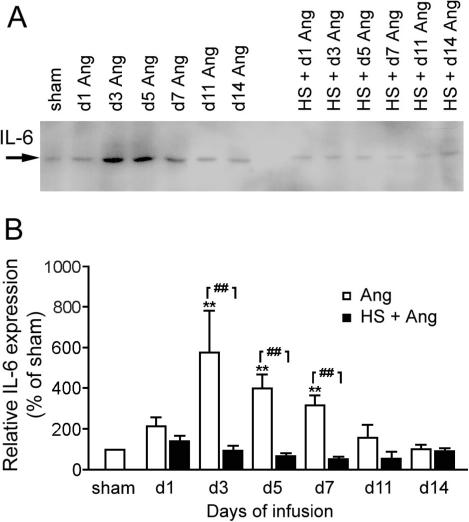
Effect of heat shock (HS) treatment on angiotensin II (Ang II)–induced interleukin-6 (IL-6) expression in rat aorta. **P < 0.01 vs sham; ##P < 0.01 Ang vs HS + Ang. Data are representative of 3 separate experiments
Fig 6.
Fig 6.
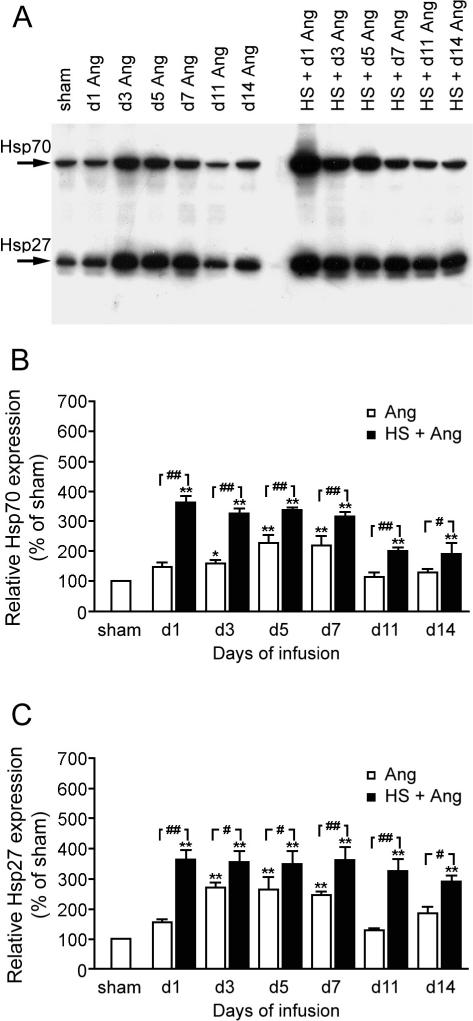
Expression of heat shock protein (Hsp)70 and Hsp27 in rat aorta after angiotensin II (Ang II) infusion and heat shock (HS) + Ang II infusion. *P < 0.05, **P < 0.01 vs sham; #P < 0.05, ##P < 0.01 Ang vs HS + Ang. Data are representative of 3 separate experiments

References

    1. Aizawa T, Ishizaka N, Taguchi J, Nagai R, Mori I, Tang SS, Ingelfinger JR, Ohno M. Heme oxygenase-1 is upregulated in the kidney of angiotensin II-induced hypertensive rats: possible role in renoprotection. Hypertension. 2000;35:800–806.0194-911X(2000)035<0800:HOIUIT>2.0.CO;2 - PubMed
    1. Beere HM. Stressed to death: regulation of apoptotic signaling pathways by the heat shock proteins. Sci STKE. 2001;31:RE1.1525-8882(2001)031<RE1:STDROA>2.0.CO;2 - PubMed
    1. Blackwell TS, Christman JW. The role of nuclear factor-kappa B in cytokine gene regulation. Am J Respir Cell Mol Biol. 1997;17:3–9.1044-1549(1997)017<0003:TRONFB>2.0.CO;2 - PubMed
    1. Currie RW, Karmazyn M, Kloc M, Mailer K. Heat-shock response is associated with enhanced post-ischemic ventricular recovery. Circ Res. 1988;63:543–549.0009-7330(1988)063<0543:HRIAWE>2.0.CO;2 - PubMed
    1. Currie RW, Plumier J-CL 1998 The heat shock response and tissue protection. In: Delayed Preconditioning and Adaptive Cardioprotection, ed Baxter GF, Yellon DM. Kluwer Academic Publishers, Dordrecht, The Netherlands, 135–153.

Publication types

MeSH terms