


The early effect of the Roux-en-Y gastric bypass on hormones involved in body weight regulation and glucose metabolism
- PMID: 15273546
- PMCID: PMC1356398
- DOI: 10.1097/01.sla.0000133117.12646.48
The early effect of the Roux-en-Y gastric bypass on hormones involved in body weight regulation and glucose metabolism
Abstract
Objective: To evaluate the early effect of Roux-en-Y (RYGB) gastric bypass on hormones involved in body weight regulation and glucose metabolism. SIGNIFICANT BACKGROUND DATA: The RYGB is an effective bariatric procedure for which the mechanism of action has not been elucidated yet. Reports of hormonal changes after RYGB suggest a possible endocrine effect of the operation; however, it is unknown whether these changes are the cause or rather the effect of surgically induced weight loss. We speculated that if the mechanism of action of the RYGB involves an endocrine effect, then hormonal changes should occur early after surgery, prior to substantial body weight changes.
Methods: Ten patients with a mean preoperative body mass index (BMI) of 46.2 kg/m (40-53 kg/m) underwent laparoscopic RYGB. Six patients had type 2 diabetes treated by oral hypoglycemic agents. Preoperatively and 3 weeks following surgery, all patients were tested for fasting glucose, insulin, glucagon, insulin-like growth factor 1 (IGF-1), leptin, gastric inhibitory polypeptide (GIP), glucagon-like peptide-1 (GLP-1), cholecystokinin (CCK), adrenocorticotropic hormone (ACTH), corticosterone, and neuropeptide Y (NPY).
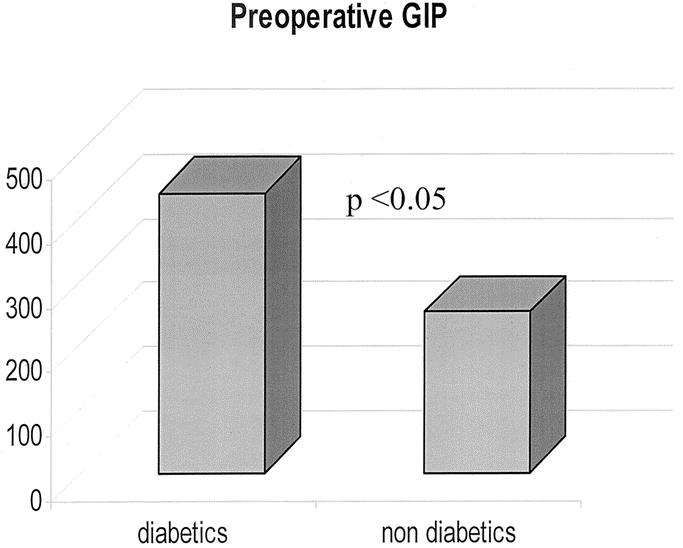
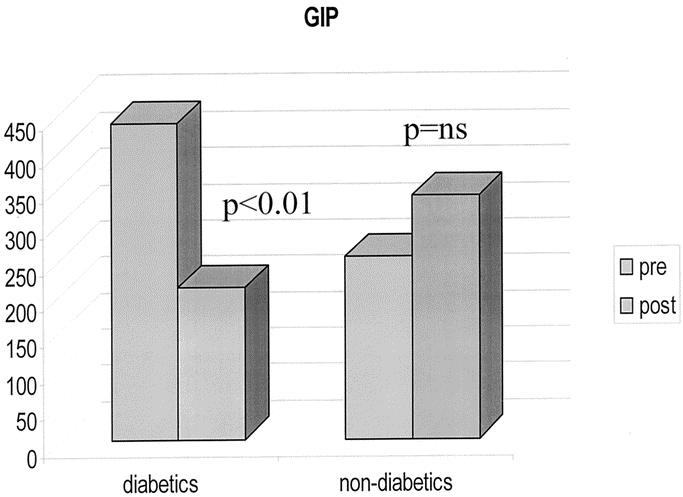
Results: Changes in mean BMI were rather minimal (43.2 kg/m; P = not significant), but there was a significant decrease in blood glucose (P = 0.005), insulin (P = 0.02), IGF-1 (P < 0.05), leptin (P = 0.001), and an increase in ACTH levels (P = 0.01). The other hormones were not significantly changed by surgery. All the 6 diabetic patients had normal glucose and insulin levels and did not require medications after surgery. The RYGB reduced GIP levels in diabetic patients (P < 0.01), whereas no changes in GIP levels were found in nondiabetics.
Conclusions: Roux-en-Y gastric bypass determines considerable hormonal changes before significant BMI changes take place. These results support the hypothesis of an endocrine effect as the possible mechanism of action of RYGB.
Figures
References
-
- Buchwald H. Overview of bariatric surgery. J Am Coll Surg. 2002;194:367–375. - PubMed
-
- Brolin RE. Update: NIH consensus conference. Gastrointestinal surgery for severe obesity. Nutrition. 1996;12:403–404. - PubMed
-
- Fruhbeck G, Gomez-Ambrosi J, Muruzabal FJ, et al. The adipocyte: a model for integration of endocrine and metabolic signaling in energy metabolism regulation. Am J Physiol Endocrinol Metab. 2001;280:E827–E847. - PubMed
-
- Beck B. Neuropeptides and obesity. Nutrition. 2000;16:916–923. - PubMed
Publication types
MeSH terms
Substances
LinkOut - more resources
Full Text Sources
Other Literature Sources
Medical
Research Materials
Miscellaneous
