


Innate immunity genes influence the severity of acute appendicitis
- PMID: 15273551
- PMCID: PMC1356403
- DOI: 10.1097/01.sla.0000133184.10676.26
Innate immunity genes influence the severity of acute appendicitis
Abstract
Objective: Using acute appendicitis as a model, we tested the hypothesis that polymorphisms in genes involved in host defense can be associated with the severity of local infection-inflammation in humans.
Summary background data: Innate immunity is the body's front-line system for antimicrobial host defense. Local inflammation is a major innate immune mechanism for containing and destroying microbes, but it may also contribute to tissue injury.
Methods: We studied 134 patients with acute appendicitis treated at an urban hospital. We looked for associations between the severity of appendicitis (uncomplicated vs. perforated or gangrenous), plasma and peritoneal cytokine concentrations, and single nucleotide polymorphisms in genes involved in recognizing bacterial molecules [CD14 (-159 C-->T); TLR4 (896 A-->G)] and in mounting an inflammatory response [IL-6 (-174 G-->C), TNF-alpha (-308 G-->A), IL-1beta (-31 C -->T)].
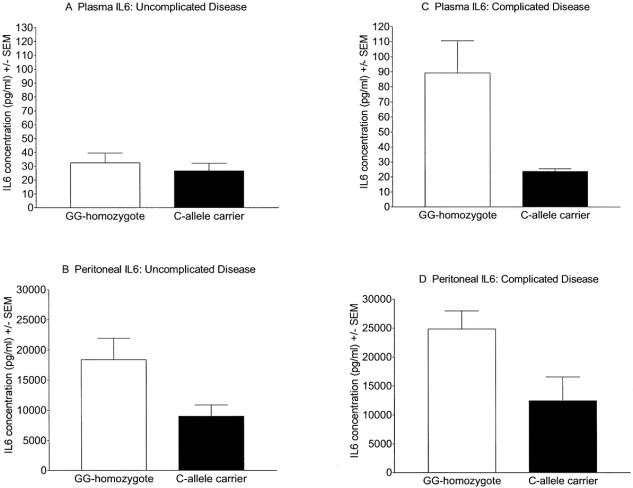
Results: Ninety-one patients (68%) had uncomplicated appendicitis and 43 (32%) had complicated disease. The SNPs in the CD14, TLR4, IL-1beta, and TNF-alpha genes were not associated with the severity of appendicitis. A strong association was found between C-allele carriage at -174 in the IL-6 gene and decreased risk of complicated disease (adjusted odds ratio = 0.24, 95% CI = 0.07-0.76). Lower plasma and peritoneal fluid IL-6 concentrations in the IL-6 -174 C-carriers than in the GG homozygotes suggest that this polymorphism contributes to decreased IL-6 production in vivo.
Conclusions: Polymorphism in the IL-6 gene was associated with the severity of appendicitis, even after adjustment for duration of symptoms. The risk for developing appendiceal perforation or gangrene may be determined, in part, by variation in the IL-6 gene.
Figures
References
-
- Medzhitov R, Janeway C Jr. Innate immunity. N Engl J Med. 2000;343:338–344. - PubMed
-
- Munford RS, Pugin J. The crucial role of systemic responses in the innate (non-adaptive) host defense. J Endotoxin Res. 2001;7:327–332. - PubMed
-
- Soffer D, Zait S, Klausner J, et al. Peritoneal cultures and antibiotic treatment in patients with perforated appendicitis. Eur J Surg. 2001;167:214–216. - PubMed
Publication types
MeSH terms
Substances
Grants and funding
LinkOut - more resources
Full Text Sources
Other Literature Sources
Medical
Research Materials
