. 2004 Aug;78(16):8437-45.
doi: 10.1128/JVI.78.16.8437-8445.2004.

Frequent transmission of cytotoxic-T-lymphocyte escape mutants of human immunodeficiency virus type 1 in the highly HLA-A24-positive Japanese population

Affiliations

Frequent transmission of cytotoxic-T-lymphocyte escape mutants of human immunodeficiency virus type 1 in the highly HLA-A24-positive Japanese population

Tae Furutsuki et al. J Virol. 2004 Aug.

Abstract

Although Japan is classified as a country with a low prevalence of human immunodeficiency virus type 1 (HIV-1), domestic sexual transmission has been increasing steadily. Because 70% of the Japanese population expresses HLA-A24 (genotype HLA-A*2402), we wished to assess the effect of the dominant HLA type on the evolution and transmission of HIV-1 among the Japanese population. Twenty-three out of 25 A24-positive Japanese patients had a Y-to-F substitution at the second position [Nef138-10(2F)] in an immunodominant A24-restricted CTL epitope in their HIV-1 nef gene (Nef138-10). None of 12 A24-negative Japanese hemophiliacs but 9 out of 16 patients infected through unprotected sexual intercourse had Nef138-10(2F) (P < 0.01). Two of two A24-positive but none of six A24-negative Australians had Nef138-10(2F). Nef138-10(2F) peptides bound well to the HLA-A*2402 heavy chain; however, Nef138-10(2F) was expressed poorly on the cell surface from the native protein. Thus, HIV-1 with Nef138-10(2F) appears to be a cytotoxic-T-lymphocyte escape mutant and has been transmitted frequently by sexual contact among the highly A24-positive Japanese population.


Figures
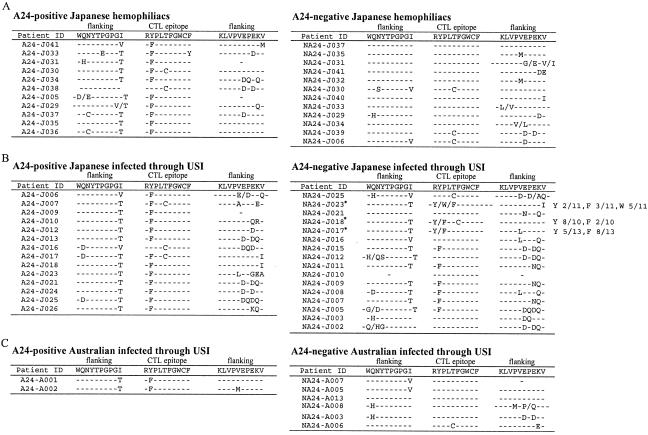
FIG. 1.
FIG. 1.
Nef138-10 epitope and its flanking sequences. Amino acid sequences deduced from the direct DNA sequencing of Nef138-10 CTL epitope and both flanking regions are presented. Wild-type sequences (HIV-1 strain SF2) are presented on the top. Dashes indicate the same amino acid as that of the wild type. Sequence substitutions are presented by single amino acid characters. Where a mixture of two or three amino acids was plausible, two or three amino acids were shown together separated by a shill. A single dash indicates that the sequences could not be determined by ambiguities. (A) Sequences from A24-positive and -negative Japanese hemophiliacs. (B) Sequences from A24-positive and -negative Japanese patients infected through USI. Asterisks indicate samples for which sequence ambiguities were found by direct sequence analysis. We cloned these PCR fragments into the pGEM-T vector and sequenced each 10 to 13 colonies. All amino acid sequences are indicated. (C) Sequences from A24-positive and -negative Australians infected through USI.
FIG. 2.
FIG. 2.
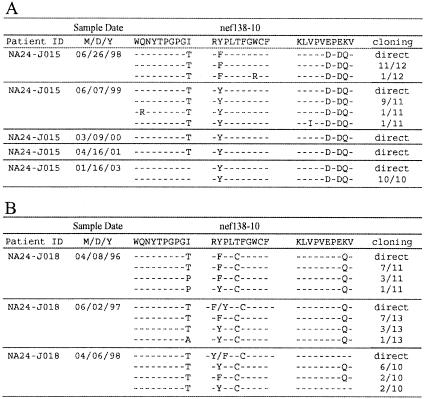
Serial Nef138-10 epitope and its flanking sequences in two A24-negative patients. Data are shown as described in the legend to Fig. 1. Fractional numbers in the right-most column indicate clone numbers with the sequences shown in the numerator and total clone numbers sequenced shown in denominator. “Direct” indicates the result of direct sequencing. (A) Patient NA24-Jo15. (B) Patient NA24-J018.
FIG. 3.
FIG. 3.
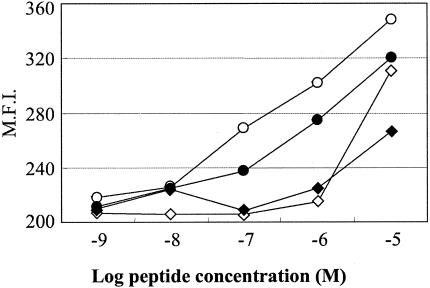
Binding of the wild-type and mutant peptides to HLA*2402 molecules. Peptide binding to HLA-A*2402 was quantified by using a T2-A24 stabilization assay. Symbols: ○, wild type; •, 2F; ◊, 5C; ⧫, 2F5C. M.F.I., mean fluorescence intensity.
FIG. 4.
FIG. 4.
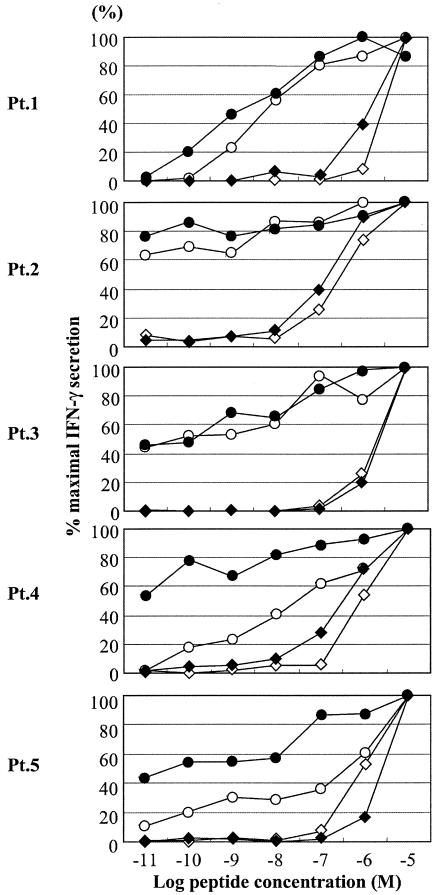
Functional avidity assay. The reactivity of peptide-specific cells in PBMCs from five patients against log-fold dilutions of peptide was determined. Symbols: ○, wild type. •, 2F; ◊, 5C; ⧫, 2F5C.
FIG. 5.
FIG. 5.
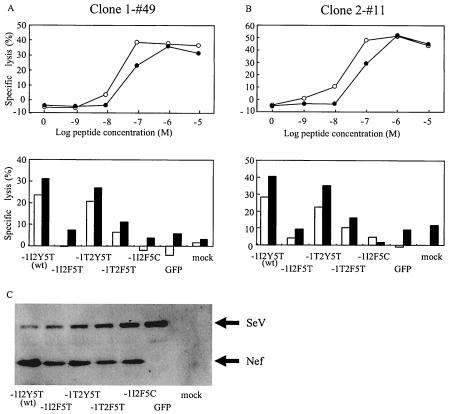
Killing activity of clone 1-#49 (A) against KWN-T4 target cells pulsed with log-fold dilutions of peptide (top) and expressing native Nef proteins containing wild-type sequences (−1I2Y5T), a Y-to-F substitution at the second position of the CTL epitope (−1I2F5T), an I-to-T substitution at the −1 flanking position (−1T2Y5T), double substitutions at the −1 and second positions (−1T2F5T), and double substitutions at the second and fifth positions (−1I2F5C) (bottom). The effector-versus-target ratio was 1:1 (□) or 2.5:1 (▪) in panel A and 1:1 (□) or 4:1 (▪) in panel B. Killing activity against KWN-T4 cells infected with control vector expressing green fluorescent protein (GFP) and mock infected (mock) are also shown. (C) Western blot analysis of intracellular expression of various Nef mutants in KWN-T4 target cells. KWN-T4 target cells expressing native Nef proteins containing wild-type sequences (−1I2Y5T), a Y-to-F substitution at the second position of the CTL epitope (−1I2F5T), an I-to-T substitution at the −1 flanking position (−1T2Y5T), double substitutions at the −1 and second positions (−1T2F5T), and double substitutions at the second and fifth positions (−1I2F5C) were examined. KWN-T4 cell lysates infected with control vector expressing GFP and mock infected are also shown. An aliquot (3 μg) of the same KNW-T4 target cells used for the killer assay in the upper panel was used for the Western blot. Symbols: ○, Nef138-10; •, Nef138-10(2F).

References

    1. Anonymous. 2003. HIV/AIDS in Japan, 2002. Infect. Agents Surveill. Rep. 24:203-204.
    1. Appay, V., P. R. Dunbar, M. Callan, P. Klenerman, G. M. A. Gillespie, L. Papagno, G. S. Ogg, A. King, F. Lechner, C. A. Spina, S. Little, D. V. Havlir, D. D. Richman, N. Gruener, G. Pape, A. Waters, P. Easterbrook, M. Salio, V. Cerundolo, A. J. McMichael, and S. L. Rowland-Jones. 2002. Memory CD8+ T cells vary in differentiation phenotype in different persistent virus infections. Nat. Med. 8:379-385. - PubMed
    1. Beekman, N. J., P. A. van Veelen, T. van Hall, A. Neisig, A. Sijts, M. Camps, P. M. Kloetzel, J. J. Neefjes, C. J. Melief, and F. Ossendorp. 2000. Abrogation of CTL epitope processing by single amino acid substitution flanking the C-terminal proteasome cleavage site. J. Immunol. 164:1898-1905. - PubMed
    1. Borrow, P., H. Lewicki, B. H. Hahn, G. M. Shaw, and M. B. Oldstone. 1994. Virus-specific CD8+ cytotoxic T-lymphocyte activity associated with control of viremia in primary human immunodeficiency virus type 1 infection. J. Virol. 68:6103-6110. - PMC - PubMed
    1. Borrow, P., H. Lewicki, X. Wei, M. S. Horwitz, N. Peffer, H. Meyers, J. A. Nelson, J. E. Gairin, B. H. Hahn, M. B. Oldstone, and G. M. Shaw. 1997. Antiviral pressure exerted by HIV-1-specific cytotoxic T lymphocytes (CTLs) during primary infection demonstrated by rapid selection of CTL escape virus. Nat. Med. 3:205-211. - PubMed

Publication types

MeSH terms