. 2004 Aug;78(16):8496-505.
doi: 10.1128/JVI.78.16.8496-8505.2004.

Diverse hepatitis C virus glycoproteins mediate viral infection in a CD81-dependent manner

Affiliations

Diverse hepatitis C virus glycoproteins mediate viral infection in a CD81-dependent manner

J A McKeating et al. J Virol. 2004 Aug.

Abstract

We recently reported that retroviral pseudotypes bearing the hepatitis C virus (HCV) strain H and Con1 glycoproteins, genotype 1a and 1b, respectively, require CD81 as a coreceptor for virus-cell entry and infection. Soluble truncated E2 cloned from a number of diverse HCV genotypes fail to interact with CD81, suggesting that viruses of diverse origin may utilize different receptors and display altered cell tropism. We have used the pseudotyping system to study the tropism of viruses bearing diverse HCV glycoproteins. Viruses bearing these glycoproteins showed a 150-fold range in infectivity for hepatoma cells and failed to infect lymphoid cells. The level of glycoprotein incorporation into particles varied considerably between strains, generally reflecting the E2 expression level within transfected cells. However, differences in glycoprotein incorporation were not associated with virus infectivity, suggesting that infectivity is not limited by the absolute level of glycoprotein. All HCV pseudotypes failed to infect HepG2 cells and yet infected the same cells after transduction to express human CD81, confirming the critical role of CD81 in HCV infection. Interestingly, these HCV pseudotypes differed in their ability to infect HepG2 cells expressing a panel of CD81 variants, suggesting subtle differences in the interaction of CD81 residues with diverse viral glycoproteins. Our current model of HCV infection suggests that CD81, together with additional unknown liver specific receptor(s), mediate the virus-cell entry process.


Figures
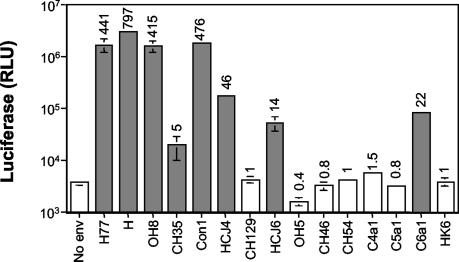
FIG. 1.
FIG. 1.
Infectivity of pseudotypes bearing diverse HCV gp's. Pseudotype viruses were pelleted through a sucrose cushion, and the particle amounts were estimated by quantifying HIV p24 antigen. Hep3B cells were infected with pseudotype viruses bearing a panel of diverse HCV gp's or no envelope gp (No env) containing 10 ng of particulate HIV p24 antigen. At 72 h postinfection, cells were lysed and assayed for luciferase activity. Values are the means of triplicate wells with the standard deviations indicated and are represented as relative light units (RLU). The values above each bar represent the relative infectivity compared to the no-env control virus; values >2-fold the mean of no-env virus infection are considered infectious (shaded bars).
FIG. 2.
FIG. 2.
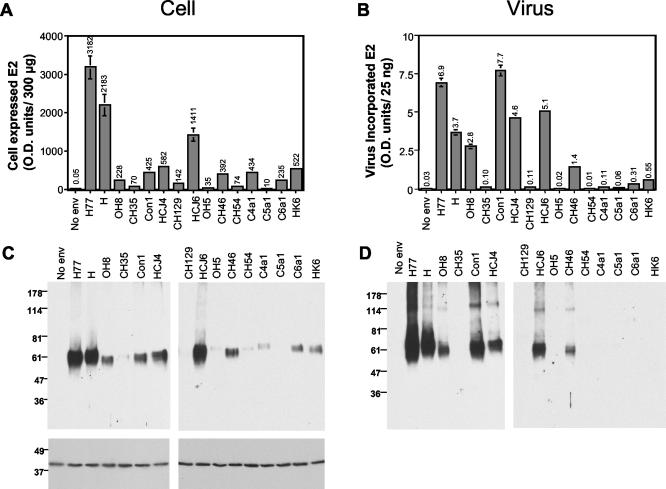
Expression and incorporation of diverse HCV gp's into pseudotype particles. 293T cells were cotransfected with pNL4-3.Luc.RE and plasmids expressing representative HCV gp's listed in Table 1 or an empty vector (No env). At 72 h posttransfection, the virus was pelleted through a sucrose cushion. The cells and virus were lysed, and both fractions were quantified for E2 expression by ELISA and Western blotting. The total E2 expressed per well of 293T cells (300 μg of cellular protein) (A) and that incorporated into pseudotype particles (B) (25 ng of particulate HIV p24 antigen) were measured by ELISA, and the data are expressed as optical density units (OD) at 450 nm and annotated above each bar. Virus preparations that gave optical density signals >2-fold the mean of the no-env virus control were considered to have incorporated gp's. Transfected cell lysate (10 μg of total protein) (C) and pelleted virus particles (D) (25 ng of particulate HIV p24 antigen) were separated by reducing SDS-PAGE and immunoblotted for E2 (MAb 3/11) and actin (MAb AC-15). The migration of molecular mass markers is indicated in kilodaltons.
FIG. 3.
FIG. 3.
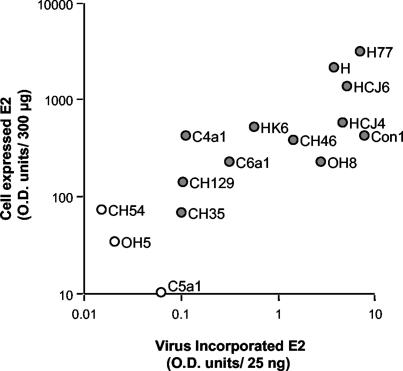
Association between cellular HCV E2 expression levels and incorporation into pseudotype particles. Relationship between the level of E2 expressed in cells and that incorporated into pseudotype particles as determined by ELISA (r2 = 0.643, P = 0.0003). HCV gp strains OH5, CH54, and C5a1 failed to show any specific incorporation into particles and are indicated by open circles.
FIG. 4.
FIG. 4.
gp incorporation and infectivity of pseudotypes bearing H77 E1E2. 293T cells were cotransfected with pNL4-3.Luc.RE and different amounts of pH77 E1E2 (2.0, 0.4, or 0.2 μg) or an empty vector (No env) to produce pseudotypes with different amounts of incorporated gp's. (A) Transfected cells were fixed with paraformaldehyde and stained for E2 expression with (dark gray shading) or without permeabilization (light gray shading) to detect total and cell surface E2 antigen, respectively. The data are expressed as mean fluorescence units (M.F.I.). The level of E2 in both the transfected cells (300 μg of cellular protein) (B) and pelleted pseudotype particles (C) (25 ng of particulate HIV p24 antigen) was measured by ELISA, and the data are expressed as optical density units (OD) at 450 nm. Hep3B cells were infected with pseudotype viruses bearing different amounts of H77 gp's or no envelope gp (No env) containing 10 (gray) and 2 ng (unshaded) of particulate HIV p24 antigen (D). At 72 h postinfection, cells were lysed and assayed for luciferase activity. Values are the mean of triplicate wells with the indicated standard deviations and are represented as relative light units (RLU).
FIG. 5.
FIG. 5.
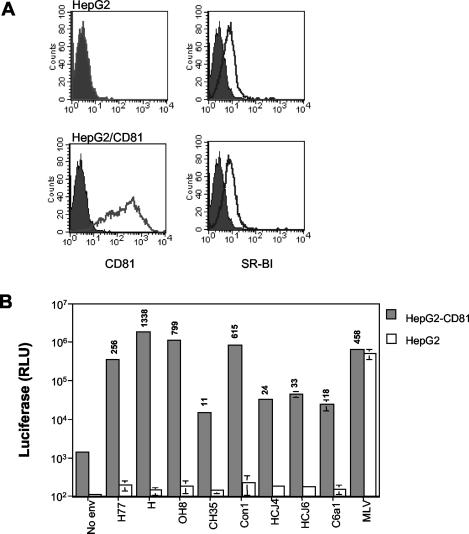
Infectivity of pseudotype viruses bearing divergent HCV gp's is CD81 dependent. (A) Cell surface expression of CD81 and SR-BI on parental HepG2 cells and cells transduced to express human CD81. (B) HepG2 and HepG2-CD81cells were infected with pseudotype viruses bearing a panel of diverse HCV gps or no envelope gp (No env) containing 10 ng of particulate HIV p24 antigen. In order to give comparable relative light unit (RLU) signals, the MLV pseudotype virus was infected at a lower dose (0.01 ng of particulate p24 antigen). At 72 h postinfection, cells were lysed and assayed for luciferase activity. Values are the means of triplicate wells with the indicated standard deviation. Values above each bar represent the relative infectivity compared to the no-env control virus; values >2-fold the mean for the no-env virus infection were considered infectious.

References

    1. Adams, N. J., R. W. Chamberlain, L. A. Taylor, F. Davidson, C. K. Lin, R. M. Elliott, and P. Simmonds. 1997. Complete coding sequence of hepatitis C virus genotype 6a. Biochem. Biophys. Res. Commun. 234:393-396. - PubMed
    1. Agnello, V., G. Abel, M. Elfahal, G. B. Knight, and Q. X. Zhang. 1999. Hepatitis C virus and other Flaviviridae viruses enter cells via low density lipoprotein receptor. Proc. Natl. Acad. Sci. USA 96:12766-12771. - PMC - PubMed
    1. Bartosch, B., J. Bukh, J. C. Meunier, C. Granier, R. E. Engle, W. C. Blackwelder, S. U. Emerson, F. L. Cosset, and R. H. Purcell. 2003. In vitro assay for neutralizing antibody to hepatitis C virus: evidence for broadly conserved neutralization epitopes. Proc. Natl. Acad. Sci. USA 100:14199-14204. - PMC - PubMed
    1. Bartosch, B., J. Dubuisson, and F. L. Cosset. 2003. Infectious hepatitis C virus pseudo-particles containing functional E1-E2 envelope protein complexes. J. Exp. Med. 197:633-642. - PMC - PubMed
    1. Bartosch, B., A. Vitelli, C. Granier, C. Goujon, J. Dubuisson, S. Pascale, E. Scarselli, R. Cortese, A. Nicosia, and F. L. Cosset. 2003. Cell entry of hepatitis C virus requires a set of coreceptors that include the CD81 tetraspanin and the SR-B1 scavenger receptor. J. Biol. Chem. 278:41624-41630. - PubMed

Publication types

MeSH terms

LinkOut - more resources