. 2004 Aug;78(16):8761-70.
doi: 10.1128/JVI.78.16.8761-8770.2004.

Antiretroviral drug resistance mutations in human immunodeficiency virus type 1 reverse transcriptase increase template-switching frequency

Affiliations

Antiretroviral drug resistance mutations in human immunodeficiency virus type 1 reverse transcriptase increase template-switching frequency

Galina N Nikolenko et al. J Virol. 2004 Aug.

Abstract

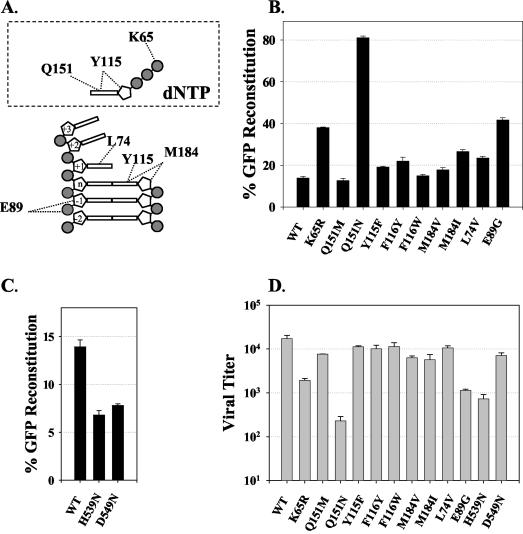
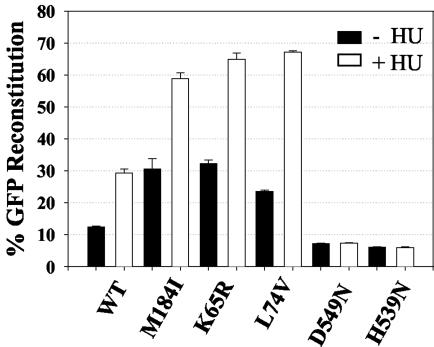
Template-switching events during reverse transcription are necessary for completion of retroviral replication and recombination. Structural determinants of human immunodeficiency virus type 1 (HIV-1) reverse transcriptase (RT) that influence its template-switching frequency are not known. To identify determinants of HIV-1 RT that affect the frequency of template switching, we developed an in vivo assay in which RT template-switching events during viral replication resulted in functional reconstitution of the green fluorescent protein gene. A survey of single amino acid substitutions near the polymerase active site or deoxynucleoside triphosphate-binding site of HIV-1 RT indicated that several substitutions increased the rate of RT template switching. Several mutations associated with resistance to antiviral nucleoside analogs (K65R, L74V, E89G, Q151N, and M184I) dramatically increased RT template-switching frequencies by two- to sixfold in a single replication cycle. In contrast, substitutions in the RNase H domain (H539N, D549N) decreased the frequency of RT template switching by twofold. Depletion of intracellular nucleotide pools by hydroxyurea treatment of cells used as targets for infection resulted in a 1.8-fold increase in the frequency of RT template switching. These results indicate that the dynamic steady state between polymerase and RNase H activities is an important determinant of HIV-1 RT template switching and establish that HIV-1 recombination occurs by the previously described dynamic copy choice mechanism. These results also indicate that mutations conferring resistance to antiviral drugs can increase the frequency of RT template switching and may influence the rate of retroviral recombination and viral evolution.


Figures
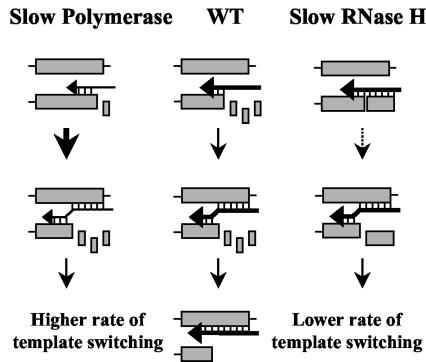
FIG. 1.
FIG. 1.
Dynamic copy choice model for RT template switching. Shaded boxes represent homologous sequences in two copackaged RNAs or in the same RNA. Horizontal arrows represent nascent DNA. The thickness of these arrows indicates the relative polymerization rate. When mutations are expected to reduce the rate of DNA synthesis (slow polymerase), the horizontal arrows are thinner relative to the wild-type RT (WT). Small boxes represent RNA degraded by the RNase H domain. When mutations are expected to reduce the rate of RNase H degradation (slow RNase H), the degraded RNA fragments are shown as larger boxes. Hydrogen bonds between the RNA template and nascent DNA are designated by vertical lines. Vertical arrows of various thicknesses indicate the relative efficiency of template switching.
FIG. 2.
FIG. 2.
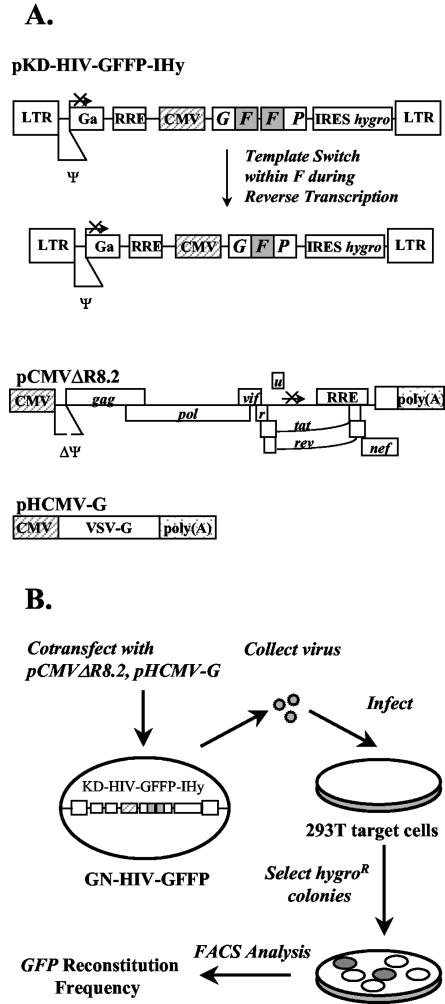
Schematic representation of HIV-1-based constructs and direct-repeat deletion assay for identification of structural determinants of HIV-1 RT that influence template switching. (A) Structures of HIV-1-based vectors pKD-HIV-GFFP-IHy, pCMVΔR8.2, and pHCMV-G. pKD-HIV-GFFP-IHy contains long terminal repeats (LTR) and all cis-acting elements of HIV-1. GFFP and hygro are transcribed from the LTR promoter or the hCMV promoter (hatched box). An IRES of encephalomyocarditis virus is used to express hygro. The directly repeated F portion of GFP is shaded. During reverse transcription, the repeated F portion may be deleted to reconstitute a functional GFP. The Rev-responsive element (RRE) and packaging signal (Ψ) are shown. The pCMVΔR8.2 helper construct (46) expresses all HIV-1 proteins except the envelope from the hCMV promoter (hatched box). The coding regions of viral proteins and a polyadenylation site [stippled box labeled poly(A)] from the insulin gene at the end of the nef reading frame are shown. The packaging signal and adjacent sequences, except the 5′ splice donor, were deleted from the 5′ untranslated region. The pHCMV-G construct expresses VSV-G from the hCMV promoter. (B) Experimental protocol. GN-HIV- GFFP, a 293T-based cell line expressing pKD-HIV-GFFP, is shown. The wild type or mutated pCMVΔR8.2 constructs were separately cotransfected with pHCMV-G into GN-HIV-GFFP cells, and the virus produced was used to infect 293T cells. The infected cell clones resistant to hygromycin were analyzed by flow cytometry to determine frequencies of direct-repeat deletion and GFP reconstitution. FACS, fluorescence-activated cell sorter.
FIG. 3.
FIG. 3.
HIV-1 RT mutations and their effects on RT template switching and viral titer. (A) Schematic representation of interactions between RT and its dNTP substrate in the polymerase active site and dNTP-binding site (modified from reference 28). Only the amino acids analyzed in this study are shown. (B) Direct-repeat deletion and GFP reconstitution frequencies of the polymerase domain RT mutants. WT, wild type. (C) Direct-repeat deletion and GFP reconstitution frequencies of the RNase H domain RT mutants. The percentage of GFP reconstitution represents the proportion of infected 293T target cells that exhibited fluorescence after hygromycin selection. Bar graphs and error bars represent the means and standard errors of the percentages of GFP reconstitution, respectively, for two to six independent experiments. (D) Viral titers represent the number of CFU per 50 ng of p24 CA as determined by ELISA. The average p24 CA concentration was 37.7 ± 2.8 ng/ml.
FIG. 4.
FIG. 4.
Effects of HU treatment on the frequency of direct-repeat deletion and GFP reconstitution. Black bar graphs and error bars represent the means and standard errors of the frequency of direct-repeat deletion, respectively, for wild-type (WT) HIV-1 RT or mutant RTs for two to six independent experiments; white bar graphs and error bars represent the means and standard errors of the frequency of direct-repeat deletion observed for the same HIV-1 RTs in the presence of 0.2 mM HU.
FIG. 5.
FIG. 5.
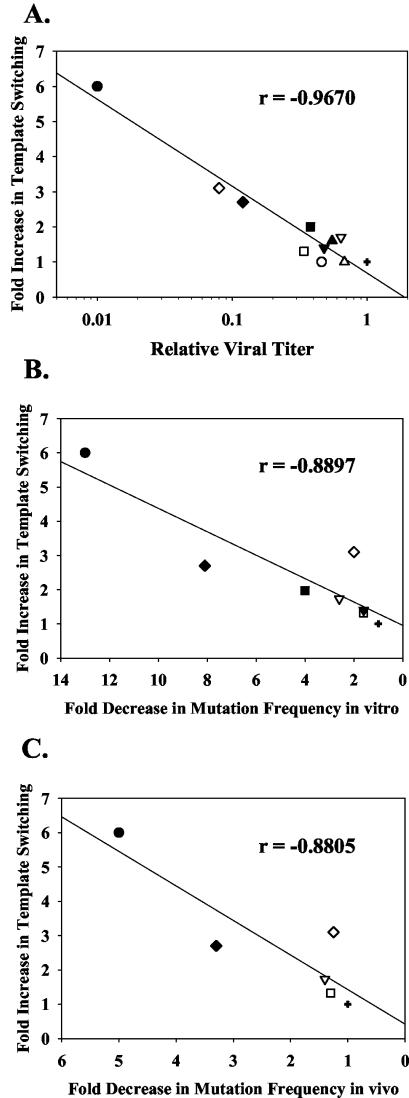
Linear regression analysis of template-switching frequencies, viral titers, and reverse transcription fidelity of HIV-1 RT polymerase domain mutants. The relative template-switching frequencies were correlated with relative viral titers (A) or mutation frequencies during reverse transcription in vitro (B) and in vivo (C). The correlation coefficients (r) were determined by using SigmaPlot 8.0 software. The relative template switching represents a ratio of the template-switching frequency of mutant HIV-1 RT obtained in each experiment divided by the template-switching frequency obtained for the wild-type HIV-1 RT. The relative viral titers represent ratios of the viral titer of mutant HIV-1 RT obtained in each experiment divided by the viral titer of wild-type HIV-1 RT in a parallel experiment. The average viral titer obtained with wild-type HIV-1 RT was 1.7 × 10⁴ CFU/50 ng of p24 CA. The n-fold decrease in mutation frequency represents an average change in mutation frequency for mutants obtained in in vitro or in vivo forward mutation assays using the lacZ alphapeptide reporter gene (, , , , , , , , ; reviewed in reference 72). The following symbols for RT genotypes were used: +, wild type; •, Q151N; ○, Q151M; ▪, M184I; □, M184V; ▴, F116Y; ▵, F116W; ▾, Y115F; ▿, L74V; ♦, K65R; ⋄, E89G.

References

    1. An, W. F., and A. Telesnitsky. 2002. Effects of varying sequence similarity on the frequency of repeat deletion during reverse transcription of a human immunodeficiency virus type 1 vector. J. Virol. 76:7897-7902. - PMC - PubMed
    1. An, W. F., and A. Telesnitsky. 2001. Frequency of direct repeat deletion in a human immunodeficiency virus type 1 vector during reverse transcription in human cells. Virology 286:475-482. - PubMed
    1. Andersen, E. S., R. E. Jeeninga, C. K. Damgaard, B. Berkhout, and J. Kjems. 2003. Dimerization and template switching in the 5′ untranslated region between various subtypes of human immunodeficiency virus type 1. J. Virol. 77:3020-3030. - PMC - PubMed
    1. Anderson, J. A., E. H. Bowman, and W. S. Hu. 1998. Retroviral recombination rates do not increase linearly with marker distance and are limited by the size of the recombining subpopulation. J. Virol. 72:1195-1202. - PMC - PubMed
    1. Anderson, J. A., R. J. Teufel, P. D. Yin, and W. S. Hu. 1998. Correlated template-switching events during minus-strand DNA synthesis: a mechanism for high negative interference during retroviral recombination. J. Virol. 72:1186-1194. - PMC - PubMed

Publication types