. 2004 Aug 10;101(32):11827-32.
doi: 10.1073/pnas.0403364101. Epub 2004 Jul 27.

TRIM5alpha mediates the postentry block to N-tropic murine leukemia viruses in human cells

Affiliations

TRIM5alpha mediates the postentry block to N-tropic murine leukemia viruses in human cells

Michel J Perron et al. Proc Natl Acad Sci U S A. .

Abstract

Murine leukemia viruses (MLVs) have been classified as N-tropic (N-MLV) or B-tropic (B-MLV), depending on their ability to infect particular mouse strains. The early phase of N-MLV infection is blocked in the cells of several mammalian species, including humans. This block is mediated by a dominant host factor that targets the viral capsid soon after virus entry into the cell has been achieved. A similar block to HIV-1 in rhesus monkey cells is mediated by TRIM5alpha. Here we show that human TRIM5alpha is both necessary and sufficient for the restriction of N-MLV in human cells. Rhesus monkey TRIM5alpha, which potently blocks HIV-1 infection, exhibited only modest inhibition of N-MLV infection. B-MLV was resistant to the antiviral effects of both human and rhesus monkey TRIM5alpha; susceptibility to TRIM5alpha-mediated restriction was conferred by alteration of residue 110 of the B-MLV capsid protein to the amino acid found in the N-MLV capsid. Our results demonstrate that species-specific variation in TRIM5alpha governs its ability to block infection by diverse retroviruses.


Figures
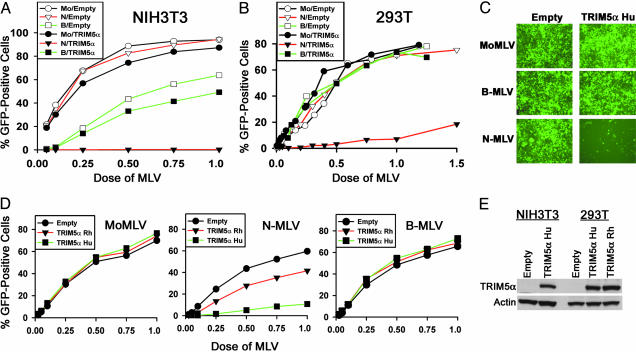
Fig. 1.
Fig. 1.
Human TRIM5α blocks N-MLV infection more potently than TRIM5αrh. (AC) TRIM5αhu specifically blocks N-MLV infection. NIH 3T3 cells (A) and 293T cells (B and C) transduced with the empty pLPCX vector or the pLPCX vector expressing TRIM5αhu were incubated with various amounts of N-MLV-GFP (N), B-MLV-GFP (B), or MoMLV-GFP (Mo). Infected, GFP-positive cells were counted by FACS. In A and B, the results of a typical experiment are shown. Similar results were obtained in three independent experiments. (D) We incubated 293T cells transduced with the empty pLPCX vector or the pLPCX vectors expressing TRIM5αrh or TRIM5αhu with various amounts of MoMLV-GFP, N-MLV-GFP, or B-MLV-GFP. Infected, GFP-positive cells were counted by FACS. The results shown represent the means from two independent experiments. (E) Expression of TRIM5αhu and TRIM5αrh in cells. Lysates from NIH 3T3 and 293T cells expressing HA-tagged TRIM5α protein or transduced with the empty pLPCX vector were subjected to Western blotting with an antibody against HA. The lysates were also Western blotted with an antibody directed against actin.
Fig. 2.
Fig. 2.
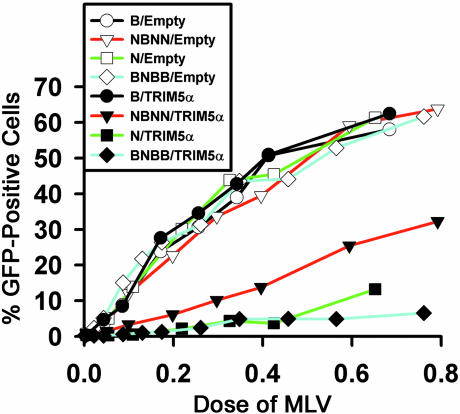
MLV capsid residue 110 influences viral susceptibility to TRIM5αhu antiviral effects. We exposed 293T cells transduced with the empty pLPCX vector or the pLPCX vector expressing TRIM5αhu to the indicated GFP-expressing viruses. Infected, GFP-positive cells were counted by FACS. The results shown are typical of those obtained in three independent experiments.
Fig. 3.
Fig. 3.
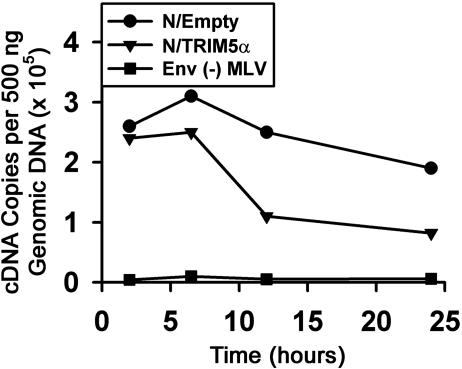
Reverse transcription of N-MLV is less efficient in target cells expressing TRIM5αhu. NIH 3T3 cells stably transduced with the empty pLPCX vector or the pLPCX vector expressing TRIM5αhu were incubated with VSV G-pseudotyped, DNase-treated N-MLV-GFP. Approximately 50% of the cells with the empty vector became GFP-positive compared with 0.72% of the cells expressing TRIM5αhu. NIH 3T3 cells transduced with the empty pLPCX vector were also incubated with N-MLV-GFP viruses lacking envelope glycoproteins [Env (-) MLV]. Target cell DNA was isolated at the indicated times and used to detect reverse transcripts. Similar results were obtained in two independent experiments.
Fig. 4.
Fig. 4.
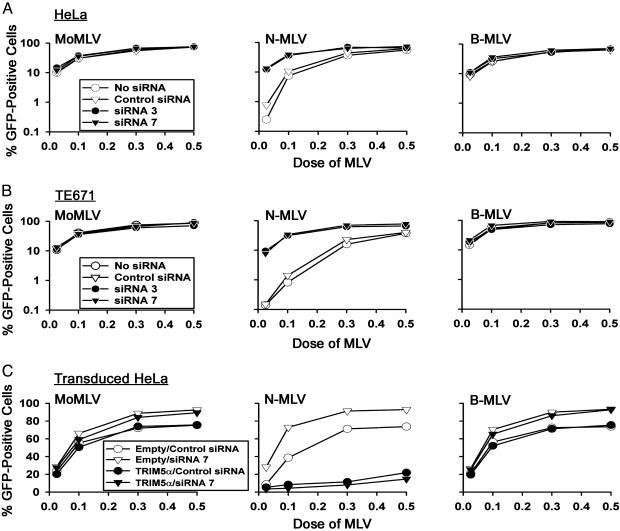
Expression of TRIM5αhu is essential for the block to N-MLV in human cells. (A and B) HeLa (A) and TE671 (B) cells were transfected with 120 nM of control siRNA, siRNA 3, or siRNA 7. Cells were then incubated with the indicated GFP-expressing viruses. Infected, GFP-positive cells were counted by FACS. The results shown are typical of those obtained in three independent experiments. (C) HeLa cells stably transduced with the empty pLPCX vector or the pLPCX vector expressing TRIM5αhu were transfected with 120 nM control siRNA, siRNA 3, or siRNA 7. Cells were then incubated with the indicated GFP-expressing viruses. Infected, GFP-positive cells were counted by FACS. The results shown are typical of those obtained in two independent experiments.
Fig. 5.
Fig. 5.
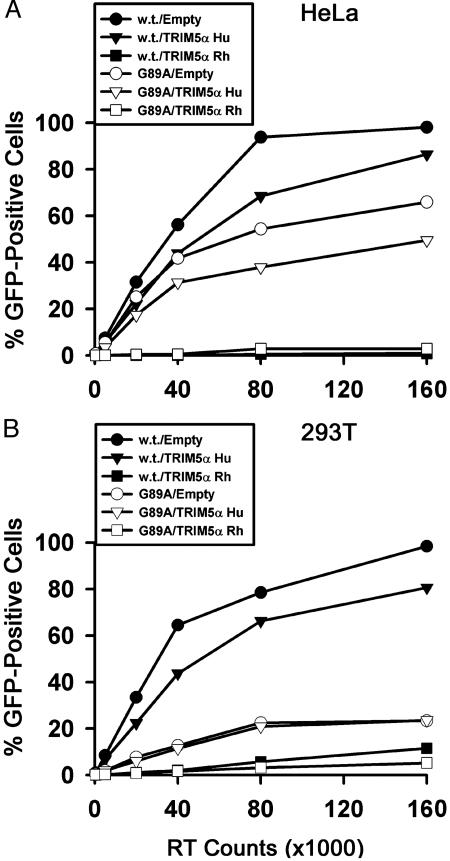
Infection of HeLa and 293T cells by wild-type HIV-1 or a mutant defective in cyclophilin A binding. HeLa (A) or 293T (B) cells stably transduced with the empty pLPCX vector or pLPCX vectors expressing TRIM5αhu or TRIM5αrh were incubated with the wild-type (w.t.) or G89A HIV-1-GFP viruses. Infected, GFP-positive cells were counted by FACS. The results shown are typical of those obtained in three independent experiments.

References

    1. Boeke, J. D. & Stoye, J. P. (1997) in Retroviruses, eds. Coffin, J. M., Hughes, S. H. & Varmus, H. E. (Cold Spring Harbor Lab. Press, Plainview, NY), pp. 343-436. - PubMed
    1. Herniou, E., Martin, J., Miller, K., Cook, J., Wilkinson, M. & Tristem, M. (1998) J. Virol. 72, 5955-5966. - PMC - PubMed
    1. Coffin, J. M. (1996) in Fundamental Virology, eds. Fields, B. N., Knipe, D. M. & Howley, P. M. (Lippincott–Raven, Philadelphia), pp. 763-844.
    1. Bieniasz, P. D. (2003) Trends Microbiol. 11, 286-291. - PubMed
    1. Stoye, J. P. (2002) Proc. Natl. Acad. Sci. USA 99, 11549-11551. - PMC - PubMed

Publication types

MeSH terms

LinkOut - more resources