. 2004 Aug;24(16):6931-46.
doi: 10.1128/MCB.24.16.6931-6946.2004.

Budding yeast silencing complexes and regulation of Sir2 activity by protein-protein interactions

Affiliations

Budding yeast silencing complexes and regulation of Sir2 activity by protein-protein interactions

Jason C Tanny et al. Mol Cell Biol. 2004 Aug.

Abstract

Gene silencing in the budding yeast Saccharomyces cerevisiae requires the enzymatic activity of the Sir2 protein, a highly conserved NAD-dependent deacetylase. In order to study the activity of native Sir2, we purified and characterized two budding yeast Sir2 complexes: the Sir2/Sir4 complex, which mediates silencing at mating-type loci and at telomeres, and the RENT complex, which mediates silencing at the ribosomal DNA repeats. Analyses of the protein compositions of these complexes confirmed previously described interactions. We show that the assembly of Sir2 into native silencing complexes does not alter its selectivity for acetylated substrates, nor does it allow the deacetylation of nucleosomal histones. The inability of Sir2 complexes to deacetylate nucleosomes suggests that additional factors influence Sir2 activity in vivo. In contrast, Sir2 complexes show significant enhancement in their affinities for acetylated substrates and their sensitivities to the physiological inhibitor nicotinamide relative to recombinant Sir2. Reconstitution experiments showed that, for the Sir2/Sir4 complex, these differences stem from the physical interaction of Sir2 with Sir4. Finally, we provide evidence that the different nicotinamide sensitivities of Sir2/Sir4 and RENT in vitro could contribute to locus-specific differences in how Sir2 activity is regulated in vivo.


Figures
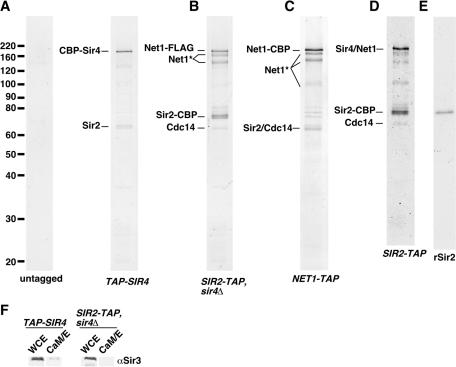
FIG. 1.
FIG. 1.
TAP of yeast Sir2. TAP purifications from various strains (the final elutions from the CaM-Sepharose column) were concentrated by TCA precipitation and analyzed by SDS-PAGE on 12.5% gels, followed by colloidal Coomassie blue staining. The positions of size markers (in kilodaltons) are shown on the left. The strains are listed in Table 1 as follows. (A) DMY2377 (untagged) and DMY2640 (TAP-SIR4); (B) DMY2636 (SIR2-TAP sir4Δ); (C) DMY1690 (NET1-TAP); and (D) DMY1704 (SIR2-TAP). (E) Twenty nanograms of recombinant 6His-Sir2 (rSir2) was analyzed in parallel with complexes. (F) Fractions from purifications from the TAP-SIR4 or SIR2-TAP sir4Δ strain were analyzed by Western blotting with a Sir3 antibody. WCE, whole-cell extract; CaM/E, final elution from the CaM-Sepharose column.
FIG. 2.
FIG. 2.
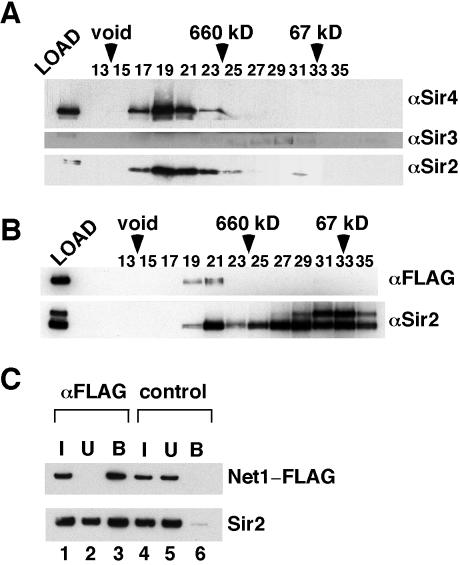
Integrity of TAP-purified Sir2 complexes. (A and B) Sir2 complexes were fractionated on a Superose 6 column. The fractions were concentrated by TCA precipitation and analyzed by Western blotting with the indicated antibodies (right). Fraction numbers are indicated above each blot. Elution positions of the size standards are indicated by arrowheads. (A) Sir2/Sir4 complex. (B) RENTa. (C) For RENTa, the purification product was immunoprecipitated with anti-FLAG M2 resin and fractions were analyzed by Western blotting with either an anti-FLAG antibody (top) or an anti-Sir2 antibody (bottom). I, input (10%; lanes 1 and 4); U, unbound (10%; lanes 2 and 5); B, bound (33%; lanes 3 and 6). The reactions in lanes 4 to 6 contained a FLAG peptide to control for nonspecific binding to the M2 resin.
FIG. 3.
FIG. 3.
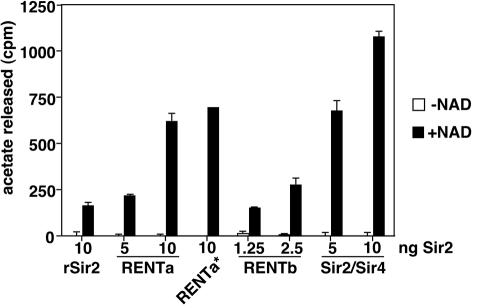
NAD-dependent deacetylase activity of Sir2 complexes. Various amounts of rSir2 or Sir2 complexes (indicated at the bottom) were incubated with [14C]acetyl-histone H4 peptide in the presence or absence of 200 μM NAD. The data shown are counts released per minute, averaged from two independent experiments, after the subtraction of background counts extracted from a buffer-only control. Error bars represent standard deviations. RENTa*, deacetylation reaction using a one-step purification from the SIR2-TAP sir4Δ strain.
FIG. 4.
FIG. 4.
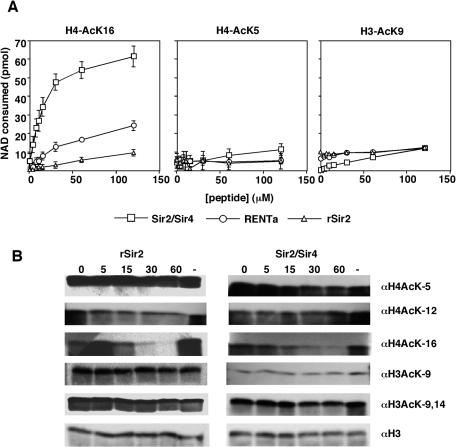
rSir2 and Sir2 complexes both preferentially deacetylate lysine 16 of histone H4 in vitro. (A) rSir2 or Sir2 complexes were incubated with [3H]nicotinamide-NAD and increasing concentrations of one of the following peptides: histone H4 amino acids 1 to 20 acetylated at lysine 16 (left), histone H4 amino acids 1 to 20 acetylated at lysine 5 (middle), or histone H3 amino acids 1 to 20 acetylated at lysine 9 (right). The released nicotinamide was extracted and counted, and the data were converted to picomoles of NAD consumed as described in Materials and Methods. (B) rSir2 (5 ng) or the Sir2/Sir4 complex (1.25 ng) was incubated with NAD and hyperacetylated HeLa core histones (600 ng) for the indicated times (in minutes), after which the reactions were terminated by the addition of SDS sample buffer and analyzed by Western blotting with the indicated antibodies. —, control reactions lacking NAD.
FIG. 5.
FIG. 5.
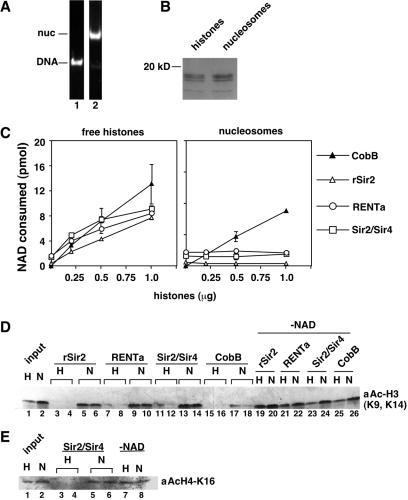
rSir2 and Sir2 complexes fail to deacetylate nucleosomes in vitro. Mononucleosomes were assembled from hyperacetylated HeLa histones and a 150-bp DNA fragment by salt dialysis and then purified by sedimentation on a sucrose gradient. (A) Representative gradient fractions containing free DNA (lane 1) or nucleosomes (lane 2) were analyzed by agarose gel electrophoresis and ethidium bromide staining. (B) Equal amounts of histones or nucleosomes were analyzed by SDS-PAGE and Coomassie blue staining. (C) rSir2 (25 ng), RENTa (10 ng), Sir2/Sir4 (2.5 ng), or CobB (12.5 ng) was incubated with [3H]nicotinamide-NAD and increasing amounts of either histones (left) or mononucleosomes (right). The released nicotinamide was extracted and counted, and the data were converted to picomoles of NAD consumed as described in Materials and Methods. (D) Deacetylation of histones and nucleosomes assayed by Western blotting. Reactions contained increasing amounts of rSir2 (25 ng in lanes 3 and 5 or 50 ng in lanes 4, 6, 19, and 20), RENTa (5 ng in lanes 7 and 9 or 10 ng in lanes 8, 10, 21, and 22), Sir2/Sir4 (2.5 ng in lanes 11 and 13 or 5 ng in lanes 12, 14, 23, and 24), or CobB (3 ng in lanes 15 and 17 or 6 ng in lanes 16, 18, 25, and 26) and either free histones (H) or histones reconstituted into mononucleosomes (N). Each reaction contained 300 ng of total histones. Lanes 1 and 2, controls that contained buffer instead of enzyme; lanes 19 to 26, controls that lacked NAD. The blot was probed with the anti-H3-Ac(K9, 14) antibody. (E) Data are as for panel D, except that the reactions contained increasing amounts of the Sir2/Sir4 complex (2.5 ng in lanes 3 and 5 or 5 ng in lanes 4, 6, 7, and 8). Lanes 1 and 2, controls that contained buffer instead of enzyme; lanes 7 and 8, controls that contained Sir2/Sir4 and lacked NAD. The blot was probed with the anti-H4-AcK16 antibody.
FIG. 6.
FIG. 6.
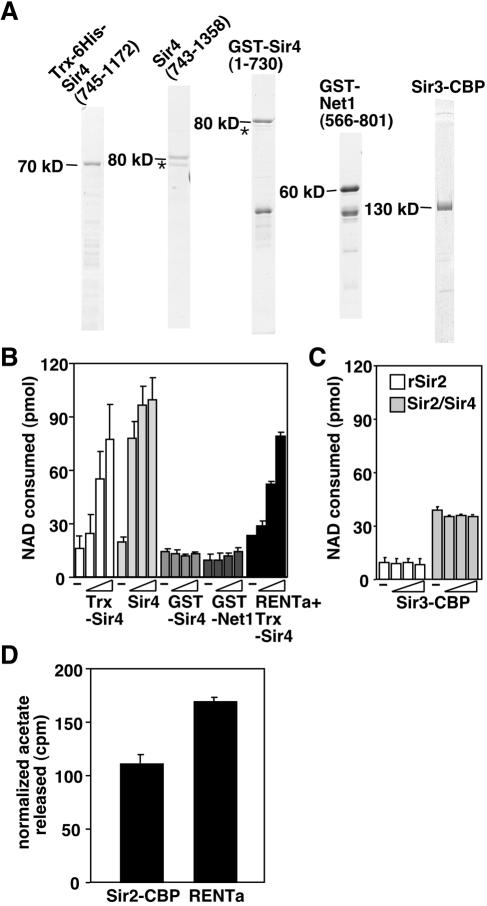
Interaction of Sir2 with Sir4 enhances its activity. (A) Recombinant protein fragments added to rSir2 reactions were subjected to SDS-PAGE and visualized by Coomassie blue staining. Size markers denote the approximate sizes of the full-length fragments. A contaminating bacterial heat shock protein is denoted by asterisks. (B) Deacetylase activity of rSir2 or RENTa (black bars only) measured by a nicotinamide release assay in the presence of increasing amounts (1.25, 6.25, and 31.25 ng) of recombinant fragments. −, control reactions without any additions. (C) Deacetylase activity of rSir2 (2.5 ng) or Sir2/Sir4 (1.25 ng) measured by a nicotinamide release assay in the presence of increasing amounts (1.25, 6.25, and 31.25 ng) of Sir3-CBP. (D) Deacetylase activity of RENTa complex depleted of Net1-FLAG (Sir2-CBP) or undepleted (RENTa) measured by an acetate release assay. Each reaction contained ∼1.5 ng of Sir2-CBP. The data shown are counts per minute released after the subtraction of background counts from control reactions lacking NAD.
FIG. 7.
FIG. 7.
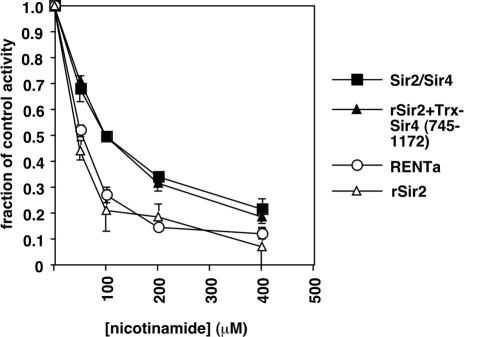
rSir2 and Sir2 complexes are differentially sensitive to nicotinamide inhibition in vitro. The deacetylase activity of rSir2 (10 ng), RENTa (2.5 ng), Sir2/Sir4 (2.5 ng), or rSir2 plus Trx-Sir4(745-1172) (10 ng and 31.25 ng, respectively) was measured by an acetate release assay in the presence of increasing concentrations of nicotinamide. Activities are expressed as fractions of the activity measured in control reactions lacking nicotinamide.
FIG. 8.
FIG. 8.
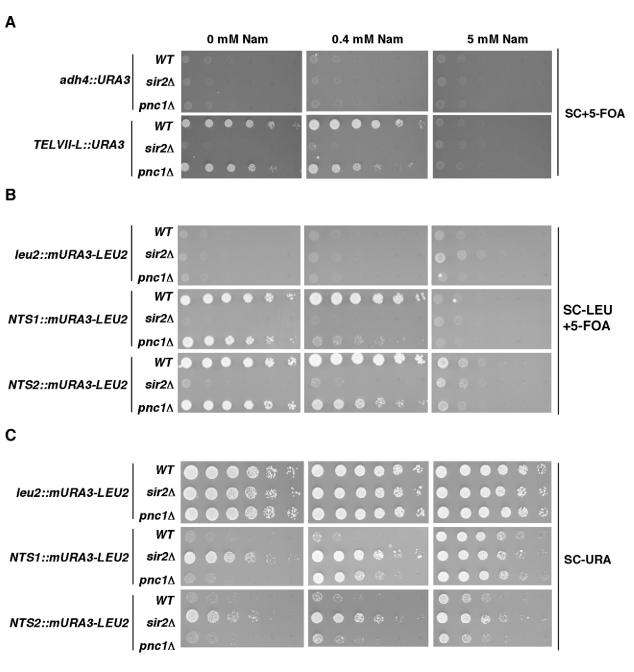
Silencing at telomeres and at rDNA is differentially sensitive to nicotinamide inhibition. (A) Fivefold serial dilutions of cultures of the indicated strains were spotted onto complete medium with 5-FOA (SC+5-FOA) to assay telomeric silencing. (B) Fivefold serial dilutions of cultures of the indicated strains were spotted onto complete medium with 5-FOA but lacking leucine (SC-LEU+5-FOA) to assay rDNA silencing. (C) The same as panel B, except that growth was on complete medium lacking uracil (SC-URA). Plates also contained various concentrations of nicotinamide (Nam), as indicated at the top.
FIG. 9.
FIG. 9.
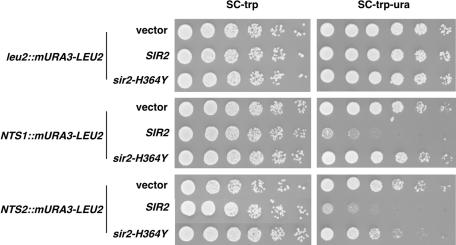
Silencing at NTS2 region of rDNA is partially independent of Sir2 activity. Fivefold serial dilutions of cultures of the indicated strains carrying plasmid pRS314 (vector), pDM608 (SIR2), or pDM607 (sir2-H364Y) were spotted onto complete medium lacking tryptophan (SC-trp) to assay growth or onto complete medium lacking tryptophan and uracil (SC-trp-ura) to assay rDNA silencing.

References

    1. Anderson, R. M., K. J. Bitterman, J. G. Wood, O. Medvedik, and D. A. Sinclair. 2003. Nicotinamide and PNC1 govern lifespan extension by calorie restriction in Saccharomyces cerevisiae. Nature 423:181-185. - PMC - PubMed
    1. Armstrong, C. M., M. Kaeberlein, S. I. Imai, and L. Guarente. 2002. Mutations in Saccharomyces cerevisiae gene SIR2 can have differential effects on in vivo silencing phenotypes and in vitro histone deacetylation activity. Mol. Biol. Cell 13:1427-1438. - PMC - PubMed
    1. Avalos, J. L., I. Celic, S. Muhammad, M. S. Cosgrove, J. D. Boeke, and C. Wolberger. 2002. Structure of a Sir2 enzyme bound to an acetylated p53 peptide. Mol. Cell 10:523-535. - PubMed
    1. Bell, S. D., C. H. Botting, B. N. Wardleworth, S. P. Jackson, and M. F. White. 2002. The interaction of Alba, a conserved archaeal chromatin protein, with Sir2 and its regulation by acetylation. Science 296:148-151. - PubMed
    1. Bitterman, K. J., R. M. Anderson, H. Y. Cohen, M. Latorre-Esteves, and D. A. Sinclair. 2002. Inhibition of silencing and accelerated aging by nicotinamide, a putative negative regulator of yeast sir2 and human SIRT1. J. Biol. Chem. 277:45099-45107. - PubMed

Publication types

MeSH terms

LinkOut - more resources