. 2004 Aug;70(8):4582-7.
doi: 10.1128/AEM.70.8.4582-4587.2004.

Enhanced arsenic accumulation in engineered bacterial cells expressing ArsR

Affiliations

Enhanced arsenic accumulation in engineered bacterial cells expressing ArsR

Jan Kostal et al. Appl Environ Microbiol. 2004 Aug.

Abstract

The metalloregulatory protein ArsR, which offers high affinity and selectivity toward arsenite, was overexpressed in Escherichia coli in an attempt to increase the bioaccumulation of arsenic. Overproduction of ArsR resulted in elevated levels of arsenite bioaccumulation but also a severe reduction in cell growth. Incorporation of an elastin-like polypeptide as the fusion partner to ArsR (ELP153AR) improved cell growth by twofold without compromising the ability to accumulate arsenite. Resting cells overexpressing ELP153AR accumulated 5- and 60-fold-higher levels of arsenate and arsenite than control cells without ArsR overexpression. Conversely, no significant improvement in Cd(2+) or Zn(2+) accumulation was observed, validating the specificity of ArsR. The high affinity of ArsR allowed 100% removal of 50 ppb of arsenite from contaminated water with these engineered cells, providing a technology useful to comply with the newly approved U.S. Environmental Protection Agency limit of 10 ppb. These results open up the possibility of using cells overexpressing ArsR as an inexpensive, high-affinity ligand for arsenic removal from contaminated drinking and ground water.


Figures
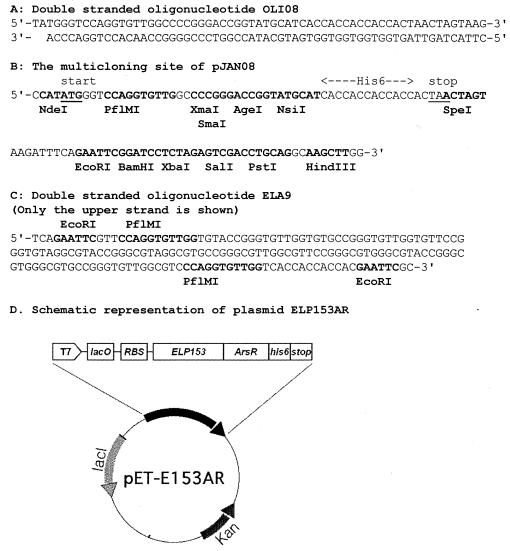
FIG. 1.
FIG. 1.
Oligonucleotide and cloning sequences used for the construction of expression vectors.
FIG. 2.
FIG. 2.
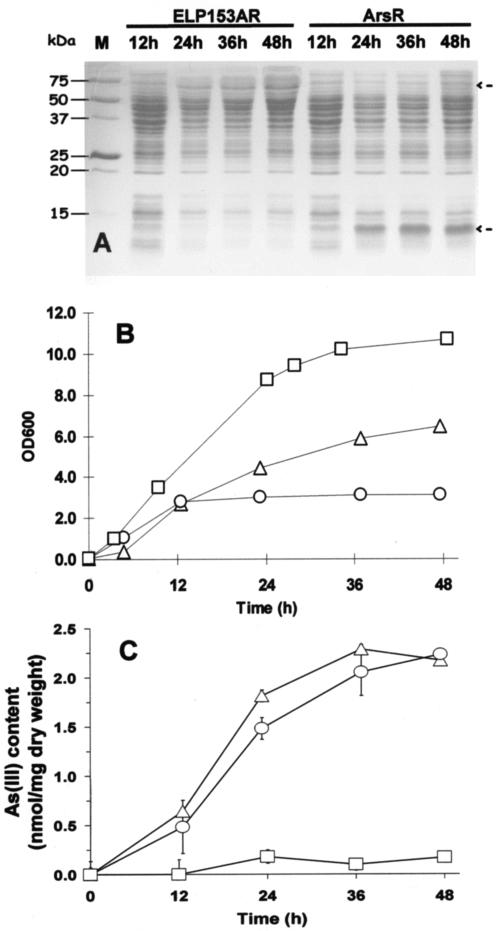
Bioaccumulation of arsenite. (A) Expression of ELP153AR and ArsR. Samples were harvested at different time points, and the total cellular proteins were analyzed by sodium dodecyl sulfate-polyacrylamide gel electrophoresis (12.5% polyacrylamide). The desired proteins are marked with arrows. (B and C) Growth profiles (B) and arsenite contents (C) of E. coli BLR(DE3) cells expressing ArsR (○), ELP153AR (▵), or no protein (□).
FIG. 3.
FIG. 3.
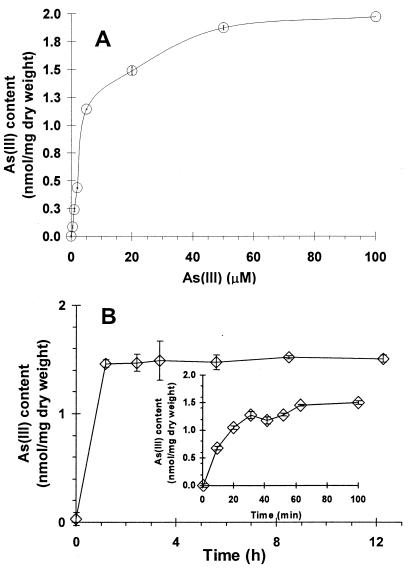
As(III) bioaccumulation by E. coli BLR(DE3) cells harboring pET-E153AR. (A) As(III) binding isotherm. As(III) binding was determined at various concentrations after 1 h of incubation. (B) Time profile of As(III) uptake by resting cells. Resting cells were resuspended in Tris buffer (pH 7.4) containing 20 μM As(III) and incubated for the indicated lengths of time. Data shown are the mean values (± standard deviations) obtained from three independent experiments.
FIG. 4.
FIG. 4.
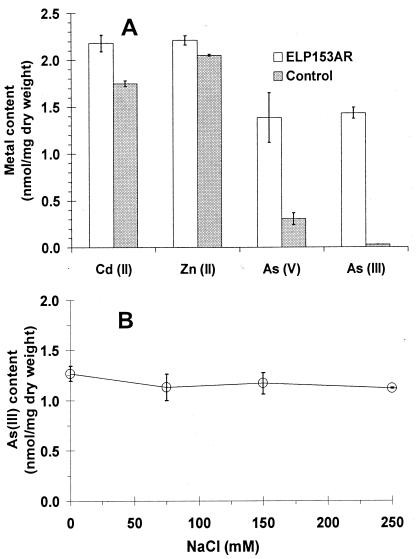
Arsenic selectivity. (A) The intracellular metal or As contents of resting cells with or without overexpression of ELP153AR (control) were determined after 1 h of incubation with either As(III) (10 μM), As(V) (10 μM), cadmium chloride (25 μM), or zinc chloride (65 μM). (B) Effect of sodium ion on As(III) binding. Resting cells were resuspended in Tris buffer (pH 7.4) containing 10 μM As(III), and the indicated concentration of NaCl was added. As(III) binding was determined after 1 h of incubation. Data shown are the mean values (± standard deviations) obtained from three independent experiments.
FIG. 5.
FIG. 5.
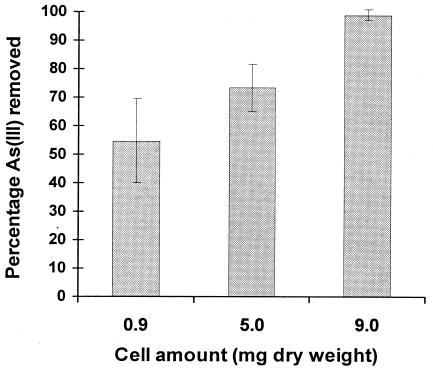
Evaluation of arsenic binding by E. coli BLR(DE3) cells harboring pET-E153AR. Water spiked with 50 ppb of arsenite was incubated with different amounts of resting cells, and the percentage of arsenite removed was determined after 1 h of incubation. Data shown are the mean values (± standard deviations) obtained from three independent experiments.

References

    1. Bae, W., C. Wu, J. Kostal, A. Mulchandani, and W. Chen. 2003. Enhanced mercury biosorption by bacterial cells with surface-displayed MerR. Appl. Environ. Microbiol. 69:3176-3180. - PMC - PubMed
    1. Bae, W., R. Mehra, A. Mulchandani, and W. Chen. 2001. Genetic engineering of Escherichia coli for enhanced bioaccumulation of mercury. Appl. Environ. Microbiol. 67:5335-5338. - PMC - PubMed
    1. Bae, W., W. Chen, A. Mulchandani, and R. Mehra. 2000. Enhanced bioaccumulation of heavy metals by bacterial cells displaying synthetic phytochelatins. Biotechnol. Bioeng. 70:518-523. - PubMed
    1. Bontidean, I., C. Berggren, G. Johansson, E. Csorgi, B. Mattiasson, J. R. Lloyd, K. J. Jakeman, and N. L. Brown. 1998. Detection of heavy metal ions at femtomolar levels using protein-based biosensors. Anal. Chem. 70:4162-4169. - PubMed
    1. Canovas, D., C. Duran, N. Rodriguez, R. Amils, and V. De Lorenzo. 2003. Testing the limits of biological tolerance to arsenic in a fungus isolated from the River Tinto. Environ. Microbiol. 5:133-138. - PubMed

Publication types

MeSH terms

LinkOut - more resources