. 2004 Aug 24;101(34):12694-9.
doi: 10.1073/pnas.0403127101. Epub 2004 Aug 10.

Major genetic marker of nidoviruses encodes a replicative endoribonuclease

Affiliations

Major genetic marker of nidoviruses encodes a replicative endoribonuclease

Konstantin A Ivanov et al. Proc Natl Acad Sci U S A. .

Abstract

Coronaviruses are important pathogens that cause acute respiratory diseases in humans. Replication of the approximately 30-kb positive-strand RNA genome of coronaviruses and discontinuous synthesis of an extensive set of subgenome-length RNAs (transcription) are mediated by the replicase-transcriptase, a barely characterized protein complex that comprises several cellular proteins and up to 16 viral subunits. The coronavirus replicase-transcriptase was recently predicted to contain RNA-processing enzymes that are extremely rare or absent in other RNA viruses. Here, we established and characterized the activity of one of these enzymes, replicative nidoviral uridylate-specific endoribonuclease (NendoU). It is considered a major genetic marker that discriminates nidoviruses (Coronaviridae, Arteriviridae, and Roniviridae) from all other RNA virus families. Bacterially expressed forms of NendoU of severe acute respiratory syndrome coronavirus and human coronavirus 229E were revealed to cleave single-stranded and double-stranded RNA in a Mn(2+)-dependent manner. Single-stranded RNA was cleaved less specifically and effectively, suggesting that double-stranded RNA is the biologically relevant NendoU substrate. Double-stranded RNA substrates were cleaved upstream and downstream of uridylates at GUU or GU sequences to produce molecules with 2'-3' cyclic phosphate ends. 2'-O-ribose-methylated RNA substrates proved to be resistant to cleavage by NendoU, indicating a functional link with the 2'-O-ribose methyltransferase located adjacent to NendoU in the coronavirus replicative polyprotein. A mutagenesis study verified potential active-site residues and allowed us to inactivate NendoU in the full-length human coronavirus 229E clone. Substitution of D6408 by Ala was shown to abolish viral RNA synthesis, demonstrating that NendoU has critical functions in viral replication and transcription.


Figures
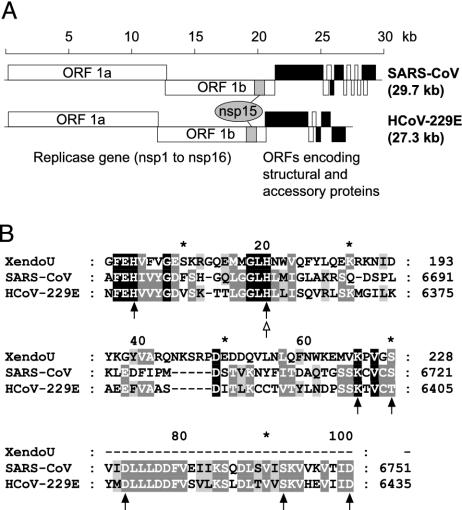
Fig. 1.
Fig. 1.
Human coronaviruses replicase genes encode a putative endoribonuclease. (A) Functional ORFs in the genomes of SARS-CoV and HCoV-229E are expressed from both genomic RNA and a set of subgenomic mRNAs. ORFs encoding the four structural proteins S, E, M, and N, are indicated in black. The ORF 1a- and ORF 1b-encoded proteins, pp1a and pp1ab, are cleaved by viral proteases to yield 16 processing end-products: nsp1-nsp16. The C-terminal part of nsp15 was predicted to harbor an endoribonuclease domain (20). (B) Partial sequence alignment of SARS-CoV and HCoV-229E NendoU domains with Xenopus laevis XendoU, a poly(U)-specific endoribonuclease. Conserved residues targeted in this study by site-directed mutagenesis are indicated by filled (HCoV-229E) and open (SARS-CoV) arrows.
Fig. 2.
Fig. 2.
RNA-specific endonuclease activity of SARS-CoV and HCoV-229E nsp15. ss and ds versions of 5′-[32P] RNA and DNA substrates, respectively, of 1 kb(p) were incubated for 20 min at 37°C without protein (lanes 1, 6, 11, and 16), with HCoV-229E MBP-nsp15_H6360A (HCoV nsp15_mut; lanes 2, 7, 12, and 17), with HCoV-229E MBP-nsp15 (HCoV nsp15; lanes 3, 8, 13, and 18), with SARS-CoV MBP-nsp15_H6678A (SCoV nsp15_mut; lanes 4, 9, 14, and 19) or with SARS-CoV MBP-nsp15 (SCoV nsp15; lanes 5, 10, 15, and 20). Reaction products and RNA size markers were separated in an 8% polyacrylamide gel containing 0.1% SDS.
Fig. 3.
Fig. 3.
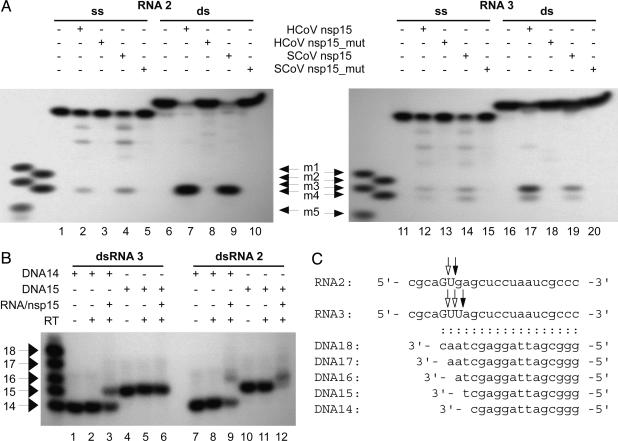
Substrate specificity of coronavirus endoribonucleases. (A) ss and ds versions of 5′-[32P]-labeled RNAs 2 and 3 were cleaved with nsp15, and the sizes of the 5′-terminal reaction products were determined by denaturing PAGE with 5′-[32P]-labeled RNAs, m1-m5, as markers. Lanes 1, 6, 11, and 16, reactions without protein; lanes 2, 7, 12, and 17, reactions with HCoV-229E MBP-nsp15; lanes 3, 8, 13, and 18, reactions with HCoV-229E MBP-nsp15_H6360A; lanes 4, 9, 14, and 19, reactions with SARS-CoV (SCoV) MBP-nsp15; lanes 5, 10, 15 and 20, reactions with SARS-CoV MBP-nsp15_H6678A. (B) Primer extension analysis suggests cleavages also downstream of the most 3′ uridylate in GU and GUU sequences. dsRNAs 3 and 2, respectively, were cleaved with nsp15, and primer extension reactions were done by using the indicated 5′-[32P]-labeled DNA primers. Reaction products were analyzed by denaturing PAGE with 5′-[32P]-labeled DNAs 14-18 as size markers. Lanes 1, 4, 7, and 10, reverse transcription primers DNA14 and DNA15, respectively; lanes 2, 5, 8, and 11, reactions in the absence of RNA template; lanes 3, 6, 9, and 12, reactions with the indicated RT primer and the indicated nsp15-cleaved dsRNA molecule as template. (C) Sequences of synthetic oligonucleotides used in this experiment. ds forms of RNAs 2 and 3 were produced by annealing with complementary RNAs. Cleavages downstream of uridylates as determined by primer extension (B) are indicated by black arrows, and cleavages upstream of uridylates (A) are indicated by open arrows.
Fig. 4.
Fig. 4.
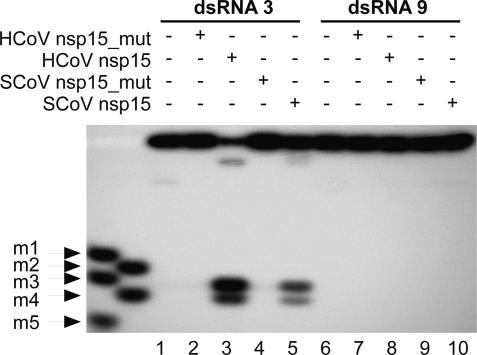
RNA 2′-O-ribose methylation blocks clearage by coronavirus nsp15. dsRNA substrates were produced by annealing RNA8 to the complementary 5′-[32P]-labeled RNA3 or its 2′-O-ribose-methylated derivative, RNA9. Substrates were incubated with SARS-CoV (SCoV) and HCoV-229E (HCoV) MBP-nsp15, respectively, or inactive control proteins. Reaction products were analyzed by denaturing PAGE and autoradiography. Lanes 1 and 6, reactions without protein; lanes 2 and 7, reactions with HCoV-229E MBP-nsp15_H6360A; lanes 3 and 8, reactions with HCoV-229E MBP-nsp15; lanes 4 and 9, reactions with SARS-CoV MBP-nsp15_H6678A; lanes 5 and 10, reactions with SARS-CoV MBP-nsp15.
Fig. 5.
Fig. 5.
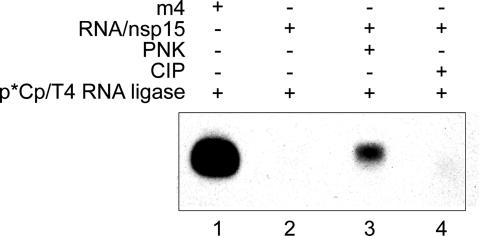
Coronavirus NendoU activity produces molecules with 2′-3′ cyclic phosphate termini. Ligation of 5′-[32P]pCp with the 3′ terminus of coronavirus nsp15 cleavage products using T4 RNA ligase requires pretreatment with PNK that (in contrast to CIP) is capable of removing 2′-3′ cyclic phosphates. Reaction products were analyzed by denaturing PAGE and autoradiography. Lane 1, ligation reaction with control RNA m4; lanes 2-4, ligation reactions with purified 5′-terminal nsp15 cleavage product without further treatment (lane 2) and after treatment with PNK (lane 3) or CIP (lane 4).
Fig. 6.
Fig. 6.
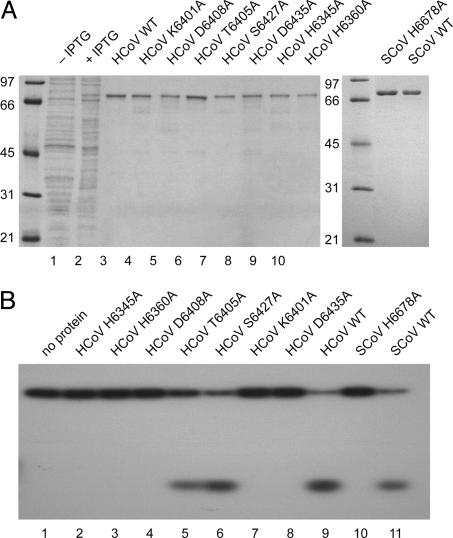
Activities of mutant forms of human coronavirus NendoU. (A) Coomassie brilliant blue-stained SDS-polyacrylamide gel showing the expression and purification of HCoV-229E (HCoV) and SARS-CoV (SCoV) MBP-nsp15 fusion proteins. Lanes 1 and 2, total lysates of E. coli cells transformed with pMal-HCoV-nsp15 plasmid DNA and grown in the absence (lane 1) or presence (lane 2) of isopropyl β-d-thiogalactoside (IPTG); lanes 3-12, purified MBP-nsp15 fusion proteins with nsp15 wild-type sequence (WT) or with the indicated substitutions of conserved residues. Numbering of residues is according to their positions in the replicase polyproteins of HCoV-229E and SARS-CoV, respectively. (B) HCoV-229E and SARS-CoV MBP-nsp15 fusion proteins or their mutant derivatives were incubated with dsRNA2, and reaction products were separated in a 20% polyacrylamide gel containing 7.5 M urea.

References

    1. Myint, S. H. (1995) in The Coronaviridae, ed. Siddell, S. G. (Plenum, New York), pp. 389-401.
    1. Peiris, J. S., Yuen, K. Y., Osterhaus, A. D. & Stöhr, K. (2003) N. Engl. J. Med. 349, 2431-2441. - PubMed
    1. Peiris, J. S., Lai, S. T., Poon, L. L., Guan, Y., Yam, L. Y., Lim, W., Nicholls, J., Yee, W. K., Yan, W. W., Cheung, M. T., et al. (2003) Lancet 361, 1319-1325. - PMC - PubMed
    1. Herold, J., Raabe, T., Schelle-Prinz, B. & Siddell, S. G. (1993) Virology 195, 680-691. - PMC - PubMed
    1. Thiel, V., Ivanov, K. A., Putics, A., Hertzig, T., Schelle, B., Bayer, S., Weissbrich, B., Snijder, E. J., Rabenau, H., Doerr, H. W., Gorbalenya, A. E. & Ziebuhr, J. (2003) J. Gen. Virol. 84, 2305-2315. - PubMed

Publication types

MeSH terms

LinkOut - more resources