Sustained virological response in hepatitis C virus type 1b infected patients is predicted by the number of mutations within the NS5A-ISDR: a meta-analysis focused on geographical differences
- PMID: 15306598
- PMCID: PMC1774214
- DOI: 10.1136/gut.2003.031336
Sustained virological response in hepatitis C virus type 1b infected patients is predicted by the number of mutations within the NS5A-ISDR: a meta-analysis focused on geographical differences
Abstract
Background and aims: There is growing evidence that the response of hepatitis C virus (HCV) genotype 1b infected patients towards interferon (IFN) therapy is influenced by the number of mutations within the carboxy terminal region of the NS5A gene, the interferon sensitivity determining region (ISDR).
Patients and methods: In order to attain better insight into this correlation, a file comprising published data on ISDR strains from 1230 HCV genotype 1b infected patients, mainly from Japan and Europe, was constructed and analysed by logistic regression. Sustained virological response (SVR) was defined as negative HCV RNA six months after treatment.
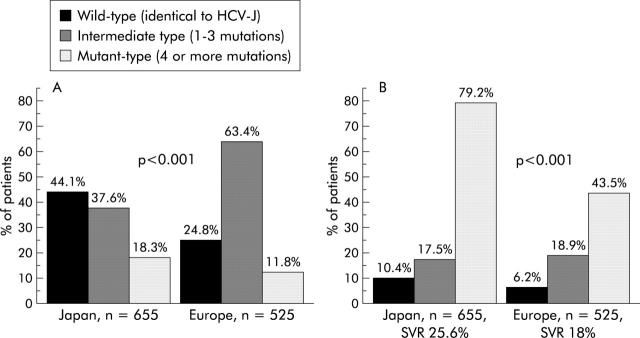
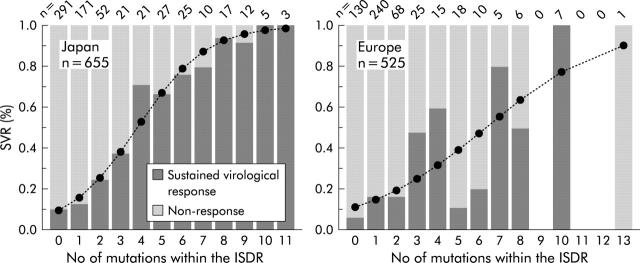
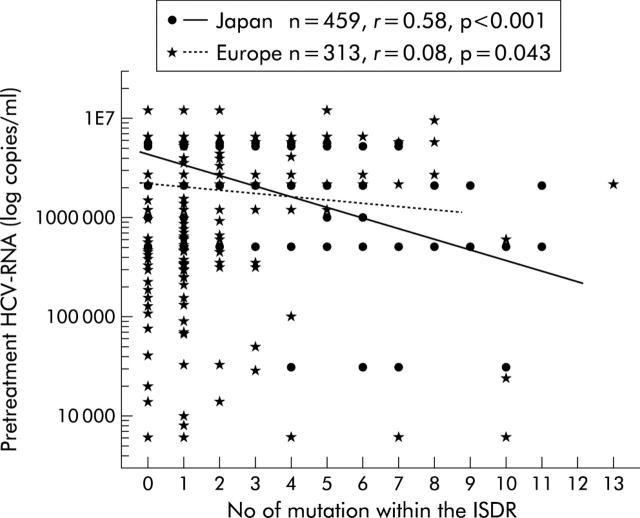
Results: The distribution of wild-, intermediate-, and mutant-type ISDR sequences differed significantly between Japanese (n = 655) (44.1%, 37.6%, and 18.3%) and European patients (n = 525) (24.8%, 63.4%, and 11.8%; p<0.001). There was a significant positive correlation between the number of ISDR mutations and SVR rate, irrespective of geographical region. The likelihood of SVR with each additional mutation within the ISDR was considerably more pronounced in Japanese compared with European patients (odds ratios 1.82 v 1.39; p<0.001). Pretreatment viraemia of <6.6 log copies/ml and ISDR mutant-type infection was associated with an SVR rate of 97.1% in Japanese patients but only 52.5% in European patients. Pretreatment viraemia was a stronger predictor of SVR than ISDR mutation number in Japanese patients whereas in European patients both parameters had similar predictive power.
Conclusion: These data support the concept that mutant-type ISDR strains may represent a subtype within genotype 1b with a more favourable response towards IFN therapy.
Figures
References
-
- Martinot-Peignoux M , Marcellin P, Pouteau M, et al. Pretreatment serum hepatitis C virus RNA levels and hepatitis C virus genotype are the main and independent prognostic factors of sustained response to interferon alfa therapy in chronic hepatitis C. Hepatology 1995;22:1050–6. - PubMed
-
- Poynard T , Leroy V, Cohard M, et al. Meta-analysis of interferon randomized trials in the treatment of viral hepatitis C: effects of dose and duration. Hepatology 1996;24:778–89. - PubMed
-
- Manns MP, McHutchison JG, Gordon SC, et al. Peginterferon alfa-2b plus ribavirin compared with interferon alfa-2b plus ribavirin for initial treatment of chronic hepatitis C: a randomized trial. Lancet 2001;358:958–65. - PubMed
-
- Fried MW, Shiffman ML, Reddy KR, et al. Peginterferon alfa-2a plus ribavirin for chronic hepatitis C virus infection. N Engl J Med 2002;347:975–82. - PubMed
Publication types
MeSH terms
Substances
LinkOut - more resources
Full Text Sources