. 2004 Aug 24;101(34):12537-42.
doi: 10.1073/pnas.0404934101. Epub 2004 Aug 11.

Cotranslational integration and initial sorting at the endoplasmic reticulum translocon of proteins destined for the inner nuclear membrane

Affiliations

Cotranslational integration and initial sorting at the endoplasmic reticulum translocon of proteins destined for the inner nuclear membrane

Suraj Saksena et al. Proc Natl Acad Sci U S A. .

Abstract

The current diffusion-retention model for protein trafficking to the inner nuclear membrane (INM) proposes that INM proteins diffuse laterally from the membrane of the endoplasmic reticulum into the INM and are then retained in the INM by binding to nuclear proteins or DNA. Because some data indicate that the sorting of baculovirus envelope proteins to the INM is protein-mediated, we have examined the early stages of INM protein integration and sorting by using photocrosslinking. Both viral and host INM-directed proteins were integrated cotranslationally through the endoplasmic reticulum translocon, and their nonrandom photocrosslinking to two translocon proteins, Sec61alpha and translocating chain-associated membrane protein (TRAM), revealed that the first transmembrane sequence (TMS) of each viral and host INM-directed protein occupied a very similar location within the translocon. Because few TMSs of non-INM-directed membrane proteins photocrosslink to TRAM, it seems that the INM-directed TMSs occupy different sites within the translocon than do non-INM-directed TMSs. The distinct proximities of translocon components to INM-directed TMSs strongly suggest that such TMSs are recognized and initially sorted within the translocon. Taken together, these data indicate that membrane protein sorting to the INM is an active process involving specific nonnuclear proteins.


Figures
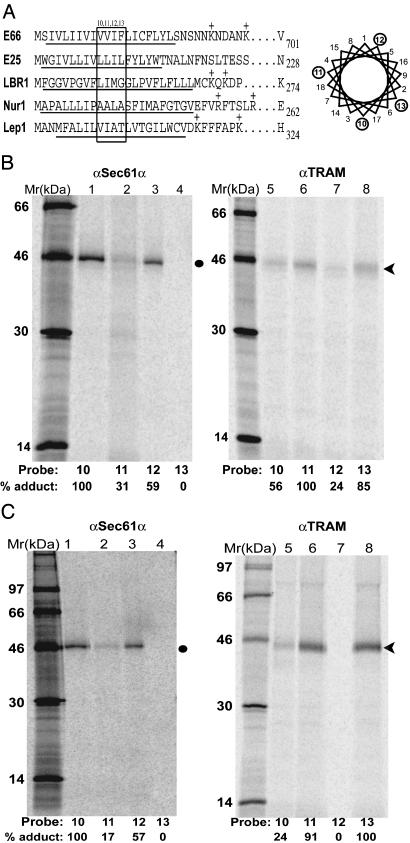
Fig. 1.
Fig. 1.
Photocrosslinking of viral INM-directed TMSs to translocon proteins. (A) The N-terminal sequences of E66 and E25 are shown with the TMS underlined, as are the N-terminal sequences of the constructs containing the first TMS of LBR (LBR1), nurim (Nur1), and Lep (Lep1). In each case, an amber codon was substituted for the codon shown at position 10, 11, 12, or 13 (boxed in figure) to position the photoreactive probes at a single nascent chain location in each sample. The probes extend from different sides of the TMS α-helix surface as shown in the helical wheel representation. (B) Integration intermediates containing 70-residue E66-A10, E66-A11, E66-A12, or E66-A13 nascent chains were photolyzed, immunoprecipitated with affinity-purified antibodies to Sec61α (lanes 1–4) or TRAM (lanes 5–8), and analyzed by SDS/PAGE. Photoadducts to Sec61α and TRAM are indicated by the closed circle and arrowhead, respectively. The relative extent of photoadduct formation was quantified by comparing each photoadduct band intensity with that of the most intense photoadduct band in the gel (assigned 100%). (C) Integration intermediates containing 70-residue E25-A10, E25-A11, E25-A12, or E25-A13 nascent chains were photolyzed and analyzed as in B.
Fig. 2.
Fig. 2.
Photocrosslinking of mammalian LBR1 and Nur1 TMSs to translocon proteins. (A) Integration intermediates containing 70-residue LBR1-A10, -A11, -A12, and -A13 nascent chains were photolyzed and analyzed as in Fig. 1. (B) Integration intermediates containing 70-residue Nur1-A10, -A11, -A12, or -A13 nascent chains were photolyzed and analyzed as in Fig. 1.
Fig. 3.
Fig. 3.
Nascent chain-length dependence of E66 photocrosslinking to translocon proteins. Photoadducts were detected by immunoprecipitation with antisera specific for either Sec61α (A) or TRAM (B). Nascent chain lengths (amino acids) in the photolyzed E66SM-A10 (A) or -A11 (B) integration intermediates are indicated below the gel. Normally terminated full-length 136-residue E66SM is shown in lanes A6 and B5. Photoadducts are identified as in Fig. 1.
Fig. 4.
Fig. 4.
Nascent chain-length dependence of SM chemical crosslinking to FP25K and E26. (A) Nascent or full-length E66SM proteins were translated in the presence of virus-infected Sf9 microsomes, chemically crosslinked, and immunoprecipitated with antisera specific for either FP25K (A) or E26 (B) as before (8). Nascent chain lengths in integration intermediates are as indicated. Covalent crosslinks between full-length E66SM and FP25K or E26 are identified by the arrowhead adjacent to lane 5 in each gel.

References

    1. Johnson, A. E. & van Waes, M. A. (1999) Annu. Rev. Cell Dev. Biol. 15, 799–842. - PubMed
    1. Schnell, D. J. & Hebert, D. N. (2003) Cell 112, 491–505. - PubMed
    1. Alder, N. N. & Johnson, A. E. (2004) J. Biol. Chem. 279, 22787–22790. - PubMed
    1. Mellman, I. & Warren, G. (2000) Cell 100, 99–112. - PubMed
    1. Barlowe, C. (2003) Trends Cell Biol. 13, 295–300. - PubMed

Publication types

Substances

LinkOut - more resources
