


doi: 10.1128/JVI.78.17.9564-9567.2004.
The central half of Pit2 is not required for its function as a retroviral receptor
Affiliations
- PMID: 15308749
- PMCID: PMC506934
- DOI: 10.1128/JVI.78.17.9564-9567.2004
Item in Clipboard
The central half of Pit2 is not required for its function as a retroviral receptor
J Virol.
2004 Sep.
Abstract
The type III sodium-dependent phosphate (NaPi) cotransporter, Pit2, is a receptor for amphotropic murine leukemia virus (A-MuLV) and 10A1 MuLV. In order to determine what is sufficient for Pit2 receptor function, a deletion mutant lacking about the middle half of the protein was made. The mutant supported entry for both viruses, unequivocally narrowing down the identification of the sequence that is sufficient to specify the receptor functions of Pit2 to its N-terminal 182 amino acids and C-terminal 170 amino acids.
Figures
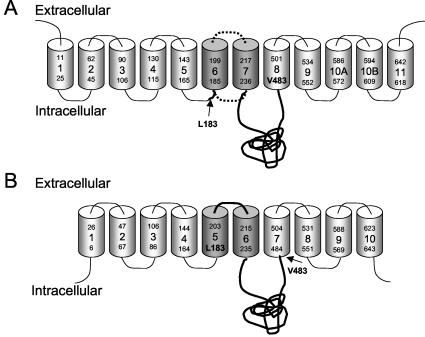
Putative membrane topology models of Pit2 based on Salaün et al. (30) (A) and Johann et al. (11, 40) (B); see references for details on the models. The membrane topology model of Pit2 after Salaün et al. (30) was based on (i) epitope tagging of N- and C-terminal ends, (ii) orientation of microsomal membrane-inserted in vitro transcribed and translated C-terminal-truncation mutants, and (iii) glycosylation of wild-type human Pit2 and lack of glycosylation of a human Pit2N81V mutant in whole-cell extracts from CHO K1 cells overexpressing Pit2 and Pit2N81V. Salaün and coworkers did not present functional studies (e.g., viral receptor function) of the C-terminal truncation mutants (30). For comparison, the first proposed membrane topology model of Pit2 based on Kyte-Doolittle hydropathy plots is shown (11, 40) in panel B. The middle part of human Pit2 including amino acid 183 to amino acid 483 (the sequences highlighted in both A and B) is deleted in the mutant Pit2ΔL183-V483.
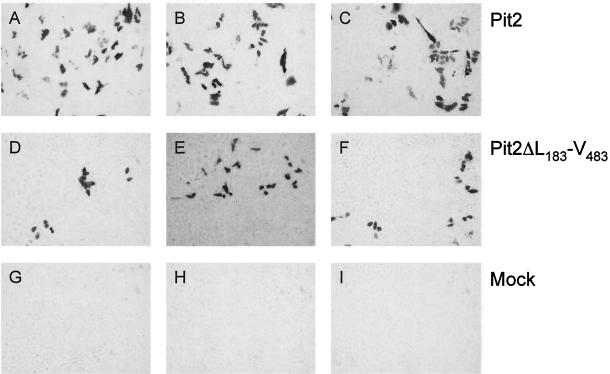
Susceptibilities of transfected CHO K1 cells. Transfections were performed as described in the text. Panels A to C show three dishes receiving independent DNA precipitates of the plasmid encoding Pit2, panels D to F show three dishes receiving independent DNA precipitates of the plasmid encoding Pit2ΔL183-V483, and panels G to I show three dishes receiving independent DNA precipitates of empty expression vector (Mock). The experiment was performed according to the method shown in Table 1; however, a third independent set of DNA preparations was used. At 48 h posttransfection, cells were challenged with PT67-derived vector pseudotypes (10A1 MuLV pseudotypes) carrying the LacZ-expressing G1BgSvN transfer vector. Forty-eight hours after vector exposure, cells were fixed and stained for the presence of β-galactosidase-positive (infected) cells; infected cells are blue (dark). No blue cells were present in the mock-transfected cultures. Random fields from each plate in the triplicate setups are shown at a magnification of ×200.
References
-
- Albritton, L. M., L. Tseng, D. Scadden, and J. M. Cunningham. 1989. A putative murine ecotropic retrovirus receptor gene encodes a multiple membrane-spanning protein and confers susceptibility to virus infection. Cell 57:659-666. - PubMed
-
- Bøttger, P., and L. Pedersen. 2002. Two highly conserved glutamate residues critical for type III sodium-dependent phosphate transport revealed by uncoupling transport function from retroviral receptor function. J. Biol. Chem. 277:42741-42747. - PubMed
Publication types
MeSH terms
Substances
Grants and funding
LinkOut - more resources
Full Text Sources
Other Literature Sources
