. 2004 Aug 24;101(34):12771-6.
doi: 10.1073/pnas.0404287101. Epub 2004 Aug 12.

Recessive-interfering mutations in the gibberellin signaling gene SLEEPY1 are rescued by overexpression of its homologue, SNEEZY

Affiliations

Recessive-interfering mutations in the gibberellin signaling gene SLEEPY1 are rescued by overexpression of its homologue, SNEEZY

Lucia C Strader et al. Proc Natl Acad Sci U S A. .

Abstract

This article reports the genetic interaction of two F-box genes, SLEEPY1 (SLY1) and SNEEZY (SNE), in Arabidopsis thaliana gibberellin (GA) signaling. The SLY1 gene encodes an F-box subunit of a Skp1-cullin-F-box (SCF) E3 ubiquitin ligase complex that positively regulates GA signaling. The sly1-2 and sly1-10 mutants have recessive, GA-insensitive phenotypes including delayed germination, dwarfism, reduced fertility, and overaccumulation of the DELLA proteins RGA (Repressor of ga1-3), GAI (GA-Insensitive), and RGL2 (RGA-Like 2). The DELLA domain proteins are putative transcription factors that negatively regulate GA signaling. The requirement for SLY1 in GA-stimulated disappearance of DELLA proteins suggests that GA targets DELLA proteins for destruction via SCF(SLY1)-mediated ubiquitylation. Overexpression of SLY1 in sly1-2 and sly1-10 plants rescues the recessive GA-insensitive phenotype of these mutants. Surprisingly, antisense expression of SLY1 also suppresses these mutants. This result caused us to hypothesize that the SLY1 homologue SNE can functionally replace SLY1 in the absence of the recessive interfering sly1-2 or sly1-10 genes. This hypothesis was supported because overexpression of SNE in sly1-10 rescues the dwarf phenotype. In addition to rescuing the sly1-10 dwarf phenotype, SNE overexpression also restored normal RGA protein levels, suggesting that the SNE F-box protein can replace SLY1 in the GA-induced proteolysis of RGA. If the C-terminal truncation in the sly1-2 and sly1-10 alleles interferes with SNE rescue, we reasoned that overexpression of sly1-2 might interfere with wild-type SLY1 function. Indeed, overexpression of sly1-2 in wild-type Ler (Landsberg erecta) yields dwarf plants.


Figures

Fig. 1.
Fig. 1.
SCFSLY1 inhibits negative regulation of GA responses by the DELLA proteins. In the absence of GA, DELLA proteins inhibit GA responses such as germination, stem elongation, and transition to flowering. Addition of GA stimulates phosphorylation of DELLA proteins by an unidentified kinase. Phosphorylation allows recognition of the DELLA protein by the SCFSLY1 complex. Polyubiquitylation mediated by the SCFSLY1 E3 ubiquitin ligase targets the DELLA protein for degradation by the 26S proteasome. This stimulates GA responses by relieving DELLA inhibition.
Fig. 2.
Fig. 2.
Antisense and overexpression of SLY1. (A) Photograph of 7-week-old plants. (B) Directional RT-PCR analysis of SLY1 and ACT2 mRNA accumulation in antisense and overexpression lines. Primers detect no mRNA in the sly1-10 negative control, because primers were designed around the rearrangement in this mutant. An ethidium bromide-stained 1.5% agarose gel from RT-PCR using 100 ng of total RNA for each sample is shown. The SLY1-AS had a similar effect on SLY1 mRNA accumulation in four independent transformants. (C) Western blot analysis of crude protein extracts of 10-day-old seedlings fractionated on 10% SDS/PAGE, and detected with anti-RGA. Lines shown are Ler and sly1-10 transformed with SLY1-AS, SLY1-OE, SNE-OE, or untransformed, as well as sly1-2/rga-24. (D) Percent germination after 5 days on Murashige and Skoog plates containing 0, 0.3, 0.6, 1.2, or 3.0 μM ABA for sly1-10 (Upper) and sly1-2 (Lower) seeds for the following lines: □, Ler wild-type control; ▪, untransformed sly1-2 or sly1-10; •, SLY1-AS transformant; ▴, SLY1-OE transformant. (E) Photograph of 4-week-old Ler, sly1-10, and suppressor of sly1-10 isolate1.3 (sly1-10 OE SNE).
Fig. 3.
Fig. 3.
Overexpression of SNE and sly1-2. (A) RNA gel blot analysis of SNE mRNA and 18S rRNA accumulation in Ler, sly1-10, and suppressor of sly1-10 isolate 1.3 using 15 μg of total RNA isolated from total aerial tissue of 5-week-old plants. The transcript size from SNE-OE in isolate 1.3 is larger than the natural SNE due to the T-DNA insertion site. (B) RT-PCR analysis of SLY1 mRNA in sly1-2-OE lines, designated as dwarf (D) or tall (T). ACT2 mRNA levels were also monitored for a loading control. An ethidium bromide-stained 1.5% agarose gel is shown. (C) Photograph of 4-week-old Ler, tall (T) and dwarf (D) sly1-2-OE lines, and sly1-2.
Fig. 4.
Fig. 4.
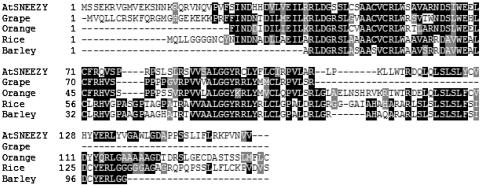
SNE homologues. clustalw alignment of predicted SNE protein (At5g48170) with plant homologues from grape (CF609441), orange (CK665669), rice (AC116426), and barley (CF609441) is shown. The amino acid sequence is predicted from the largest ORF in each sequence.
Fig. 5.
Fig. 5.
SNE developmental mRNA expression. A Northern blot analysis of SNE mRNA and 18S rRNA control using 15 μg of total RNA isolated from wild-type Ler stems (ST), rosette leaves (RL), cauline leaves (CL), flowers (F), green siliques (GS), and seedlings (Sdlg).

References

    1. Olszewski, N., Sun, T. P. & Gubler, F. (2002) Plant Cell 14 Suppl., S61-S80. - PMC - PubMed
    1. Gomi, K. & Matsuoka, M. (2003) Curr. Opin. Plant Biol. 6, 489-493. - PubMed
    1. Jacobsen, S. E., Olszewski, N. E. & Meyerowitz, E. M. (1998) Symp. Soc. Exp. Biol. 51, 73-78. - PubMed
    1. Fridborg, I., Kuusk, S., Robertson, M. & Sundberg, E. (2001) Plant Physiol. 127, 937-948. - PMC - PubMed
    1. Silverstone, A. L., Ciampaglio, C. N. & Sun, T. (1998) Plant Cell 10, 155-169. - PMC - PubMed

Publication types

MeSH terms