Clinical Trial
. 2004 Oct 5;101 Suppl 2(Suppl 2):14677-82.
doi: 10.1073/pnas.0404735101. Epub 2004 Aug 13.

Vaccination with genetically engineered allergens prevents progression of allergic disease

Affiliations
Clinical Trial

Vaccination with genetically engineered allergens prevents progression of allergic disease

V Niederberger et al. Proc Natl Acad Sci U S A. .

Abstract

IgE-mediated allergy affects >25% of the population in industrialized countries. Repeated contact with the disease-eliciting allergens induces rises of allergen-specific IgE Abs and progression of the disease to more severe manifestations. Our study uses a type of vaccine that is based on genetically modified allergen derivatives to treat allergic patients. We developed hypoallergenic derivatives of the major birch pollen allergen, Bet v 1, by genetic engineering and vaccinated birch pollen-allergic patients (n = 124) in a double-blind, placebo-controlled study. Active treatment induced protective IgG Abs that inhibited allergen-induced release of inflammatory mediators. We also observed a reduction of cutaneous sensitivity as well as an improvement of symptoms in actively treated patients. Most important, rises of allergen-specific IgE induced by seasonal birch pollen exposure were significantly reduced in vaccinated patients. Vaccination with genetically engineered allergen derivatives is a therapy for allergy that not only ameliorates allergic reactions but also reduces the IgE production underlying the disease.


Figures
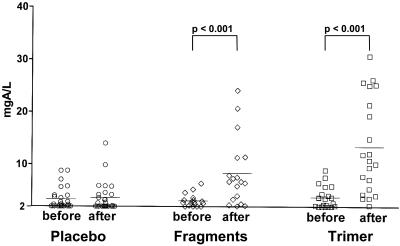
Fig. 1.
Fig. 1.
Bet v 1-specific IgG Ab levels [y axis, mg of antigen per liter (mgA/L)] (placebo, n = 27; fragments, n = 18; or trimer, n = 21) before and after treatment. Statistically significant differences are indicated.
Fig. 2.
Fig. 2.
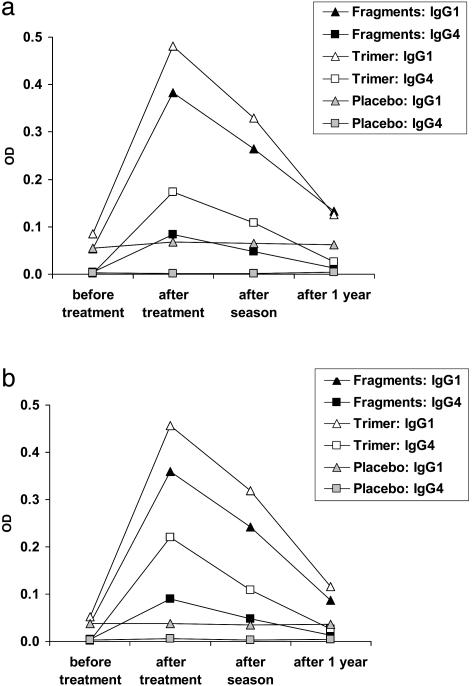
Vaccination character of immunotherapy with genetically engineered Bet v 1 derivatives. Treatment with Bet v 1 fragments and trimer, but not with placebo, induces de novo IgG1 and IgG4 responses to fragments 1 (a) and 2 (b). Mean OD values corresponding to the amount of Abs in the three groups (fragments, n = 18; trimer, n = 21; placebo, n = 27) (y axis) are given for different times (x axis).
Fig. 3.
Fig. 3.
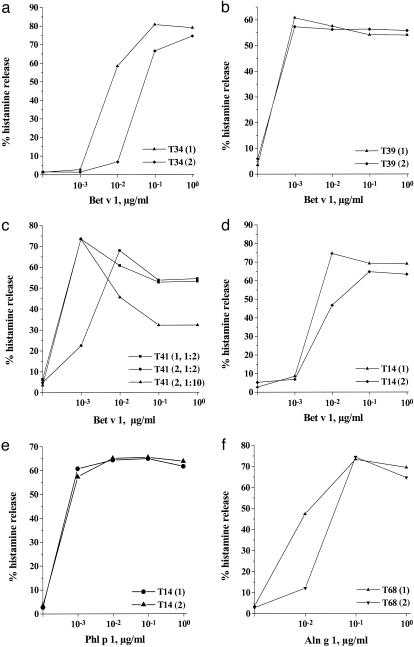
Therapy-induced Abs inhibit basophil histamine release in an allergen-specific manner. Basophils from birch pollen-allergic patients were exposed to different concentrations of rBet v 1, which were preincubated with sera from a trimer-treated (T34) (a) and placebo-treated (b) patient (T39) obtained before (1) and after (2) therapy. (c)Influence of preincubation of Bet v 1 with sera obtained from a trimer-treated patient (T41) before (1, 1:2 dilution) and after (2, 1:2 and 1:10 dilution) therapy on Bet v 1-specific histamine release. The effects of sera from a fragment-treated patient (T14) obtained before and after therapy on Bet v 1-induced (d) and Phl p 1-induced (e) histamine release are shown. The Bet v 1-cross-reactive allergen from alder pollen, Aln g 1, was preincubated with sera obtained from a fragment-treated patient (T68) (f) before (1) and after (2) therapy. The percentages of histamine release (y axis) for different allergen concentrations (x axis) are shown.
Fig. 4.
Fig. 4.
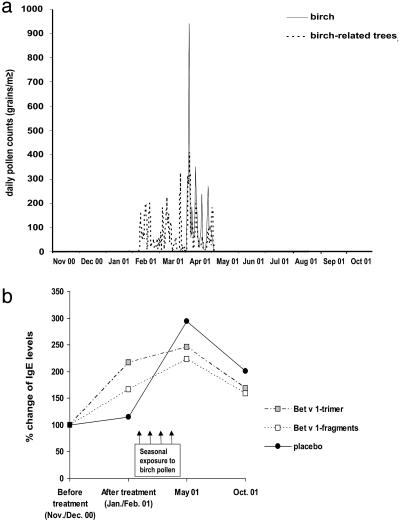
Reduction of IgE increases in vaccinated patients. (a) Exposure to birch pollen (solid line) and birch-related pollens (dotted line) (y axis: grains per m3/10) in Vienna between November 2000 and the end of October 2001. (b) Bet v 1-specific IgE levels. Percentages of alteration compared with the baseline before treatment (November/December 2000) in the three patient groups (placebo, n = 27; fragments, n = 18; trimer, n = 21), after treatment (February 2001), after the birch pollen season (May 2001), and in October 2001 are given.

References

    1. Kay, A. B. (1997) Allergy and Allergic Diseases (Blackwell Science, Oxford).
    1. Wills-Karp, M., Santeliz, M. & Karp, C. L. (2001) Nat. Rev. Immunol. 1, 69-75. - PubMed
    1. Valenta, R. (2002) Nat. Rev. Immunol. 2, 446-453. - PubMed
    1. Kinet, J. P. (1999) Annu. Rev. Immunol. 17, 931-972. - PubMed
    1. Hendersen, L. L., Larson, J. B. & Gleich, G. J. (1975) J. Allergy Clin. Immunol. 55, 10-15. - PubMed

Publication types

MeSH terms