. 2004 Aug 24;101(34):12598-603.
doi: 10.1073/pnas.0404892101. Epub 2004 Aug 16.

The RD1 virulence locus of Mycobacterium tuberculosis regulates DNA transfer in Mycobacterium smegmatis

Affiliations

The RD1 virulence locus of Mycobacterium tuberculosis regulates DNA transfer in Mycobacterium smegmatis

Jessica L Flint et al. Proc Natl Acad Sci U S A. .

Abstract

Conjugal DNA transfer occurs by an atypical mechanism in Mycobacterium smegmatis. The transfer system is chromosomally encoded and requires recipient recombination functions for both chromosome and plasmid transfer. Cis-acting sequences have been identified that confer mobility on nontransferable plasmids, but these are larger and have different properties to canonical oriT sites found in bacterial plasmids. To identify trans-acting factors required for mediating DNA transfer, a library of transposon insertion mutants was generated in the donor strain, and individual mutants were screened for their effect on transfer. From this screen, a collection of insertion mutants was isolated that increased conjugation frequencies relative to wild type. Remarkably, the mutations map to a 25-kb region of the M. smegmatis chromosome that is syntenous with the RD1 region of Mycobacterium tuberculosis, which is considered to be the primary attenuating deletion in the related vaccine strain Mycobacterium bovis bacillus Calmette-Guérin. The genes of the RD1 region encode a secretory apparatus responsible for exporting Cfp10- and Esat-6, both potent antigens and virulence factors. In crosses using two M. smegmatis donors, we show that wild-type cells can suppress the elevated transfer phenotype of mutant donors, which is consistent with the secretion of a factor that suppresses conjugation. Most importantly, the RD1 region of M. tuberculosis complements the conjugation phenotype of the RD1 mutants in M. smegmatis. Our results indicate that the M. tuberculosis and M. smegmatis RD1 regions are functionally equivalent and provide a unique perspective on the role of this critical secretion apparatus.


Figures
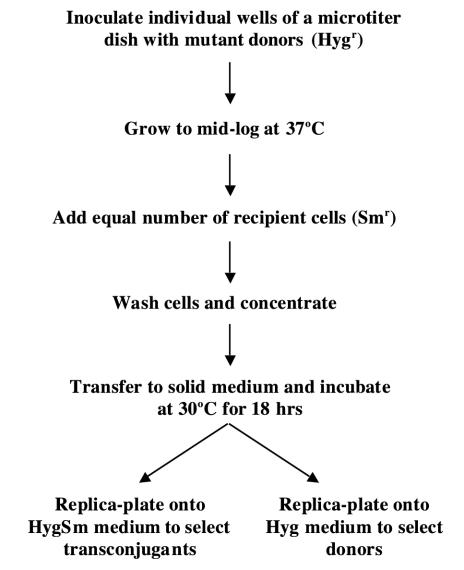
Fig. 1.
Fig. 1.
A schematic outline of the microtiter mating procedure used to screen for insertion mutants affecting DNA transfer in M. smegmatis.
Fig. 2.
Fig. 2.
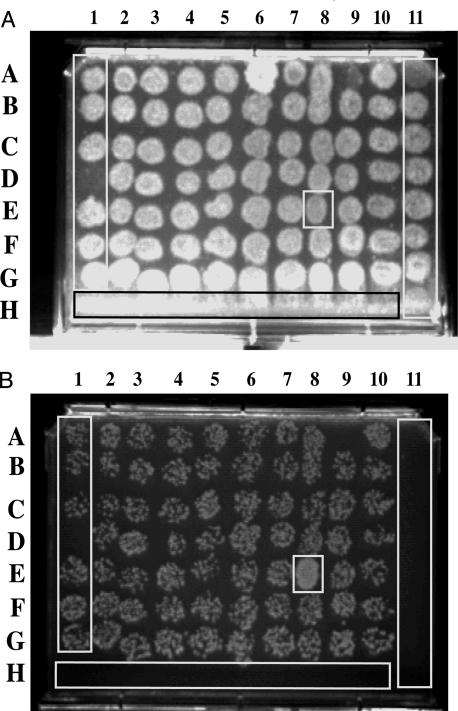
Microtiter replica plates used to identify transfer-up mutants. The example shown is the result of a single 96-well mating assay replica-plated onto trypticase soy agar plates. (A) Hyg-containing trypticase soy agar medium selecting for donors. (B) HygSm-containing trypticase soy agar medium selecting for transconjugants. The spot boxed at 8E is an example of an up-mutant. Note the confluent growth of 8E transconjugants compared with the speckled growth of other spots. Controls are indicated in rectangles and were as follows. Column 11 contains wild-type donor cells only, and consequently growth is only observed on plate A. In row H, wells 1–10 contain recipient cells only, which cannot grow on either plate A or B. In column 1, rows A–G contain wild-type donor and recipient and represent normal levels of Hygr transfer on plate B.
Fig. 3.
Fig. 3.
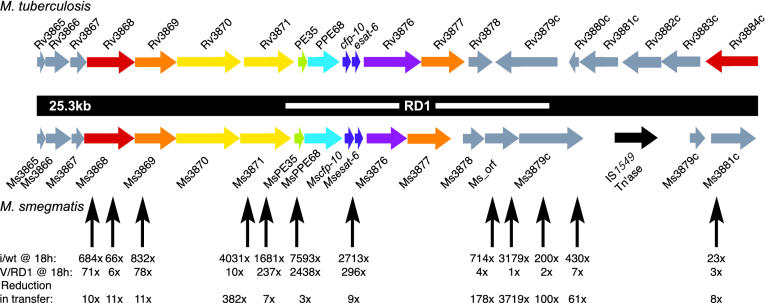
Alignment of the M. tuberculosis and M. smegmatis RD1 regions. ORFs are colored according to their putative functions, which were derived from the pfam and tuberculist databases (18, 19), as follows: red ORFs encode AAA domains (pfam accession no. PF0004); orange ORFs encode putative transmembrane proteins; yellow ORFs encode FtsK/SpoIIIE domains (PF01580, note that the FtsK/SpoIIIE and AAA domains are specific examples of the AAA+ domain); green ORFs encode PE (PF00934) proteins; cyan ORFs encode PPE (PF00823) proteins; purple ORFs encode members of COG0455 (35), ATPases involved in chromosome partitioning are shown. The functions of the gray ORFs are unclear. An ORF corresponding to the transposase of IS1549 is black. M. smegmatis ORFs (Ms) were given names reflective of the closest M. tuberculosis (H37Rv) homologue. Note that the genes downstream of Ms3878 and Rv3878, although conserved, are not in the same orientation. This finding contradicts previous computational predictions of the region (27) but is in agreement with sequencing analyses from both our laboratory and the tigr database. Ms-orf is a predicted gene with no known M. tuberculosis homologue. The white bar indicates the RD1 deletion originally defined in BCG, which also attenuates M. bovis and M. tuberculosis. Black vertical arrows below the maps represent mariner/Kmr insertions, which increase DNA transfer. For clarity, a third insertion in Ms3871 and an insertion 2.6 kb downstream of Ms3881c, which also elevates DNA transfer, are not shown. The fold increase (i/wt) in DNA transfer for each insertion mutant (i) compared with wild type (wt), after an 18-h mating, is shown immediately below each arrow. In these experiments, the wild-type transfer frequency was 1 × 10⁻⁵ events per donor cell. Mutant transfer frequencies were determined from five independent crosses. V/RD1 indicates the fold increase in DNA transfer for the mutants when complemented with an integrated M. tuberculosis cosmid encompassing the entire region. These frequencies are compared with just the cosmid vector (v) integrated into the attB site of M. smegmatis. The bottom row indicates the overall reduction in transfer frequency (i.e., the extent of complementation).

References

    1. Corbett, E. L., Watt, C. J., Walker, N., Maher, D., Williams, B. G., Raviglione, M. C. & Dye, C. (2003) Arch. Intern. Med. 163, 1009–1021. - PubMed
    1. Hatfull, G. F. (1996) Curr. Top. Microbiol. Immunol. 215, 29–47. - PubMed
    1. Jacobs, W. R. & Bloom, B. R. (1994) in Tuberculosis, ed. Bloom, B. R. (Am. Soc. Microbiol., Washington, DC), pp. 253–270.
    1. Derbyshire, K. M. & Bardarov, S. (2000) in Molecular Genetics of Mycobacteria, eds. Hatfull, G. F. & Jacobs, W. R. (Am. Soc. Microbiol., Washington, DC), pp. 93–107.
    1. Wang, J. & Derbyshire, K. M. (2004) Mol. Microbiol. 53, 1233–1242. - PubMed

Publication types