Review
doi: 10.1371/journal.pbio.0020241.
Epub 2004 Aug 17.
Mouse models of human autoimmune diseases: essential tools that require the proper controls
Affiliations
- PMID: 15314657
- PMCID: PMC509303
- DOI: 10.1371/journal.pbio.0020241
Item in Clipboard
Review
Mouse models of human autoimmune diseases: essential tools that require the proper controls
PLoS Biol.
2004 Aug.
Abstract
What can we learn about human autoimmune disorders that have a genetic component -- such as systemic lupus erythematosus -- from mouse models?
Figures
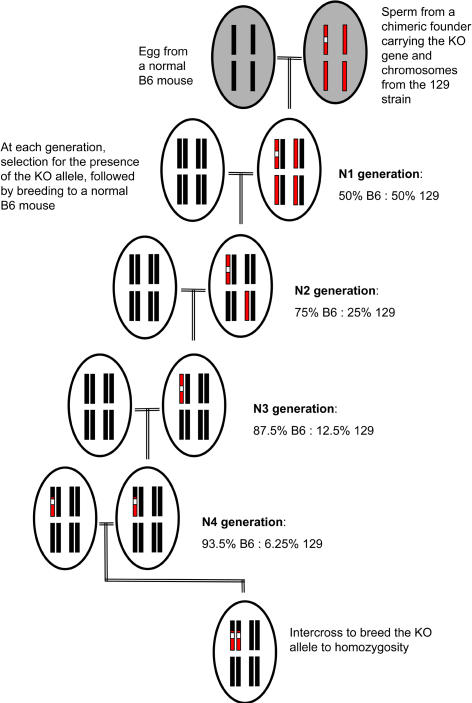
For clarity, only 4 of the 20 pairs of the mouse chromosomes are represented by black (B6) or red (129) bars. The KO allele is shown by a white box. Chimeric males are obtained from the integration of ES cells from the 129 strain that have been engineered to carry the KO allele to B6 blastocysts. These males are then bred to normal B6 females, resulting in an N1 progeny that is made up of 50% B6 and 50% 129 genome. N1 mice are subsequently “backcrossed” to B6, and their N2 progeny is selected for the presence of the KO allele. The contribution of 129 genome among the N2 progeny is normally distributed around a mean of 25%. This process can be repeated (shown here to N4), resulting in an average reduction of the 129 genome to one half of what it was in the previous generation. At any point in the process, homozygosity for the KO allele, which is necessary to prevent expression of that gene, can be obtained by intercrossing heterozygous mice, shown here at N4.
References
-
- Bickerstaff MCM, Botto M, Hutchinson WL, Herbert J, Tennent GA, et al. Serum amyloid P component controls chromatin degradation and prevents antinuclear autoimmunity. Nat Med. 1999;5:694–697. - PubMed
-
- Botto M, Dell'Agnola C, Bygrave AE, Thompson EM, Cook HT, et al. Homozygous C1q deficiency causes glomerulonephritis associated with multiple apoptotic bodies. Nat Genet. 1998;19:56–59. - PubMed
-
- Mestas J, Hughes CCW. Of mice and not men: Differences between mouse and human immunology. J Immunol. 2004;172:2731–2738. - PubMed
-
- Morahan G, Morel L. Genetics of autoimmunity in patients and models. Curr Opin Immunol. 2002;14:803–811. - PubMed
Publication types
MeSH terms
Substances
LinkOut - more resources
Full Text Sources
Other Literature Sources
Medical