


Prospective open-label study of add-on and monotherapy topiramate in civilians with chronic nonhallucinatory posttraumatic stress disorder
- PMID: 15315714
- PMCID: PMC516778
- DOI: 10.1186/1471-244X-4-24
Prospective open-label study of add-on and monotherapy topiramate in civilians with chronic nonhallucinatory posttraumatic stress disorder
Abstract
Background: In order to confirm therapeutic effects of topiramate on posttraumatic stress disorder (PTSD) observed in a prior study, a new prospective, open-label study was conducted to examine acute responses in chronic, nonhallucinatory PTSD.
Methods: Thirty-three consecutive newly recruited civilian adult outpatients (mean age 46 years, 85% female) with DSM-IV-diagnosed chronic PTSD, excluding those with concurrent auditory or visual hallucinations, received topiramate either as monotherapy (n = 5) or augmentation (n = 28). The primary measure was a change in the PTSD Checklist-Civilian Version (PCL-C) score from baseline to 4 weeks, with response defined as a >/= 30% reduction of PTSD symptoms.
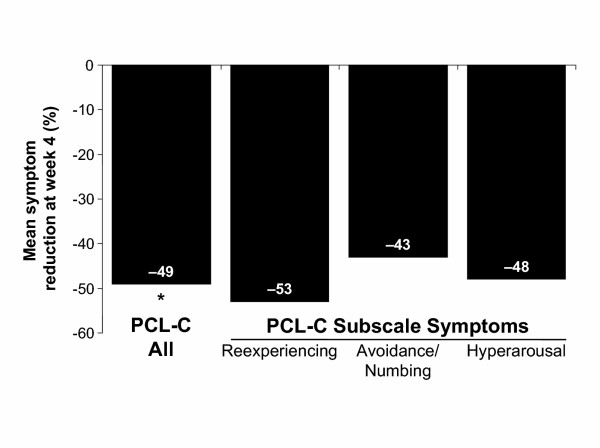
Results: For those taking the PCL-C at both baseline and week 4 (n = 30), total symptoms declined by 49% at week 4 (paired t-test, P < 0.001) with similar subscale reductions for reexperiencing, avoidance/numbing, and hyperarousal symptoms. The response rate at week 4 was 77%. Age, sex, bipolar comorbidity, age at onset of PTSD, duration of symptoms, severity of baseline PCL-C score, and monotherapy versus add-on medication administration did not predict reduction in PTSD symptoms. Median time to full response was 9 days and median dosage was 50 mg/day.
Conclusions: Promising open-label findings in a new sample converge with findings of a previous study. The use of topiramate for treatment of chronic PTSD, at least in civilians, warrants controlled clinical trials.
Figures
References
-
- Breslau N. The epidemiology of posttraumatic stress disorder: what is the extent of the problem? J Clin Psychiatry. 2001;62:16–22. - PubMed
-
- van der Kolk BA. The psychobiology of posttraumatic stress disorder. J Clin Psychiatry. 1997;58:16–24. - PubMed
-
- Berlant J. Antiepileptic treatment of posttraumatic stress disorder. Primary Psychiatry. 2003;10:41–49.
-
- Davidson JR. Biological therapies for posttraumatic stress disorder: an overview. J Clin Psychiatry. 1997;58:29–32. - PubMed
Publication types
MeSH terms
Substances
LinkOut - more resources
Full Text Sources
Medical
