


Stress, burnout and doctors' attitudes to work are determined by personality and learning style: a twelve year longitudinal study of UK medical graduates
- PMID: 15317650
- PMCID: PMC516448
- DOI: 10.1186/1741-7015-2-29
Stress, burnout and doctors' attitudes to work are determined by personality and learning style: a twelve year longitudinal study of UK medical graduates
Abstract
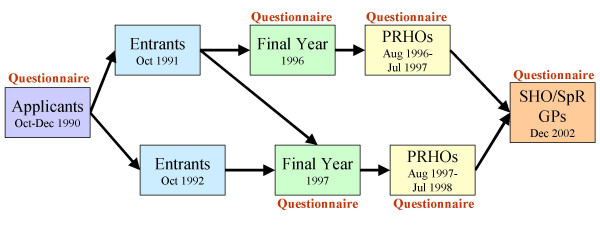
Background: The study investigated the extent to which approaches to work, workplace climate, stress, burnout and satisfaction with medicine as a career in doctors aged about thirty are predicted by measures of learning style and personality measured five to twelve years earlier when the doctors were applicants to medical school or were medical students.
Methods: Prospective study of a large cohort of doctors. The participants were first studied when they applied to any of five UK medical schools in 1990. Postal questionnaires were sent to all doctors with a traceable address on the current or a previous Medical Register. The current questionnaire included measures of Approaches to Work, Workplace Climate, stress (General Health Questionnaire), burnout (Maslach Burnout Inventory), and satisfaction with medicine as a career and personality (Big Five). Previous questionnaires had included measures of learning style (Study Process Questionnaire) and personality.
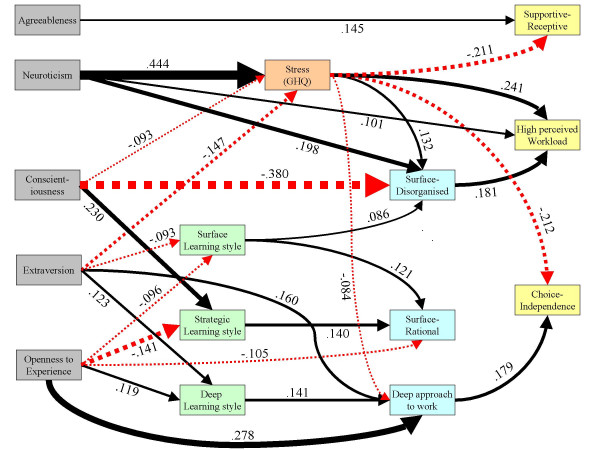
Results: Doctors' approaches to work were predicted by study habits and learning styles, both at application to medical school and in the final year. How doctors perceive their workplace climate and workload is predicted both by approaches to work and by measures of stress, burnout and satisfaction with medicine. These characteristics are partially predicted by trait measures of personality taken five years earlier. Stress, burnout and satisfaction also correlate with trait measures of personality taken five years earlier.
Conclusions: Differences in approach to work and perceived workplace climate seem mainly to reflect stable, long-term individual differences in doctors themselves, reflected in measures of personality and learning style.
Figures
References
-
- Osler W. Aequanimitas. 3. London: H K Lewis; 1932.
-
- Knapper CK. Approaches to study and lifelong learning: Some Canadian initiatives. In: Gibbs C, editor. In Improving student learning through assessment and evaluation. Oxford: Oxford Centre for Staff Development; 1995.
-
- Kirby JR, Knapper CK, Evans CJ, Carty AE, Gadula C. Approaches to learning at work and workplace climate. International Journal of Training and Development. 2003;7:31–52. doi: 10.1111/1468-2419.00169. - DOI
-
- Delva MD, Schultz K, Kirby J, Godwin M. Learning approaches in clerkship and residency: The effect of workplace climate. Submitted. 2003. - PubMed
Publication types
MeSH terms
LinkOut - more resources
Full Text Sources
