. 2004 Sep;137(3):559-65.
doi: 10.1111/j.1365-2249.2004.02550.x.

Decreased interferon-alpha production and impaired T helper 1 polarization by dendritic cells from patients with chronic hepatitis C

Affiliations

Decreased interferon-alpha production and impaired T helper 1 polarization by dendritic cells from patients with chronic hepatitis C

H Murakami et al. Clin Exp Immunol. 2004 Sep.

Abstract

Patients with chronic hepatitis C (CHC) are unable to prime and maintain vigorous T cell responses that are initiated during the acute phase of hepatitis C virus (HCV) infection. As dendritic cells (DCs) induce and regulate both innate and adaptive immune responses, the aim of this study was to analyse two critical functions of DCs: firstly, production of interferon (IFN)-alpha and, secondly, polarization of T helper 1 lymphocytes. The frequencies of plasmacytoid DC (PDC) and myeloid DC (MDC) were estimated in 63 patients with CHC and 34 normal controls using four-colour flow cytometry. Circulating DCs were isolated from peripheral blood of CHC patients (n = 10) and normal controls (n = 10). These DCs were cultured with herpes simplex virus-1 to evaluate their capacity to produce IFN-alpha. The capacity of DCs to induce polarization of autologous naive CD4(+) T lymphocytes to IFN-gamma-producing effector T lymphocytes was also assessed. The frequencies of PDCs producing intracellular IFN-alpha (P < 0.01) and the levels of IFN-alpha in culture supernatant of PDCs (P < 0.01) were significantly lower in patients with CHC compared to those of normal controls. The numbers of MDC were significantly lower in patients with CHC (8.2 (6.0)/ micro l, median (interquartile range), n = 63) compared to normal control (11.7 (7.8)/ micro l, n = 34) (P < 0.01). Moreover, DCs from patients with CHC induced significantly lower numbers of IFN-gamma-producing effector T lymphocytes compared to that of controls (P < 0.01). This study indicates that the low IFN-alpha-producing capacity and impaired T helper 1 polarization ability of DCs from patients with CHC might be responsible for the typical low anti-HCV immune responses in these patients.


Figures
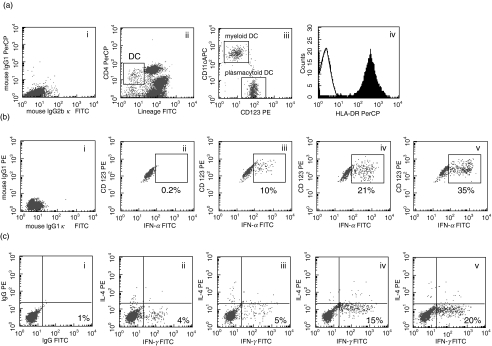
Fig. 1
Fig. 1
Flow cytometric profile showing the method of detection of circulating dendritic cells (DCs), myeloid DC and plasmacytoid DC. The flow cytometric profiles of isotype controls have been shown in part (i) of (a), (b) and (c). (i) Circulating DCs were detected as lineage negative and CD4+ lymphocytes of peripheral blood mononuclear cells (ii). Plasmacytoid DCs and myeloid DCs were enumerated by the expression of CD123 and CD11c on circulating DCs (iii). Circulating DCs expressed high levels of HLA-DR (iv). (b) Plasmacytoid DCs were stimulated with no HSV-1 (ii), 1 × 10⁵ (iii) 5 × 10⁵ (iv) and 1 × 10⁶ (v) plaque forming units/ml of HSV. DCs were then stained for intracellular IFN-α, as described in Method. Plasmacytoid DC expressing intracellular IFN-α showed a right shift in the histogram depending on the dose of HSV-1. (c) Intracellular expression of IFN-γ by CD4+ T lymphocytes due to stimulation of naïve CD4+ T cells with 1 × 10³ (iii) 3 × 10³ (iv) and 1 × 10⁴ (v) of DC or without DCs (ii). The culture was done for 7 days to evaluate the polarization of naïve CD4+ T lymphocytes by DCs. The numbers of IFN-γ-producing T lymphocytes increased as the amounts of DCs were increased in the cultures.
Fig. 2
Fig. 2
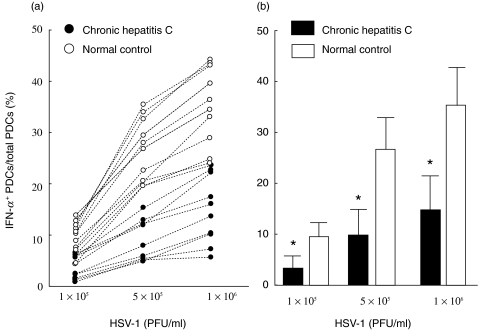
Impaired production of intracellular IFN-α in plasmacytoid DCs from patients with chronic hepatitis C due to stimulation with various doses of herpes simplex virus-1. The numbers of plasmacytoid DCs expressing IFN-α from individual normal control (○) and patient with chronic hepatitis C (•) are plotted in (A). Mean and standard deviation of the data of Figure in (a) is shown in (b). *P < 0·01 compared to normal controls.
Fig. 3
Fig. 3
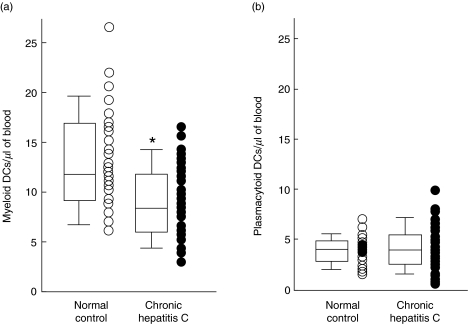
Decreased numbers of myeloid DC from patients with chronic hepatitis C. The numbers of myeloid DC and plasmacytoid DC from normal control (○) and patient with chronic hepatitis C (•) are plotted from the data of flow cytometric analysis. *P < 0·01.
Fig. 4
Fig. 4
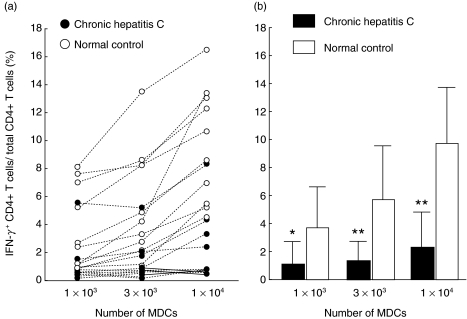
Decreased capacity of myeloid DCs from patients with chronic hepatitis C to induce Th1 polarization of naïve autologous CD4+ T cells. The ratio of IFN-γ-expressing CD4+ T lymphocytes to total CD4+ T lymphocytes represents the polarization of naïve CD4+ T lymphocytes to effector T lymphocytes due to stimulation with myeloid DC for 7 days. The frequencies of IFN-γ-expressing CD4+ T lymphocytes to total CD4+ T lymphocytes was adjusted according to the numbers of myeloid DCs (MDCs) in the culture. Individual data are shown in (a) and mean and standard deviation are shown in (b). *P < 0·05. **P < 0·01.

References

    1. Miller RM, Purcell RH. Hepatitis C virus shares amino acid sequence similarity with pestivirus and flavivirus as well as members of two plant virus supergroups. Proc Natl Acad Sci USA. 1990;87:2057–61. - PMC - PubMed
    1. Liang TJ, Seeff L, Hoofnagle JH. Pathogenesis, natural history, treatment and prevention of hepatitis C. Ann Intern Med. 2000;132:296–305. - PubMed
    1. Diepolder HM, Gerlach JT, Zachoval R, et al. Immunodominant CD4+ T-cell epitope within nonstructural protein 3 in acute hepatitis C virus infection. J Virol. 1997;71:6011–9. - PMC - PubMed
    1. Cooper S, Erickson AL, Adams EJ, et al. Analysis of a successful immune response against hepatitis C virus. Immunity. 1999;10:439–49. - PubMed
    1. Gerlach JT, Diepolder HM, Jung M-C, et al. Recurrence of hepatitis C virus after loss of virus-specific CD4+ T-cell response in acute hepatitis C. Gastroenterology. 1999;117:933–41. - PubMed

Substances