. 2004 Aug 31;101(35):13038-43.
doi: 10.1073/pnas.0405152101. Epub 2004 Aug 23.

Phosphorylation of hepatitis C virus nonstructural protein 5A modulates its protein interactions and viral RNA replication

Affiliations

Phosphorylation of hepatitis C virus nonstructural protein 5A modulates its protein interactions and viral RNA replication

Matthew J Evans et al. Proc Natl Acad Sci U S A. .

Abstract

The study of the hepatitis C virus (HCV) has been hindered by the lack of in vitro model systems. The recent development of HCV subgenomic RNA replicons has permitted the study of viral RNA replication in cell culture; however, the requirements for efficient replication of replicons in this system are poorly understood. Many viral isolates do not function as replicons and most require conserved changes, termed adaptive mutations, to replicate efficiently. In this report, we focus on the HCV nonstructural protein 5A (NS5A), a frequent locus for adaptive mutation. We found the interaction between NS5A and human vesicle-associated membrane protein-associated protein A (hVAP-A), a cellular target N-ethylmaleimide-sensitive factor attachment protein receptor, to be required for efficient RNA replication: NS5A mutations that blocked interaction with hVAP-A strongly reduced HCV RNA replication. Further analyses revealed an inverse correlation between NS5A phosphorylation and hVAP-A interaction. A subset of the previously identified adaptive mutations suppressed NS5A hyperphosphorylation and promoted hVAP-A binding. Our results support a model in which NS5A hyperphosphorylation disrupts interaction with hVAP-A and negatively regulates viral RNA replication, suggesting that replicon-adaptive mutations act by preventing the phosphorylation-dependent dissociation of the RNA replication complex.


Figures

Fig. 1.
Fig. 1.
Organization of the HCV genome/replicon. (A) Diagram of the HCV genomic RNA. (B) Structure of the HCV subgenomic replicon. The majority of the structural region of the polyprotein has been replaced with the neomycin phosphotransferase gene (Neo) such that translation is driven from the HCV internal ribosome entry site. Translation of the remaining NS proteins is conducted by the encephalomyocarditis virus internal ribosome entry site (EMCV). Position of the NS4B adaptive mutation K1846T is indicated by an asterisk. A bracket represents the location of the cluster of NS5A adaptive mutations (P2196S, S2197P, S2197C, A2199S, A2199T, and S2204I) and the hVAP-A binding determinants.
Fig. 2.
Fig. 2.
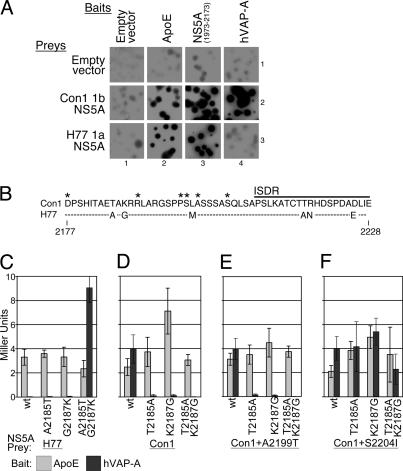
Identifying and mapping NS5A subtype-specific hVAP-A interaction determinants. (A) β-galactosidase filter lift assay of yeast transformed with the indicated yeast two-hybrid baits and preys. Interaction strength is proportional to colony color intensity. Empty DBD and AD fusion vectors control for reporter activation by protein fusions in the absence of a suitable partner. (B) Alignment of Con1 and H77 amino acids 2,177-2,228 encoding NS5A determinants for hVAP-A interaction. Differences between genotypes are indicated, and those unchanged are indicated by a dashed line. Positions of previously identified replicon adaptive mutations, shown as asterisks, and the beginning of the interferon sensitivity determining region (ISDR) are indicated. (C-F) Quantitative analysis of NS5A/hVAP-A interactions. Wild-type (wt) and hVAP-A-binding determinant mutant NS5A preys were assayed in yeast for interaction against baits containing either ApoE (light bars) or hVAP-A (dark bars). Reporter activation was quantified in Miller units by β-galactosidase liquid assay. (C) Assays with H77 1a NS5A preys. (D-F) Assays with Con1 1b NS5A preys, with either no adaptive mutation (D), the A2199T adaptive mutation (E), or the S2204I adaptive mutation (F).
Fig. 3.
Fig. 3.
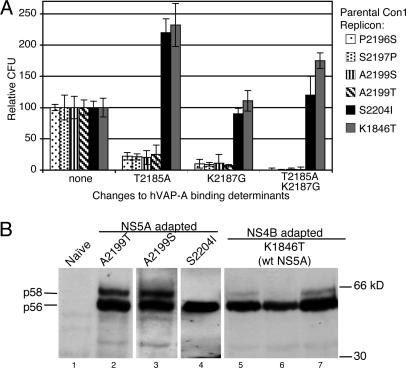
Analysis of effects of mutations in replicon system. (A) Various adapted Con1 replicons were constructed containing the 1a amino acids at positions 2,185 and 2,187. Huh7 cells electroporated with equivalent quantities of in vitro transcribed RNAs were selected with G418 for several weeks. Colony-forming units (CFU) have been normalized to that of the parental adapted replicon with wild-type hVAP-A-binding determinants. The adaptive mutation used in each data series is indicated by fill pattern. (B) Both the NS5A S2204I and NS4B K1846T adaptive mutations reduce NS5A hyperphosphorylation. G418 resistant clones transfected with the indicated adapted Con1 replicons were isolated and expanded. Total protein extracts from these cells were resolved by SDS/PAGE and Western blotted for NS5A. Molecular masses are labeled to the right, and the positions of the hypophosphorylated p56 and the hyperphosphorylated p58 NS5A species are indicated to the left. wt, wild-type.
Fig. 4.
Fig. 4.
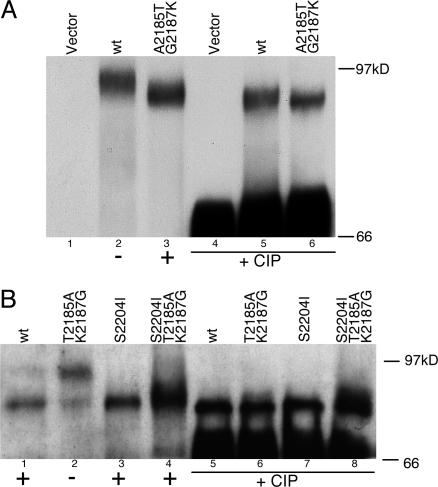
NS5A prey expression in yeast. NS5A immunoblots of total cell lysates from yeast expressing various NS5A preys. The capacity for each prey to interact with hVAP-A in the yeast two-hybrid system is indicated below each lane as a plus or minus sign. (A) Blot of H77 subtype 1a wild-type (wt) and mutant (interactor) NS5A preys, with or without CIP treatment. (B) Blot of Con1 subtype 1b NS5A preys with or without CIP treatment. Both wild-type and S2204I preys are shown without or with the hVAP-A noninteracting mutations.
Fig. 5.
Fig. 5.
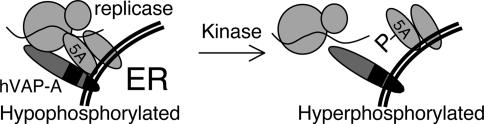
Model of NS5A phosphorylation modulating assembly of the HCV RNA replication complex. (Left) In the HCV RNA replicase, NS5A exists as a hypophosphorylated species capable of interacting with hVAP-A. (Right) NS5A hyperphosphorylation impairs hVAP-A interaction capacity, breaking apart this complex and allowing postRNA replication viral life cycle events to occur. ER, endoplasmic reticulum.

References

    1. World Health Organization (1999) J. Viral. Hepat. 6, 35-47.
    1. Bartenschlager, R. & Lohmann, V. (2000) J. Gen. Virol. 81, 1631-1648. - PubMed
    1. Lindenbach, B. D. & Rice, C. M. (2001) in Fields Virology, eds. Howley, P. M. & Knipe, D. M. (Lippincott-Raven, Philadelphia, PA), Vol. 1, pp. 991-1041.
    1. Lohmann, V., Korner, F., Koch, J. O., Herian, U., Theilmann, L. & Bartenschlager, R. (1999) Science 285, 110-113. - PubMed
    1. Robertson, B., Myers, G., Howard, C., Brettin, T., Bukh, J., Gaschen, B., Gojobori, T., Maertens, G., Mizokami, M., Nainan, O., et al. (1998) Arch. Virol. 143, 2493-2503. - PubMed

Publication types

LinkOut - more resources