


The myeloperoxidase product hypochlorous acid oxidizes HDL in the human artery wall and impairs ABCA1-dependent cholesterol transport
- PMID: 15326314
- PMCID: PMC516512
- DOI: 10.1073/pnas.0405292101
The myeloperoxidase product hypochlorous acid oxidizes HDL in the human artery wall and impairs ABCA1-dependent cholesterol transport
Abstract
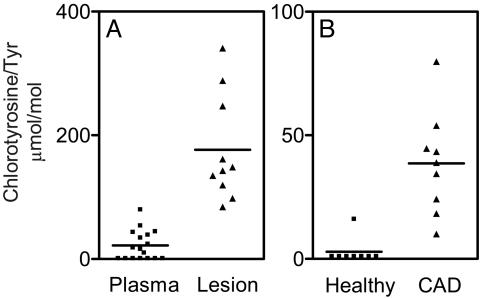
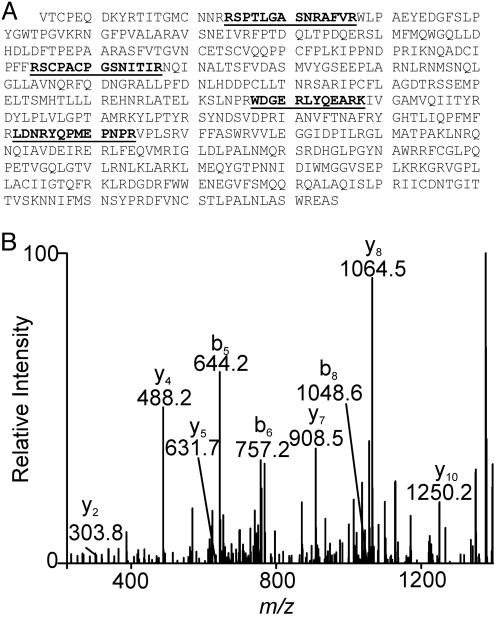
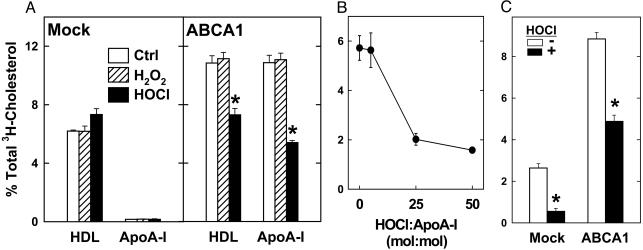
Although oxidatively damaged lipoproteins are implicated in vascular injury, there is little information regarding the role of high-density lipoprotein (HDL) oxidation in atherogenesis. One potential pathway involves hypochlorous acid (HOCl) produced by myeloperoxidase (MPO), a heme protein secreted by phagocytes. We previously showed that 3-chlorotyrosine is a specific product of HOCl. Therefore, to explore the role of oxidized HDL in the pathogenesis of vascular disease, we used MS to quantify 3-chlorotyrosine in HDL isolated from plasma and atherosclerotic tissue. HDL from human aortic atherosclerotic intima had an 8-fold higher level of 3-chlorotyrosine than plasma HDL. Tandem MS analysis identified MPO as a component of lesion HDL, suggesting that the two interact in the artery wall. Moreover, immunohistochemical studies found that specific epitopes derived from HOCl colocalized with apolipoprotein A-I, the major protein of HDL. These observations strongly support the hypothesis that MPO promotes HDL oxidation in the human artery wall. Levels of 3-chlorotyrosine were elevated in HDL isolated from the blood of humans with established coronary artery disease, suggesting that circulating levels of oxidized HDL represent a unique marker for clinically significant atherosclerosis. HDL or lipid-free apolipoprotein A-I exposed to HOCl was less able to remove cholesterol from cultured cells by a pathway requiring the cell membrane transporter ATP-binding cassette transporter A1. The detection of 3-chlorotyrosine in HDL isolated from vascular lesions raises the possibility that MPO, by virtue of its ability to form HOCl, may promote atherogenesis by counteracting the established antiatherogenic effects of HDL and the ATP-binding cassette transporter A1 pathway.
Copyright 2004 The National Academy of Sciencs of the USA
Figures


References
-
- Miller, N. E., Thelle, D. S., Forde, O. H. & Mjos, O. D. (1977) Lancet 1, 965-968. - PubMed
-
- Keys, A. (1980) Lancet 2, 603-606. - PubMed
-
- Oram, J. F. & Yokoyama, S. (1996) J. Lipid Res. 37, 2473-2491. - PubMed
-
- Rothblat, G. H., de la Llera-Moya, M., Atger, V., Kellner-Weibel, G., Williams, D. L. & Phillips, M. C. (1999) J. Lipid Res. 40, 781-796. - PubMed
-
- Brooks-Wilson, A., Marcil, M., Clee, S. M., Zhang, L. H., Roomp, K., van Dam, M., Yu, L., Brewer, C., Collins, J. A., Molhuizen, H. O., et al. (1999) Nat. Genet. 22, 336-345. - PubMed
Publication types
MeSH terms
Substances
Grants and funding
- R01 HL055362/HL/NHLBI NIH HHS/United States
- P01 HL018645/HL/NHLBI NIH HHS/United States
- HL18645/HL/NHLBI NIH HHS/United States
- R01 AG021191/AG/NIA NIH HHS/United States
- P01 HL030086/HL/NHLBI NIH HHS/United States
- HL34343/HL/NHLBI NIH HHS/United States
- DK02456/DK/NIDDK NIH HHS/United States
- HL030086/HL/NHLBI NIH HHS/United States
- ES07033/ES/NIEHS NIH HHS/United States
- HL073996/HL/NHLBI NIH HHS/United States
- HL64344/HL/NHLBI NIH HHS/United States
- R01 HL064344/HL/NHLBI NIH HHS/United States
- P50 HL073996/HL/NHLBI NIH HHS/United States
- P30 ES007033/ES/NIEHS NIH HHS/United States
- P01 DK002456/DK/NIDDK NIH HHS/United States
- HL55362/HL/NHLBI NIH HHS/United States
- AG021191/AG/NIA NIH HHS/United States
- R01 HL075381/HL/NHLBI NIH HHS/United States
- HL75381/HL/NHLBI NIH HHS/United States
- P01 HL034343/HL/NHLBI NIH HHS/United States
LinkOut - more resources
Full Text Sources
Other Literature Sources
Medical
Research Materials
Miscellaneous
