


Screening and characterization of mutations in isoniazid-resistant Mycobacterium tuberculosis isolates obtained in Brazil
- PMID: 15328099
- PMCID: PMC514764
- DOI: 10.1128/AAC.48.9.3373-3381.2004
Screening and characterization of mutations in isoniazid-resistant Mycobacterium tuberculosis isolates obtained in Brazil
Abstract
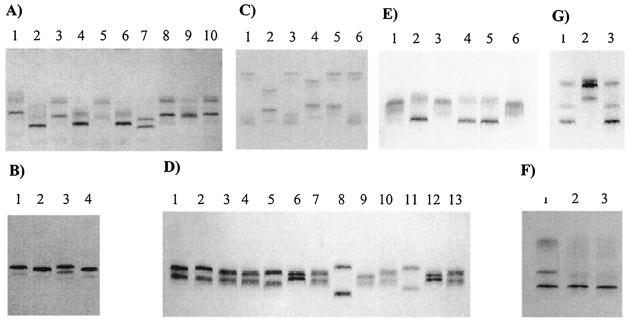
We investigated mutations in the genes katG, inhA (regulatory and structural regions), and kasA and the oxyR-ahpC intergenic region of 97 isoniazid (INH)-resistant and 60 INH-susceptible Mycobacterium tuberculosis isolates obtained in two states in Brazil: São Paulo and Paraná. PCR-single-strand conformational polymorphism (PCR-SSCP) was evaluated for screening mutations in regions of prevalence, including codons 315 and 463 of katG, the regulatory region and codons 16 and 94 of inhA, kasA, and the oxyR-ahpC intergenic region. DNA sequencing of PCR amplicons was performed for all isolates with altered PCR-SSCP profiles. Mutations in katG were found in 83 (85.6%) of the 97 INH-resistant isolates, including mutations in codon 315 that occurred in 60 (61.9%) of the INH-resistant isolates and 23 previously unreported katG mutations. Mutations in the inhA promoter region occurred in 25 (25.8%) of the INH-resistant isolates; 6.2% of the isolates had inhA structural gene mutations, and 10.3% had mutations in the oxyR-ahpC intergenic region (one, nucleotide -48, previously unreported). Polymorphisms in the kasA gene occurred in both INH-resistant and INH-susceptible isolates. The most frequent polymorphism encoded a G(269)A substitution. Although KatG(315) substitutions are predominant, novel mutations also appear to be responsible for INH resistance in the two states in Brazil. Since ca. 90.7% of the INH-resistant isolates had mutations identified by SSCP electrophoresis, this method may be a useful genotypic screen for INH resistance.
Figures
References
-
- Banerjee, A., E. Dubnal, A. Quemard, V. Balasubramanian, K. S. Um, T. Wilson, D. Collins, G. Lisle, and W. R. Jacobs. 1994. inhA, a gene encoding a target for isoniazid and ethionamide in Mycobacterium tuberculosis. Science 263:227-230. - PubMed
-
- Bardou, F., C. Raynaud, C. Ramos, M. A. Laneele, and G. Laneele. 1998. Mechanism of isoniazid uptake in Mycobacterium tuberculosis. Microbiology 144:2539-2544. - PubMed
-
- Basso, L. A., R. Zheng, J. M. Musser, W. R. Jacobs, Jr., and J. S. Blanchard. 1998. Mechanisms of isoniazid resistance in Mycobacterium tuberculosis: enzymatic characterization of enoyl reductase mutants identified in isoniazid-resistant clinical isolates. J. Infect. Dis. 178:769-775. - PubMed
-
- Canetti, G., N. Rist, and J. Grosset. 1963. Mésure de la sensibilité du bacilli tuberculeux aux drogues antibacilares par la méthode des proportions. Rev. Tuberc. Pneumol. 27:217-272. - PubMed
-
- Cockerill, F. R., III, J. R. Uhl, Z. Temesgen, Y. Zhang, L. Stockman, G. D. Roberts, D. L. Williams, and B. C. Kline. 1995. Rapid identification of a point mutation of the Mycobacterium tuberculosis catalase-peroxidase (katG) gene associated with isoniazid resistance. J. Infect. Dis. 171:240-245. - PubMed
Publication types
MeSH terms
Substances
LinkOut - more resources
Full Text Sources
Medical
