. 2004 Sep;2(9):E258.
doi: 10.1371/journal.pbio.0020258. Epub 2004 Aug 24.

Interdependency of brassinosteroid and auxin signaling in Arabidopsis

Affiliations

Interdependency of brassinosteroid and auxin signaling in Arabidopsis

Jennifer L Nemhauser et al. PLoS Biol. 2004 Sep.

Abstract

How growth regulators provoke context-specific signals is a fundamental question in developmental biology. In plants, both auxin and brassinosteroids (BRs) promote cell expansion, and it was thought that they activated this process through independent mechanisms. In this work, we describe a shared auxin:BR pathway required for seedling growth. Genetic, physiological, and genomic analyses demonstrate that response from one pathway requires the function of the other, and that this interdependence does not act at the level of hormone biosynthetic control. Increased auxin levels saturate the BR-stimulated growth response and greatly reduce BR effects on gene expression. Integration of these two pathways is downstream from BES1 and Aux/IAA proteins, the last known regulatory factors acting downstream of each hormone, and is likely to occur directly on the promoters of auxin:BR target genes. We have developed a new approach to identify potential regulatory elements acting in each hormone pathway, as well as in the shared auxin:BR pathway. We show that one element highly overrepresented in the promoters of auxin- and BR-induced genes is responsive to both hormones and requires BR biosynthesis for normal expression. This work fundamentally alters our view of BR and auxin signaling and describes a powerful new approach to identify regulatory elements required for response to specific stimuli.


Conflict of interest statement

The authors have declared that no conflicts of interest exist.

Figures
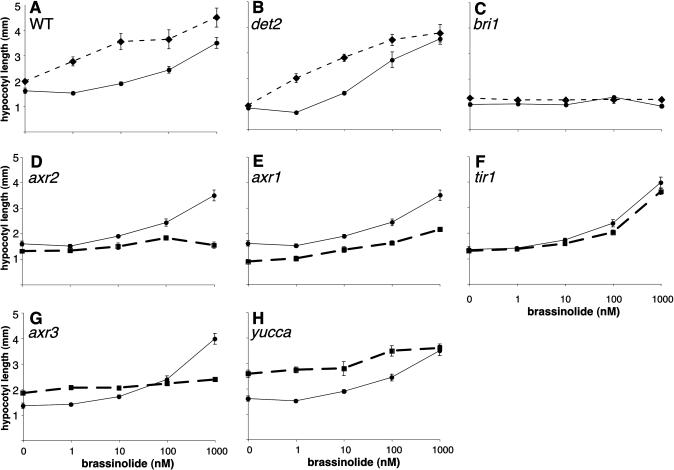
Figure 1
Figure 1. BR and Auxin Pathways Are Interdependent, as Measured by Hypocotyl Elongation
(A) Mild temperature elevation causes elongation of the hypocotyl and BR hypersensitivity in WT plants. Columbia ecotype is shown but results are similar for Wassilewskija. Hypocotyls of 3-d-old plants grown at either 26 °C (diamonds, dashed line) or 22 °C (circles, solid line) were measured. (B) det2-1 plants are defective in BR biosynthesis and are also insensitive to the temperature increase. As the det2 deficiency is rescued by exogenous BL, temperature sensitivity is restored. (C) Plants with the weak bri1-5 mutation are insensitive both to temperature and exogenous BR. (D–H) BR response depends upon auxin response. WT is shown in circles with a solid thin line and mutants are shown in squares with a thick dashed line. Known auxin response mutants axr2-1 (D), axr1-12 (E), tir1-1 (F), and axr3-1 (G) have decreased BR response. (F) tir1 has no hypocotyl elongation phenotype in the absence of exogenous hormone treatment and only very modest effects on BR sensitivity. Response is significantly reduced in tir1 mutants at 100 nM BL, as measured by Student's t-test (p = 0.03, using Bonferroni adjustment for multiple tests; Hochberg 1988). (H) yucca plants, which overproduce auxin, also show reduced BR response. Error bars represent standard error. Data in (F) and (G) were collected in a separate experiment from other panels, resulting in small differences in the values for WT hypocotyl length.
Figure 2
Figure 2. Enhanced Hypocotyl Elongation of yucca Mutants Requires Functional BRI1
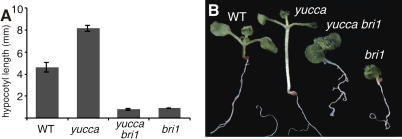
(A) Average hypocotyl lengths of 3-d-old plants. Error bars represent standard error. (B) Ten-day-old WT, yucca, yucca bri1-116, and bri-116 seedlings.
Figure 3
Figure 3. BR and Auxin Have Shared Genomic Effects
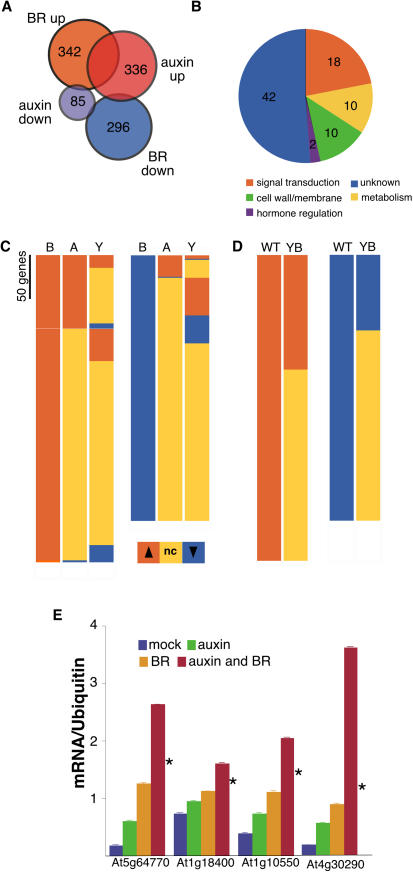
(A) Venn diagram showing relative proportion of BR- and auxin-responsive genes and the degree of overlap. (B) Functional categories of BR–auxin shared genes reveal a potential growth signature. (C and D) Effects of auxin on BR-regulated gene expression. Transcripts which show elevated levels are shown in orange, those with decreased levels are shown in blue, and those transcripts whose levels are not changed are shown in yellow. (C) Relative ratios were derived from the following comparisons (from left to right): BR versus mock treatment (WT plants; B), auxin versus mock treatment (WT plants; A), and yucca versus WT (Y). The three columns to the left are BR-upregulated genes and the three columns to the right are BR-downregulated genes. Among the BR-upregulated genes, there are a large number that are also induced by auxin treatment or in a yucca background. Few BR-repressed genes are repressed by auxin. nc, no change. (D) Effect of BR treatment in yucca background. Relative ratios represent BR versus mock treatment in WT plants (WT) or in yucca mutants (YB). Approximately two-thirds of BR-regulated genes were not affected by BR treatment of yucca plants. (E) Quantitative PCR shows that shared target genes are synergistically induced when treated with both auxin and BRs. At5g64770 encodes a protein with unknown function. At1g18400 encodes BEE1, a bHLH-containing protein known to be required for the BR response (Friedrichsen et al. 2002). At1g10550 and At4g30290 are putative endoxyloglucan transferases. Asterisks indicate response under an additive model.
Figure 4
Figure 4. Endogenous BR Levels Affect Expression of an Auxin-Responsive Reporter but Do Not Induce Aux/IAA Protein Turnover
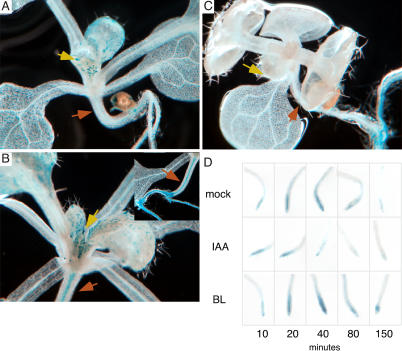
(A) WT, (B) det2, and (C) DW4FOX plants carrying the DR5::GUS transgene. (A) GUS staining is particularly strong in young leaves (yellow arrow). (B) det2 plants show no GUS staining in aerial tissues. (C) DWF4OX plants show increased intensity of staining, particularly at the tips of emerging leaves (yellow arrow) and in the hypocotyl (orange arrows). Inset shows hypocotyl-root junction. (D) Aux/IAA stability does not appear to be affected by treatment with BRs. Plants carrying a heat shock–inducible fusion of the N-terminal portion of AXR3 and GUS reporter were subjected to 2 h at 37 °C and then treated with mock or hormone treatments for the time periods listed.
Figure 5
Figure 5. A Model of BR–Auxin Interaction
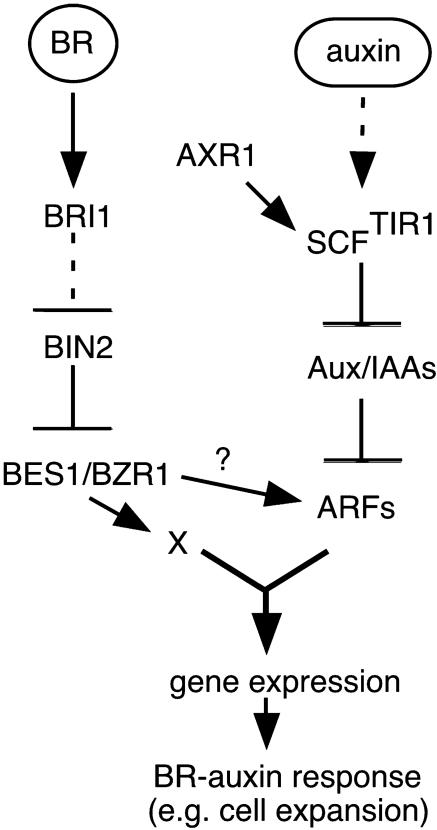
Auxin and BR signals are likely integrated on promoters of shared target genes. The node(s) of intersection between auxin and BR pathways must be downstream of BES1 and Aux/IAAs and upstream of gene expression. One likely mechanism is via regulation of transcriptional complexes, such as those containing the ARFs.

References

    1. Abel S, Nguyen MD, Theologis A. The PS-IAA4/5-like family of early auxin-inducible mRNAs in Arabidopsis thaliana . J Mol Biol. 1995;251:533–549. - PubMed
    1. Alonso JM, Ecker JR. Sci STKE 2001: RE1; 2001. The ethylene pathway: A paradigm for plant hormone signaling and interaction. - PubMed
    1. Bailey TL, Elkan C. The value of prior knowledge in discovering motifs with MEME. Proc Int Conf Intell Syst Mol Biol. 1995;3:21–29. - PubMed
    1. Bouquin T, Meier C, Foster R, Nielsen ME, Mundy J. Control of specific gene expression by gibberellin and brassinosteroid. Plant Physiol. 2001;127:450–458. - PMC - PubMed
    1. Clay NK, Nelson T. VH1, a provascular cell-specific receptor kinase that influences leaf cell patterns in Arabidopsis . Plant Cell. 2002;14:2707–2722. - PMC - PubMed

Publication types

MeSH terms