. 2004 Aug 26;430(7003):1053-8.
doi: 10.1038/nature02836.

Structural rearrangements in the membrane penetration protein of a non-enveloped virus

Affiliations

Structural rearrangements in the membrane penetration protein of a non-enveloped virus

Philip R Dormitzer et al. Nature. .

Abstract

Non-enveloped virus particles (those that lack a lipid-bilayer membrane) must breach the membrane of a target host cell to gain access to its cytoplasm. So far, the molecular mechanism of this membrane penetration step has resisted structural analysis. The spike protein VP4 is a principal component in the entry apparatus of rotavirus, a non-enveloped virus that causes gastroenteritis and kills 440,000 children each year. Trypsin cleavage of VP4 primes the virus for entry by triggering a rearrangement that rigidifies the VP4 spikes. We have determined the crystal structure, at 3.2 A resolution, of the main part of VP4 that projects from the virion. The crystal structure reveals a coiled-coil stabilized trimer. Comparison of this structure with the two-fold clustered VP4 spikes in a approximately 12 A resolution image reconstruction from electron cryomicroscopy of trypsin-primed virions shows that VP4 also undergoes a second rearrangement, in which the oligomer reorganizes and each subunit folds back on itself, translocating a potential membrane-interaction peptide from one end of the spike to the other. This rearrangement resembles the conformational transitions of membrane fusion proteins of enveloped viruses.


Figures

Figure 1
Figure 1
Rotavirus virion structure, VP4 domains and fragments. a, The icosahedral virion has three layers: an inner VP2 layer, which contains the genome, polymerase and capping enzyme; a middle VP6 layer; and an outer VP7 layer. To initiate infection, a 710 Å diameter subviral particle, consisting of the inner two layers and their contents, is delivered into the cytoplasm. Head (H), body (B), stalk (S) and foot (F) regions of the VP4 spikes are indicated. The approximate two-fold axis of the head and body does not correspond to any icosahedral symmetry axis. The protruding portion of the spike is within the icosahedral asymmetric unit. The drawing is based on an electron cryomicroscopy image reconstruction. b, Diagram illustrating the VP8* (residues M1–R231) and VP5* (A248–L776) fragments, produced by priming virions with trypsin; the VP5CT fragment (A248–L525 to F528), produced by serially digesting soluble VP4 with chymotrypsin and trypsin; and the VP8* core domain (L65–L224).
Figure 2
Figure 2
VP5CT structure. a, Ribbon diagram of VP5CT. The trimer stands 84 Å high with a 37 Å maximum radius. The green and blue subunits depict residues I254–D519; the yellow subunit depicts residues E252–L517. Int, integrin-binding motif; MI, potential membrane interaction (F′ G) loop. b, Ribbon diagram of a single VP5CT subunit (I254–L523). The colours of the secondary structure elements match those in e. c, The VP5CT surface oriented as in a and coloured by electrostatic potential: blue, positive; red, negative. Surfaces formed by residues selected in neutralizing antibody escape mutants (Supplementary Table 1) are labelled with residue numbers coloured by epitope in black text boxes: 5-1, yellow; 5-2, white; 5-3, green; 5-4, pink; 5-5, orange. I254, L517 and D519 mark N- and C termini of the depicted subunits. D308, G309 and E310 form the integrin-binding motif at the tip of the claw-like CD hairpin. d, The VP5CT surface, coloured as in c and viewed along the three-fold symmetry axis from the bottom. Surfaces formed by hydrophobic residues at the apex of the globular domain are labelled on the upper-left subunit. e, Secondary structure assigned to the RRV primary amino acid sequence.β-strands are arrows; the α-helix is a tube. Variable secondary structure at the N- and C termini is indicated by dashed outlines. Blue letters indicate neutralization escape mutations; escape mutations in strain RRV are boxed. The green underline identifies the integrin-binding motif. The red underline identifies the potential membrane interaction loop. Residues that make hydrophobic contacts around the three-fold axis of the coiled-coil are indicated by ‘a’ or ‘d’, corresponding to heptad repeat positions.
Figure 3
Figure 3
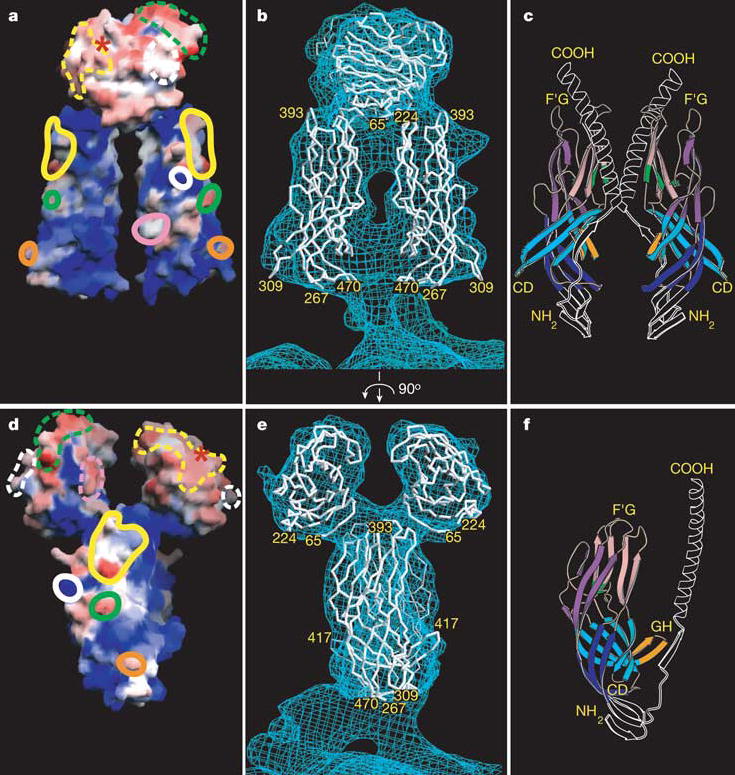
The VP5* antigen domain and the VP8* core fit to an electron cryomicroscopy image reconstruction. Each model in df is rotated 90° about a vertical axis relative to the corresponding model in ac. a, d, Surface models oriented as in the spike. The surfaces are coloured by conservation in 20 P genotypes (sequences referenced in Supplementary Table 2): blue, conserved; red, variable. Neutralization epitopes are outlined: 5-1, solid yellow; 5-2, solid white; 5-3, solid green; 5-4, solid pink; 5-5, solid orange; 8-1, dashed yellow; 8-2, dashed white; 8-3, dashed green; 8-4, dashed pink. VP8* epitopes and the sialoside-binding site (red asterisk) have been described previously. b, e, Cα traces of the VP8* core and VP5* antigen domain fit to an image reconstruction of trypsinized virions at ~12 Å resolution, contoured at 0.45σ. Labelled residues: 65 and 224, VP8* core termini; 267 and 470, VP5* antigen domain termini; 309, glycine of the DGE integrin-binding motif (CD loop); 393, immunodominant site in the potential membrane interaction (F′ G) loop; 417, tip of the GH hairpin. c, f, Ribbon diagrams of the VP5CT subunit, with the antigen domain oriented to fit the spike body. The antigen domain is coloured to match Fig. 2b. Residues outside the antigen domain, which must fold differently in the spike, are drawn in white outline.
Figure 4
Figure 4
Model for VP4 rearrangements during priming and entry. The colours in the cartoon (ac) match those in the linear diagram (d). The VP7 shell is blue. a, Uncleaved state. The wavy lines indicate flexibility. b, Trypsin-primed state. The activation region (brown in a) between VP8* and VP5* has been removed by digestion. Two clustered molecules form the visible spike. The head is the yellow oval (the VP8* core), notched at the sialoside-binding cleft. The body includes the red ‘kidney’ (the VP5* antigen domain), the orange cap (the potential membrane interaction loop), the purple appendage, and part of the grey and cyan tubes. The stalk is the lower part of the cyan tubes. The foot is the green hexagonal prism. c, Folded-back state. This state corresponds to the VP5CT crystal structure and may form during membrane penetration. The dashed blue line indicates potential loss of VP7. d, Linear diagram of structural elements. The VP8* and VP5* fragments are in black boxes. Grey, residues M1–V64; yellow, L65–L224; pink, P225–R231; brown, N232–R247; purple, A248–Q266; red, Y267–T381 and A401–L470; orange, G382–G400; cyan, I471–unknown; green, unknown–L776.

References

    1. Parashar UD, Hummelman EG, Bresee JS, Miller MA, Glass RI. Global illness and deaths caused by rotavirus disease in children. Emerg Infect Dis. 2003;9:565–572. - PMC - PubMed
    1. Crawford SE, et al. Trypsin cleavage stabilizes the rotavirus VP4 spike. J Virol. 2001;75:6052–6061. - PMC - PubMed
    1. Ruigrok RW, et al. Studies on the structure of the influenza virus haemagglutinin at the pH of membrane fusion. J Gen Virol. 1988;69:2785–2795. - PubMed
    1. Weissenhorn W, et al. The ectodomain of HIV-1 env subunit gp41 forms a soluble, alpha-helical, rod-like oligomer in the absence of gp120 and the N-terminal fusion peptide. EMBO J. 1996;15:1507–1514. - PMC - PubMed
    1. Modis Y, Ogata S, Clements D, Harrison SC. Structure of the dengue virus envelope protein after membrane fusion. Nature. 2004;427:313–319. - PubMed

Publication types

MeSH terms

Associated data