Can attention selectively bias bistable perception? Differences between binocular rivalry and ambiguous figures
- PMID: 15330700
- PMCID: PMC1403736
- DOI: 10.1167/4.7.2
Can attention selectively bias bistable perception? Differences between binocular rivalry and ambiguous figures
Abstract
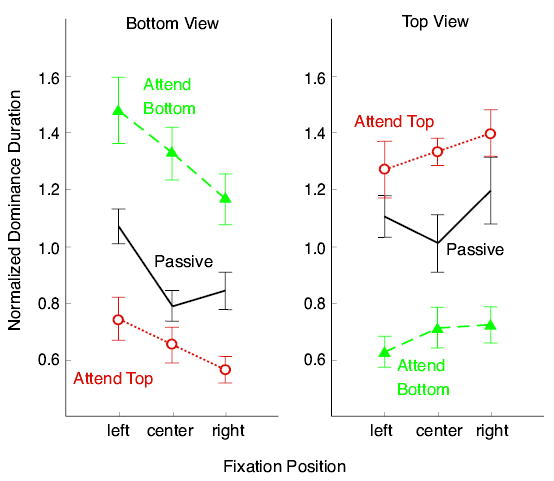
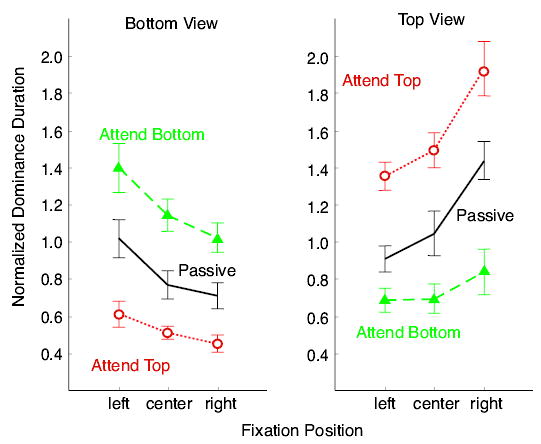
It is debated whether different forms of bistable perception result from common or separate neural mechanisms. Binocular rivalry involves perceptual alternations between competing monocular images, whereas ambiguous figures such as the Necker cube lead to alternations between two possible pictorial interpretations. Previous studies have shown that observers can voluntarily control the alternation rate of both rivalry and Necker cube reversal, perhaps suggesting that bistable perception results from a common mechanism of top-down selection. However, according to the biased competition model of selective attention, attention should be able to enhance the attended percept and suppress the unattended percept. Here, we investigated selective attentional modulation of dominance durations in bistable perception. Observers consistently showed much weaker selective attentional control for rivalry than for Necker cube reversal, even for rivalry displays that maximized the opportunities for feature-, object-, or space-based attentional selection. In contrast, nonselective control of alternation rate was comparably strong for both forms of bistable perception and corresponded poorly with estimates of selective attentional control. Our results support the notion that binocular rivalry involves a more automatic, stimulus-driven form of visual competition than Necker cube reversal, and as a consequence, is less easily biased by selective attention.
Figures




References
-
- Blake R. A neural theory of binocular rivalry. Psychological Review. 1989;96:145–167. [PubMed] - PubMed
-
- Blake R. A primer on binocular rivalry, including current controversies. Brain & Mind. 2001;2:5–38.
-
- Blake R, Logothetis NK. Visual competition. Nature Reviews Neuroscience. 2002;3:13–21. [PubMed] - PubMed
-
- Blake R, Westendorf DH, Overton R. What is suppressed during binocular rivalry? Perception. 1980;9:223–231. [PubMed] - PubMed
-
- Bossink CJ, Stalmeier PF, De Weert CM. A test of Levelt’s second proposition for binocular rivalry. Vision Research. 1993;33:1413–1419. [PubMed] - PubMed
Publication types
MeSH terms
Grants and funding
LinkOut - more resources
Full Text Sources