


VP16-dependent association of chromatin-modifying coactivators and underrepresentation of histones at immediate-early gene promoters during herpes simplex virus infection
- PMID: 15331701
- PMCID: PMC515004
- DOI: 10.1128/JVI.78.18.9689-9696.2004
VP16-dependent association of chromatin-modifying coactivators and underrepresentation of histones at immediate-early gene promoters during herpes simplex virus infection
Abstract
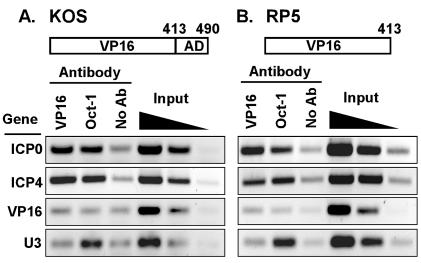
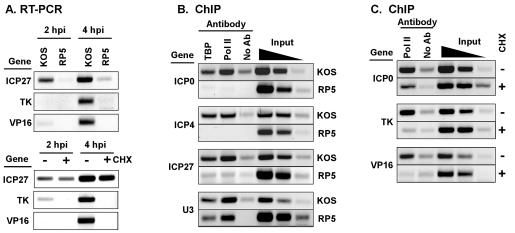
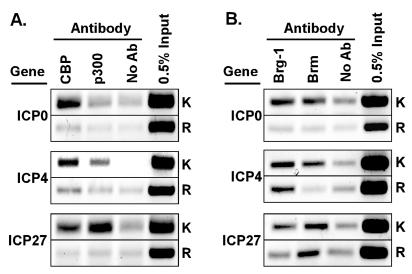
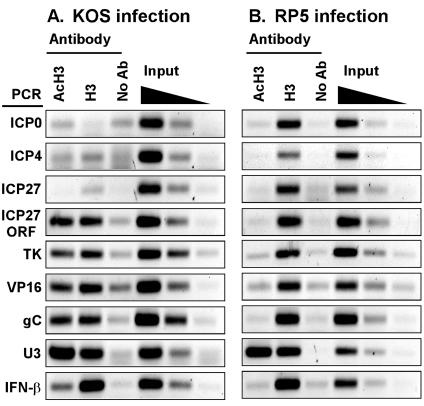
During infection by herpes simplex virus type 1 (HSV-1), the virion protein VP16 activates the transcription of viral immediate-early (IE) genes. Genetic and biochemical assays have shown that the potent transcriptional activation domain of VP16 can associate with general transcription factors and with chromatin-modifying coactivator proteins of several types. The latter interactions are particularly intriguing because previous reports indicate that HSV-1 DNA does not become nucleosomal during lytic infection. In the present work, chemical cross-linking and immunoprecipitation assays were used to probe the presence of activators, general transcription factors, and chromatin-modifying coactivators at IE gene promoters during infection of HeLa cells by wild-type HSV-1 and by RP5, a viral strain lacking the VP16 transcriptional activation domain. The presence of VP16 and Oct-1 at IE promoters did not depend on the activation domain. In contrast, association of RNA polymerase II, TATA-binding protein, histone acetyltransferases (p300 and CBP), and ATP-dependent remodeling proteins (BRG1 and hBRM) with IE gene promoters was observed in wild-type infections but was absent or reduced in cells infected by RP5. In contrast to the previous evidence for nonnucleosomal HSV-1 DNA, histone H3 was found associated with viral DNA at early times of infection. Interestingly, histone H3 was underrepresented on IE promoters in a manner dependent on the VP16 activation domain. Thus, the VP16 activation domain is responsible for recruiting general transcription factors and coactivators to IE promoters and also for dramatically reducing the association of histones with those promoters.
Copyright 2004 American Society for Microbiology
Figures
References
-
- Barlev, N. A., R. Candau, L. Wang, P. Darpino, N. Silverman, and S. L. Berger. 1995. Characterization of physical interactions of the putative transcriptional adaptor, ADA2, with acidic activation domains and TATA-binding protein. J. Biol. Chem. 270:19337-19344. - PubMed
-
- Berger, S. L., B. Pina, N. Silverman, G. A. Marcus, J. Agapite, J. L. Regier, S. J. Triezenberg, and L. Guarente. 1992. Genetic isolation of ADA2: a potential transcriptional adaptor required for function of certain acidic activation domains. Cell 70:251-265. - PubMed
-
- Boeger, H., J. Griesenbeck, J. S. Strattan, and R. D. Kornberg. 2003. Nucleosomes unfold completely at a transcriptionally active promoter. Mol. Cell 11:1587-1598. - PubMed
-
- Brown, C. E., T. Lechner, L. Howe, and J. L. Workman. 2000. The many HATs of transcription coactivators. Trends Biochem. Sci. 25:15-19. - PubMed
Publication types
MeSH terms
Substances
Grants and funding
LinkOut - more resources
Full Text Sources
Other Literature Sources
Miscellaneous
