. 2004 Sep;78(18):9798-806.
doi: 10.1128/JVI.78.18.9798-9806.2004.

NSs protein of Rift Valley fever virus blocks interferon production by inhibiting host gene transcription

Affiliations

NSs protein of Rift Valley fever virus blocks interferon production by inhibiting host gene transcription

Agnès Billecocq et al. J Virol. 2004 Sep.

Abstract

Rift Valley fever virus (RVFV) is an important cause of epizootics and epidemics in Africa and a potential agent of bioterrorism. A better understanding of the factors that govern RVFV virulence and pathogenicity is required, given the urgent need for antiviral therapies and safe vaccines. We have previously shown that RVFV strains with mutations in the NSs gene are excellent inducers of alpha/beta interferon (IFN-alpha/beta) and are highly attenuated in mice. Here, we demonstrate that NSs is sufficient to block IFN-beta gene expression at the transcriptional level. In cells transiently expressing NSs, IFN-beta transcripts were not inducible by viral infection or by transfection of poly(I:C). NSs with anti-IFN activity accumulated in the nucleus. In contrast, mutant forms of NSs that had lost their IFN-inhibiting activity remained in the cytoplasm, indicating that nuclear localization plays a role. IFN synthesis is regulated by specific transcription factors, including interferon regulatory factor (IRF-3), NF-kappaB, and AP-1. In the presence of NSs, IRF-3 was still activated and moved to the nucleus. Likewise, NF-kappaB and AP-1 were activated normally, as shown in electrophoretic mobility shift assays. Moreover, NSs was found to inhibit transcriptional activity of a constitutive promoter, in agreement with recent findings showing that NSs targets the basal cellular transcription factor TFIIH. The present results suggest that NSs, unlike other viral IFN antagonists, does not inhibit IFN-specific transcription factors but blocks IFN gene expression at a subsequent step.


Figures

FIG. 1.
FIG. 1.
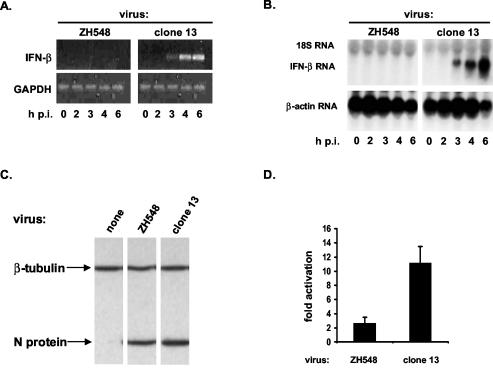
Induction of IFN-β gene expression in RVFV-infected cells. (A and B) Detection of IFN-β transcripts. Total RNA was extracted from BF cells infected with either strain ZH548 or clone 13 at the indicated time points of infection. p.i., postinfection. (A) RT-PCR. Following RT, cDNAs were amplified using primers specific for mouse IFN-β or GAPDH. (B) Northern blotting. RNA samples were separated on a 1% gel, transferred to a nylon membrane, and hybridized with probes specific for mouse IFN-β mRNA or β-actin mRNA. (C) Viral protein synthesis. Lysates of cells either mock-infected or infected with the indicated RVFV strains were monitored for expression of the viral N protein and β-tubulin (as a loading control) by Western blotting. (D) Activation of the IFN-β promoter. 293 cells were transfected with the reporter plasmid pIF-luc. At 5 h after transfection, cells were infected with the wild-type or mutant RVFV strain. Cell lysates were assayed for firefly luciferase activities 16 h after infection.
FIG. 2.
FIG. 2.
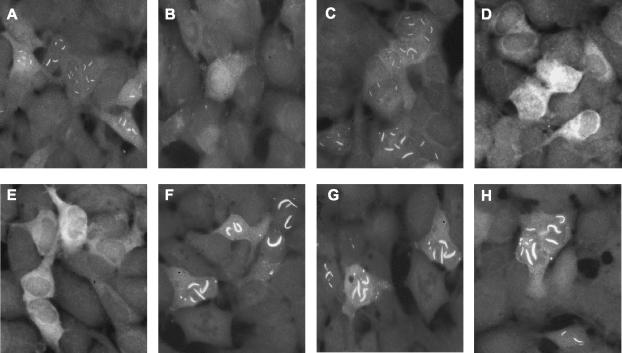
Localization and filament formation of wild-type and mutant NSs proteins. ZH548 NSs (A), clone 13 NSs (B), NSs-PP3/4 (C), NSs-PP1 (D), NSs-PP2 (E), NSs-S252A (F), NSs-S256A (G), NSs-S252A/S256A (H). For an explanation of the introduced mutations, see the legend to Fig. 4.
FIG. 3.
FIG. 3.
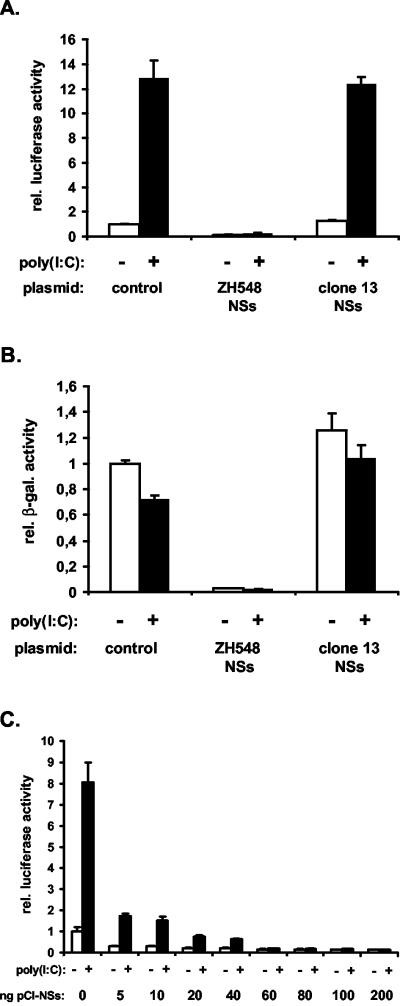
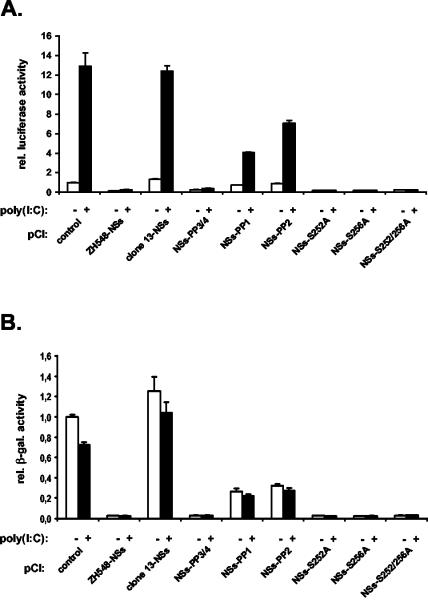
NSs protein suppresses IFN-β promoter activation. 293 cells were cotransfected with the indicated NSs expression plasmids, the reporter construct pIF-luc, and the control plasmid pβGal. At 24 h posttransfection, cells were mock treated or stimulated with poly(I:C) for 16 h. Cell lysates were assayed for firefly luciferase and β-galactosidase (β-gal.) activity. rel., relative. (A and C) Effect of NSs on the activation of the IFN-β promoter. (B) Effect of NSs on the constitutively active CMV promoter.
FIG. 4.
FIG. 4.
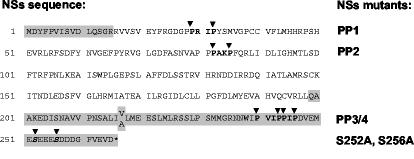
Generation of mutant NSs proteins. Proline residues in PXXP motifs (bold letters) were replaced by alanines (arrowheads) leading to the mutant NSs proteins designated PP1, PP2, and PP3/4, respectively. Exchange of the serine residues (bold, italic letters) by alanines resulted in the single mutants S252A and S256A and the double mutant S252A/S256A. These mutations removed one or both casein kinase II phosphorylation sites in the NSs protein. The sequence of the clone 13 NSs protein is shown in the gray boxes. In addition to the large in-frame deletion, a V-to-A substitution at position 216 is present.
FIG. 5.
FIG. 5.
Suppression of IFN-β promoter activation by mutant NSs proteins. rel., relative; β-gal., β-galactosidase. (A) Effect of NSs on the activation of the IFN-β promoter. (B) Effect of NSs on the constitutively active CMV promoter. The experiment was performed as described in the legend to Fig. 3.
FIG. 6.
FIG. 6.
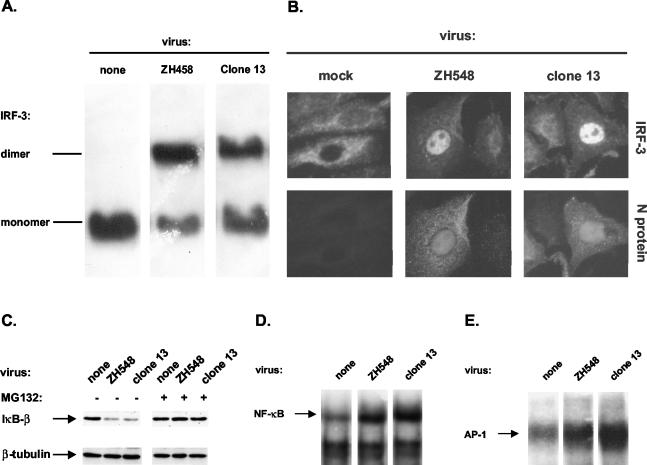
RVFV infection activates IRF-3, NF-κB, and AP-1. (A) Dimerization of IRF-3. 293 cells were infected with the indicated RVFV strains for 12 h, and formation of IRF-3 dimers was detected as described in Materials and Methods. (B) Nuclear translocation of IRF-3. Vero cells were assayed for localization of IRF-3 and expression of the RVFV N protein by immunofluorescence 4 h after infection. (C) Degradation of IκB-β. RVFV-infected or mock-infected BF cells were incubated in the absence or presence of the proteasome inhibitor MG132, beginning at 1 h postinfection and ending at 5 h postinfection. Cell lysates were analyzed for degradation of IκB-β by Western blotting. Detection of β-tubulin was performed as a loading control. (D and E) Activation of NF-κB and AP-1. Nuclear extracts from RVFV-infected and mock-infected BF cells were prepared 5 h after infection and incubated with [32P]ATP-labeled probes specific for NF-κB or AP-1, and binding of the transcription factors was detected in gel shift assays.
FIG. 7.
FIG. 7.
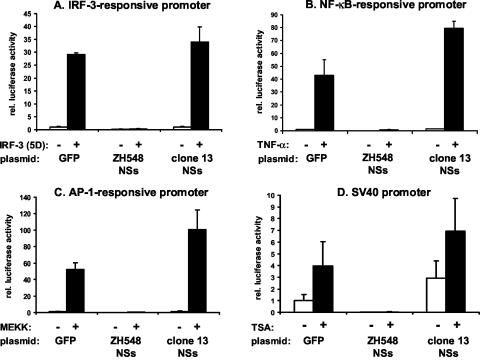
(A to C) NSs protein blocks promoter activation mediated by IRF-3, NF-κB, and AP-1. 293 cells were cotransfected with expression plasmids for NSs or GFP (as a control) and reporter constructs containing the indicated transcription factor binding sites of the IFN-β promoter. Promoter activation was achieved by coexpression of the constitutively active IRF-3 mutant IRF-3(5D) (A), incubation with tumor necrosis factor alpha (TNF-α) (B), or coexpression of MEK kinase (MEKK) (C). (D) NSs inhibits transcriptional activation of a constitutive promoter. Cells were cotransfected with expression plasmids for NSs or GFP (as a control) and a reporter construct containing a constitutively active SV40 promoter. Promoter-independent activation of transcription was achieved by incubation with TSA. rel., relative.

References

    1. Ahmed, M., M. O. McKenzie, S. Puckett, M. Hojnacki, L. Poliquin, and D. S. Lyles. 2003. Ability of the matrix protein of vesicular stomatitis virus to suppress beta interferon gene expression is genetically correlated with the inhibition of host RNA and protein synthesis. J. Virol. 77:4646-4657. - PMC - PubMed
    1. Ausubel, F. M., R. Brent, R. E. Kingston, D. D. Moore, J. G. Seidmann, J. A. Smith, and K. Struhl. 1994. Current protocols in molecular biology. John Wiley & Sons, Inc., New York, N.Y.
    1. Baigent, S. J., G. Zhang, M. D. Fray, H. Flick-Smith, S. Goodbourn, and J. W. McCauley. 2002. Inhibition of beta interferon transcription by noncytopathogenic bovine viral diarrhea virus is through an interferon regulatory factor 3-dependent mechanism. J. Virol. 76:8979-8988. - PMC - PubMed
    1. Basler, C. F., A. Mikulasova, L. Martinez-Sobrido, J. Paragas, E. Muhlberger, M. Bray, H. D. Klenk, P. Palese, and A. Garcia-Sastre. 2003. The Ebola virus VP35 protein inhibits activation of interferon regulatory factor 3. J. Virol. 77:7945-7956. - PMC - PubMed
    1. Billecocq, A., P. Vialat, and M. Bouloy. 1996. Persistent infection of mammalian cells by Rift Valley fever virus. J. Gen. Virol. 77:3053-3062. - PubMed

Publication types

Substances

LinkOut - more resources