. 2004 Aug 27;32(15):4646-56.
doi: 10.1093/nar/gkh804. Print 2004.

Novel non-coding RNAs in Dictyostelium discoideum and their expression during development

Affiliations

Novel non-coding RNAs in Dictyostelium discoideum and their expression during development

Anders Aspegren et al. Nucleic Acids Res. .

Abstract

The quest for non-coding RNAs (ncRNAs) in the last few years has revealed a surprisingly large number of small RNAs belonging to previously known as well as entirely novel classes. Computational and experimental approaches have uncovered new ncRNAs in all kingdoms of life. In this work, we used a shotgun cloning approach to construct full-length cDNA libraries of small RNAs from the eukaryotic model organism Dictyostelium discoideum. Interestingly, two entirely novel classes of RNAs were identified of which one is developmentally regulated. The RNAs within each class share conserved 5'- and 3'-termini that can potentially form stem structures. RNAs of both classes show predominantly cytoplasmic localization. In addition, based on conserved structure and/or sequence motifs, several of the identified ncRNAs could be divided into classes known from other organisms, e.g. 18 small nucleolar RNA candidates (17 box C/D, of which a few are developmentally regulated, and one box H/ACA). Two ncRNAs showed a high degree of similarity to the small nuclear U2 RNA and signal recognition particle RNA (SRP RNA), respectively. Furthermore, the majority of the regions upstream of the sequences encoding the isolated RNAs share conserved motifs that may constitute new promoter elements.


Figures
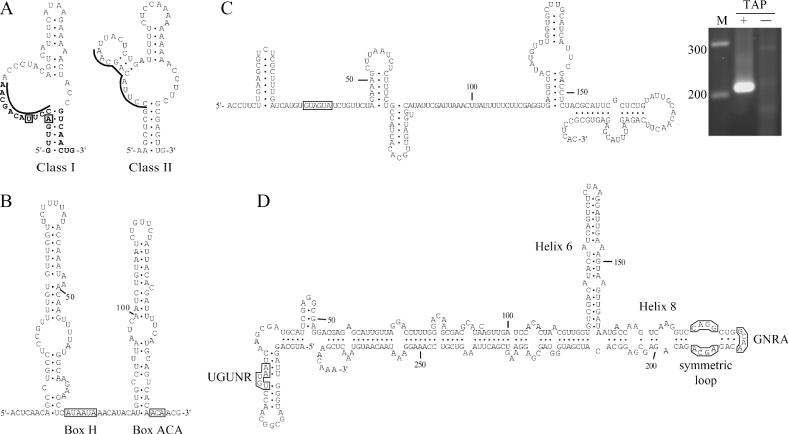
Figure 1
Figure 1
Structures of Dictyostelium ncRNAs as predicted by Mfold version 2.3 at 22°C. (A) Sequence and structure comparison of Class I (DdR-21) and Class II (DdR-35) RNAs. Sequences shared by the Class I RNAs are shown in boldface. Boxed nucleotides represent deviations from the consensus sequence (DdR-31: A to G substitution, DdR-34: U to C substitution). The solid line represents the sequence motif present in both Class I and Class II RNAs. (B) Box H/ACA snoRNA DdR-18. Boxed nucleotides represent conserved boxes H and ACA. (C) Left, predicted structure of the Dictyostelium U2 homolog DdR-19, as derived from the human U2 structure (37). The boxed sequence represents nucleotides complementary to the pre-mRNA splicing branch site. Right, RACE mapping of the U2 5′ end with and without prior treatment with TAP, respectively, indicating a non-processed 5′ triphosphate. (D) Predicted structure of SRP RNA DdR-20. Conserved motifs UGUNR (A), the symmetric loop (B) and GNRA (C) are indicated, as well as the conserved helices 6 and 8.
Figure 2
Figure 2
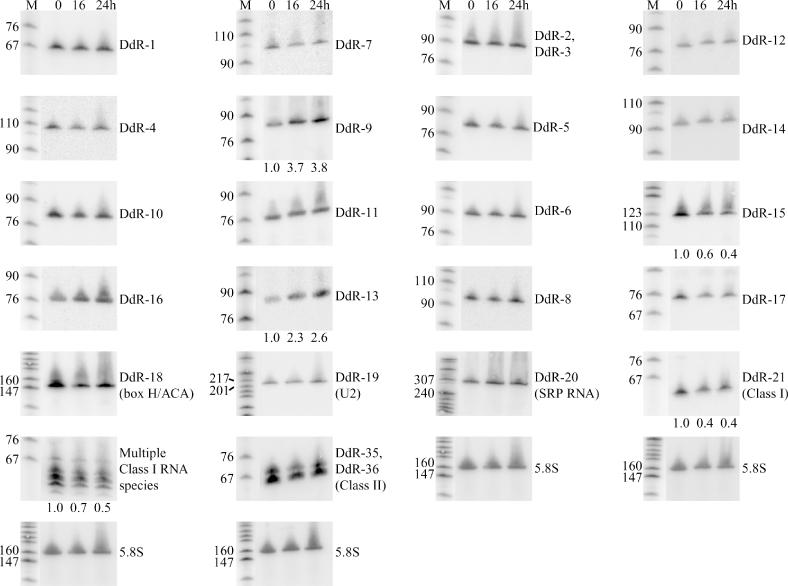
Expression patterns of small RNAs during Dictyostelium development as shown by northern blot analysis. Time points represent hours of development where 0 h designates growing cells. Size markers (M) are shown for reference. Developmental regulation of Class I RNA expression was shown both by using a probe complementary to the conserved 5′ end (multiple Class I RNA species) and by a probe detecting DdR-21 specifically. The increase/decrease in expression of developmentally regulated RNAs (after normalization to 5.8S rRNA) is shown below the panels.
Figure 3
Figure 3
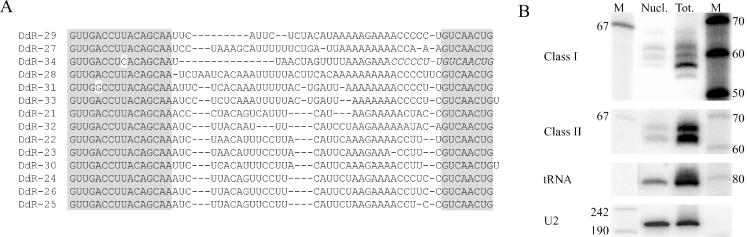
(A) Alignment of isolated Class I RNAs. Shaded nucleotides represent conserved 5′ and 3′ sequences. The 3′ end of DdR-34 (shown in italics) was obtained from dictyBase. Nucleotides deviating from the 5′ consensus sequence are presented on white background. (B) Class I and Class II RNAs are primarily cytoplasmic, as shown by northern blot analysis of nuclear and total RNA. Each panel shows the same membrane successively probed for the different RNAs. RNA amounts loaded from the two preparations were adjusted to give approximately equal U2 signals, to facilitate comparison. The probe used for Class I hybridizes to the conserved 5′ sequence, and the probe for Class II recognizes both DdR-35 and DdR-36 (see Results). Signals were quantified after normalization to the nuclear control U2 snRNA. The estimated fractions located in the cytoplasm were tRNA, 91%; Class I, 93%; Class II, 95%. Size markers (M), MspI-digested pUC19 DNA (left) and RNA Decade marker (right).
Figure 4
Figure 4
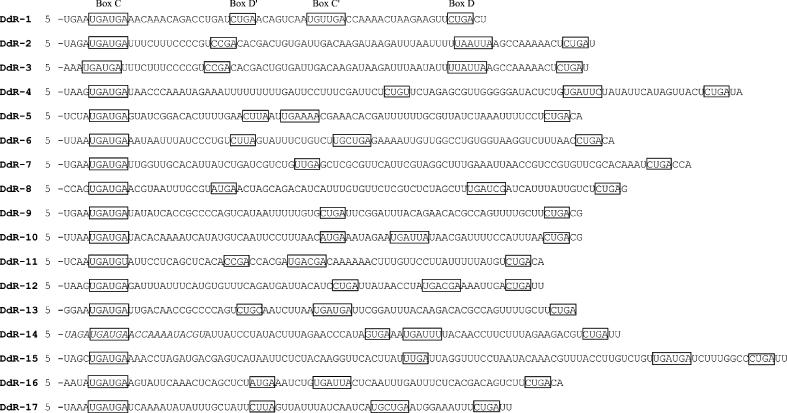
Sequences and conserved elements of Dictyostelium box C/D snoRNAs DdR-1 to DdR-17. Conserved boxes C, D′, C′ and D are shown as boxed nucleotides (Materials and Methods). The 5′ end of DdR-14 (shown in italics) was obtained from dictyBase.
Figure 5
Figure 5
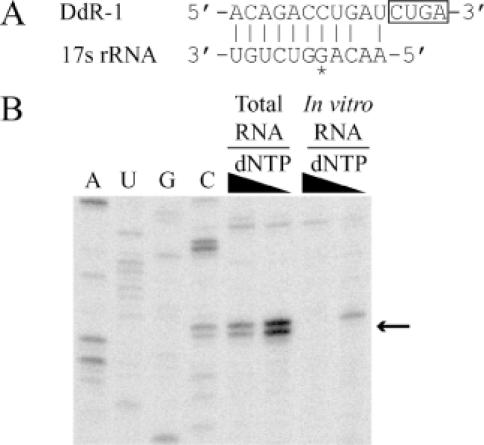
Confirmation of predicted target for box C/D snoRNA DdR-1. (A) Predicted base pair interaction between DdR-1 and its 17S rRNA target sequence. Boxed nucleotides represent the predicted D′ box and the asterisk indicates the methylated nucleotide Gm1501. (B) Experimental verification of predicted 17S rRNA 2′-O-ribose methylation site by primer extension analysis in the presence of high- and low concentration of dNTP, on total and in vitro-transcribed RNA, respectively. The reverse transcription termination caused by rRNA methylation is indicated by an arrow. Sequencing reactions on in vitro-transcribed RNA were run in parallel.
Figure 6
Figure 6
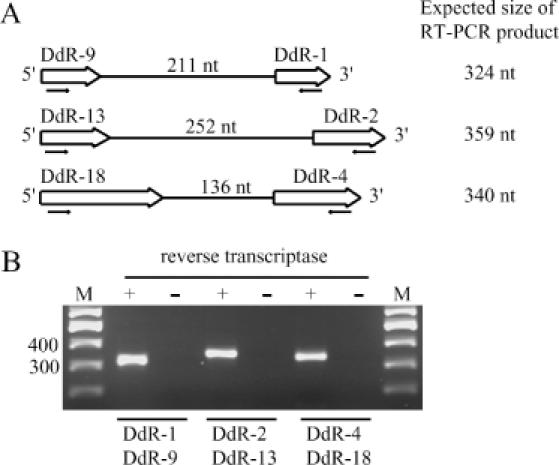
Cluster analysis. (A) Schematic drawing of snoRNA pairs located in clusters. Open arrows represent snoRNAs, and small solid arrows indicate location of primers used for the analysis. The distance between each snoRNA is indicated. The clusters are drawn to scale. (B) RT–PCR products run on 2% agarose gel. The PCR signals were dependent on previous treatment of the RNA with reverse transcriptase (+). No signals were detected in the DNA contamination controls (−).
Figure 7
Figure 7
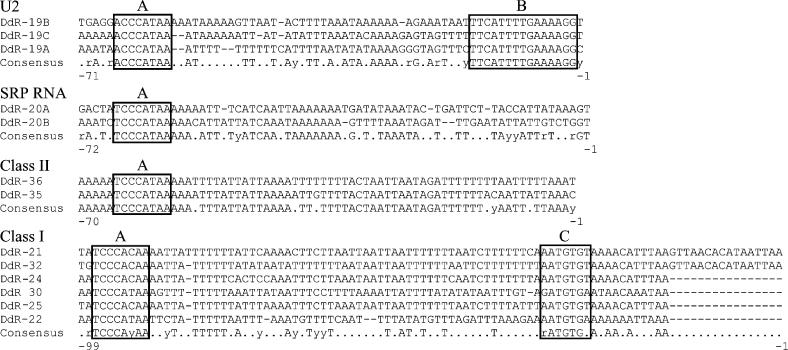
Putative Dictyostelium promoter elements. Alignments of genomic sequences present upstream from regions encoding U2 snRNA, SRP RNA, Class II RNAs and Class I RNAs (a few representative sequences shown). Putative promoter elements A, B and C are indicated. Numbers represent distance from the 5′ end of the coding regions.

References

    1. Vogel J., Bartels,V., Tang,T.H., Churakov,G., Slagter-Jäger,J.G., Hüttenhofer,A. and Wagner,E.G.H. (2003) RNomics in Escherichia coli detects new sRNA species and indicates parallel transcriptional output in bacteria. Nucleic Acids Res., 31, 6435–6443. - PMC - PubMed
    1. Marker C., Zemann,A., Terhorst,T., Kiefmann,M., Kastenmayer,J.P., Green,P., Bachellerie,J.P., Brosius,J. and Hüttenhofer,A. (2002) Experimental RNomics. identification of 140 candidates for small non-messenger RNAs in the plant Arabidopsis thaliana. Curr. Biol., 12, 2002–2013. - PubMed
    1. Yuan G., Klambt,C., Bachellerie,J.P., Brosius,J. and Hüttenhofer,A. (2003) RNomics in Drosophila melanogaster: identification of 66 candidates for novel non-messenger RNAs. Nucleic Acids Res., 31, 2495–2507. - PMC - PubMed
    1. Tang T.H., Bachellerie,J.P., Rozhdestvensky,T., Bortolin,M.L., Huber,H., Drungowski,M., Elge,T., Brosius,J. and Hüttenhofer,A. (2002) Identification of 86 candidates for small non-messenger RNAs from the archaeon Archaeoglobus fulgidus. Proc. Natl Acad. Sci. USA, 99, 7536–7541. - PMC - PubMed
    1. Hüttenhofer A., Kiefmann,M., Meier-Ewert,S., O'Brien,J., Lehrach,H., Bachellerie,J.P. and Brosius,J. (2001) RNomics: an experimental approach that identifies 201 candidates for novel, small, non-messenger RNAs in mouse. EMBO J., 20, 2943–2953. - PMC - PubMed

Publication types

MeSH terms

Associated data