. 2004 Oct;10(10):1625-36.
doi: 10.1261/rna.7270204. Epub 2004 Aug 30.

Recruitment of the Puf3 protein to its mRNA target for regulation of mRNA decay in yeast

Affiliations

Recruitment of the Puf3 protein to its mRNA target for regulation of mRNA decay in yeast

John S Jackson Jr et al. RNA. 2004 Oct.

Abstract

The Puf family of RNA-binding proteins regulates mRNA translation and decay via interactions with 3' untranslated regions (3' UTRs) of target mRNAs. In yeast, Puf3p binds the 3' UTR of COX17 mRNA and promotes rapid deadenylation and decay. We have investigated the sequences required for Puf3p recruitment to this 3' UTR and have identified two separate binding sites. These sites are specific for Puf3p, as they cannot bind another Puf protein, Puf5p. Both sites use a conserved UGUANAUA sequence, whereas one site contains additional sequences that enhance binding affinity. In vivo, presence of either site partially stimulates COX17 mRNA decay, but full decay regulation requires the presence of both sites. No other sequences outside the 3' UTR are required to mediate this decay regulation. The Puf repeat domain of Puf3p is sufficient not only for in vitro binding to the 3' UTR, but also in vivo stimulation of COX17 mRNA decay. These experiments indicate that the essential residues involved in mRNA decay regulation are wholly contained within this RNA-binding domain.


Figures

FIGURE 1.
FIGURE 1.
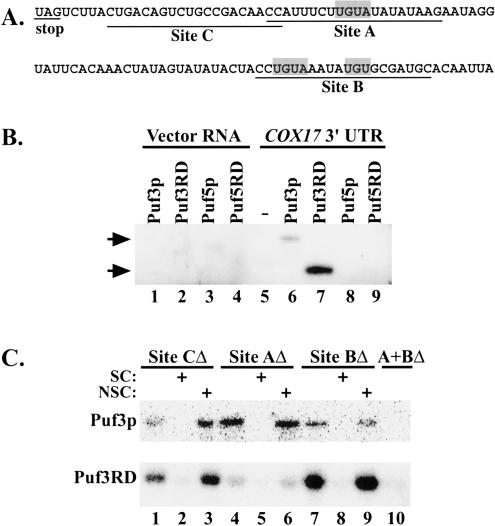
Puf3p and Puf3RD bind to specific sites in the COX17 3′UTR. (A) The COX17 3′-UTR sequence used in binding reactions is shown. The shaded boxes highlight three UGU(A) sequences in the 3′ UTR. DNA oligos complementary to the underlined Sites A, B, and/or C were used in RNase H reactions to delete the corresponding sites from the 3′ UTR. (B) In vitro binding reactions of uniformly radio-labeled transcripts (Vector or COX17 3′ UTR) in the presence or absence of GST-tagged proteins (Puf3p, Puf3RD, Puf5p, or Puf5RD) were UV cross-linked and digested of unbound RNA. Radiolabel that remains bound to the protein represents a direct interaction between the RNA and the Puf protein. Shown is an SDS-polyacrylamide gel of radiolabeled Puf proteins in digested binding reactions. Positions of full-length Puf3p (124 kDa) and Puf3RD (74 kDa) based on Western analysis are shown by the arrows. Sizes of Puf5p (121 kDa) and Puf5RD (81.5 kDa) have been verified by Western analysis. (C) In vitro binding reactions of radiolabeled COX17 3′ UTR deleted of Site C (lanes 13), Site A (lanes 46), Site B (lanes 79), or Site A and B (lane 10) in the presence of Puf3p (top panel) or Puf3RD (bottom panel) were UV cross-linked, digested of unbound RNA, and electrophoresed as described in A. Excess unlabeled full-length COX17 3′ UTR or Vector RNA were used as specific (SC, lanes 2,5,8) or non-specific (NSC, lanes 3,6,9) competitors, respectively.
FIGURE 2.
FIGURE 2.
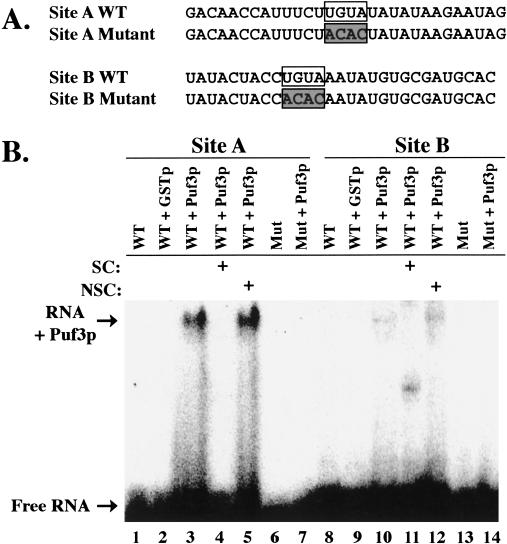
Puf3p binding to minimal Sites A and B requires UGUA. (A) Sequences of the 29–30-nt transcripts of wild-type (WT) and mutant Site A and Site B used in binding reactions are shown. UGUA regions are boxed. Mutant transcripts contain ACAC (shaded boxes) in place of UGUA. (B) In vitro binding reactions of radiolabeled RNA (Site A WT, lanes 15; Site A mutant, lanes 6,7; Site B WT, lanes 812; Site B mutant, lanes 13,14) in the presence or absence of 20 μM GST (lanes 2,9) or 0.14 μM GST-Puf3p (lanes 35,7,1012,14) were separated on a native polyacrylamide gel. Excess unlabeled full-length COX17 3′ UTR or Vector RNA were used as specific (SC, lanes 4,11) or nonspecific (NSC, lanes 5,12) competitors, respectively. Positions of free radiolabeled RNA (Free RNA) and RNA bound to Puf3p (RNA + Puf3p) are indicated.
FIGURE 3.
FIGURE 3.
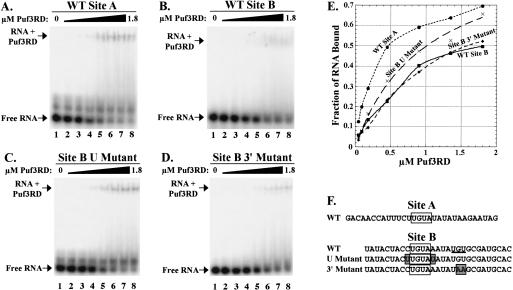
Differential binding affinities of Puf3RD to Sites A and B. In vitro binding reactions of radiolabeled wild-type (WT) Site A (A), WT Site B (B), Site B U Mutant (C), or Site B 3′ Mutant (D) transcripts in the absence or presence of increasing concentrations of Puf3RD were separated on native polyacrylamide gels. Concentrations of Puf3RD used in binding reactions were 0, 0.045, 0.09, 0.18, 0.45, 0.9, 1.35, and 1.8 μM in lanes 18, respectively. Positions of free radiolabeled RNA (Free RNA) and RNA bound to Puf3RD (RNA + Puf3RD) are indicated. (E) Data from the gel mobility shifts in AD are plotted, with the μmolar concentration of Puf3RD used in the binding reaction on the x-axis and the fraction of RNA shifted from free form to bound form on the y-axis. Best-fit binding curves are shown for WT Site A (circle), WT Site B (square), Site B U Mutant (X), and Site B 3′ Mutant (diamond). Data points are averages of multiple experiments. (F) Sequences of wild-type (WT) and mutant Site A and Site B transcripts used in binding reactions are shown. UGUA regions are boxed. Sequences altered in the mutant transcripts are indicated by shaded boxes. The second UGU sequence in wild-type Site B is underlined.
FIGURE 4.
FIGURE 4.
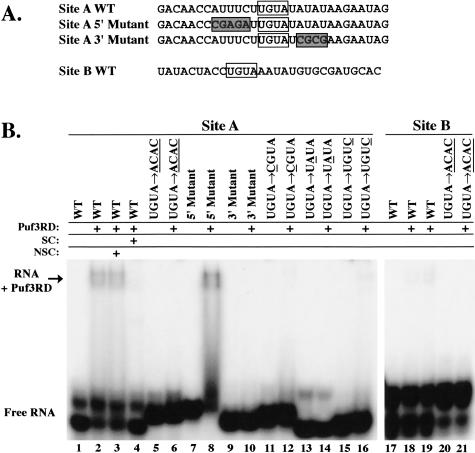
Puf3RD binding requires additional sequences flanking the conserved UGUA regions. (A) Sequences of wild-type (WT) and mutant Site A and Site B transcripts used in binding reactions are shown. UGUA regions are boxed. Sequences altered in the mutant transcripts are indicated by shaded boxes. (B) In vitro binding reactions of radiolabeled transcripts in the absence or presence of 0.45 μM Puf3RD were separated on a native polyacrylamide gel. Base substitutions in UGUA mutants of Site A and Site B transcripts are given, with altered bases underlined. Excess unlabeled wild-type Site A RNA was used as specific competitor (SC, lane 4), and excess unlabeled mutant Site A RNA containing a UGUA → ACAC alteration was used as nonspecific competitor (NSC, lane 3). Lane 19 contains 0.9 μM Puf3RD. Similar results were also obtained with full-length Puf3p (data not shown). Positions of free radiolabeled RNA (Free RNA) and RNA bound to Puf3RD (RNA + Puf3RD) are indicated.
FIGURE 5.
FIGURE 5.
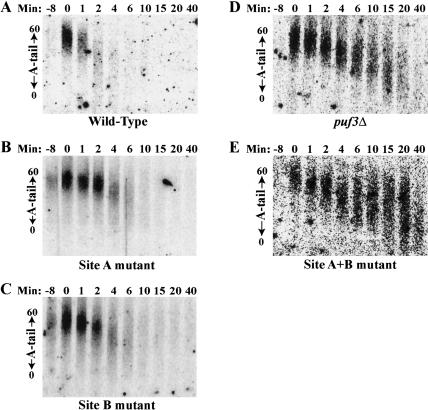
Both UGUA regions are required for in vivo regulation of COX17 mRNA deadenylation and decay by Puf3p. Shown are Northern blot analyses of transcriptional pulse-chase experiments examining decay of the COX17 transcript from wild-type PUF3 (A); wild-type PUF3, Site A mutant (B); wild-type PUF3, Site B mutant (C); puf3Δ (D), and wild-type PUF3, Site A + B mutant (E) strains. Minutes after transcriptional repression are indicated above each blot. The -8 lane in each blot corresponds to background levels of RNA expression prior to galactose induction of the COX17 transcript. The distribution of poly(A) tail lengths are indicated by arrows on the left of each blot, from a maximum length of 60 A’s (top) to a fully deadenylated length of 0 A’s (bottom).
FIGURE 6.
FIGURE 6.
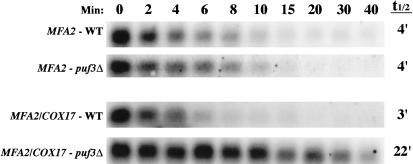
The COX17 3′ UTR is sufficient to promote Puf3p regulation of mRNA decay. Shown are Northern blot analyses of the decay of MFA2 mRNA or the hybrid MFA2/COX17 mRNA expressed from a wild-type (WT) strain or a puf3Δ strain. Minutes following transcriptional repression are indicated above the set of blots, with the half-lives (t1/2) as determined from multiple experiments.
FIGURE 7.
FIGURE 7.
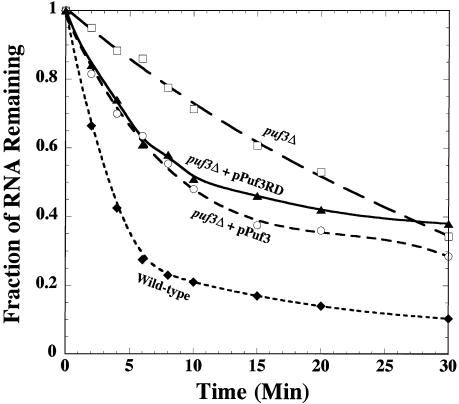
The Puf3RD rescues decay of COX17 mRNA in a puf3Δ strain. Data from Northern blot analyses of COX17 decay are plotted, with minutes following transcriptional repression on the x-axis and the fraction of RNA remaining as compared to the steady-state RNA level at time 0 on the y-axis. Decay was monitored in the following strains: wild-type (closed diamond), puf3Δ (open square), puf3Δ transformed with a plasmid expressing Puf3p (open circle), and puf3Δ transformed with plasmid expressing Puf3RD (closed triangle). Data points are averages of multiple experiments.

References

    1. Andersson, M.G. and Cerenius, L. 2002. Pumilio homologue from Saprolegnia parasitica specifically expressed in undifferentiated spore cysts. Eukaryot. Cell 1: 105–111. - PMC - PubMed
    1. Asaoka-Taguchi, M., Yamada, M., Nakamura, A., Hanyu, K., and Kobayashi, S. 1999. Maternal Pumilio acts together with Nanos in germline development in Drosophila embryos. Nat. Cell Biol. 1: 431–437. - PubMed
    1. Beers, J., Glerum, D.M., and Tzagoloff, A. 1997. Purification, characterization and localization of yeast COX17p, a mitochondrial copper shuttle. J. Biol. Chem. 272: 33191–33196. - PubMed
    1. Caponigro, G., Muhlrad, D., and Parker, R. 1993. A small segment of the MATa1 transcript promotes mRNA decay in Saccharomyces cerevisiae: A stimulatory role for rare codons. Mol. Cell. Biol. 13: 5141–5148. - PMC - PubMed
    1. Chagnovich, D. and Lehmann, R. 2001. Poly (A)-independent regulation of maternal hunchback translation in the Drosophila embryo. Proc. Natl. Acad. Sci. 98: 11359–11364. - PMC - PubMed

Publication types

MeSH terms