


Understanding the mechanisms of drug-associated interstitial lung disease
- PMID: 15340376
- PMCID: PMC2750813
- DOI: 10.1038/sj.bjc.6602065
Understanding the mechanisms of drug-associated interstitial lung disease
Abstract
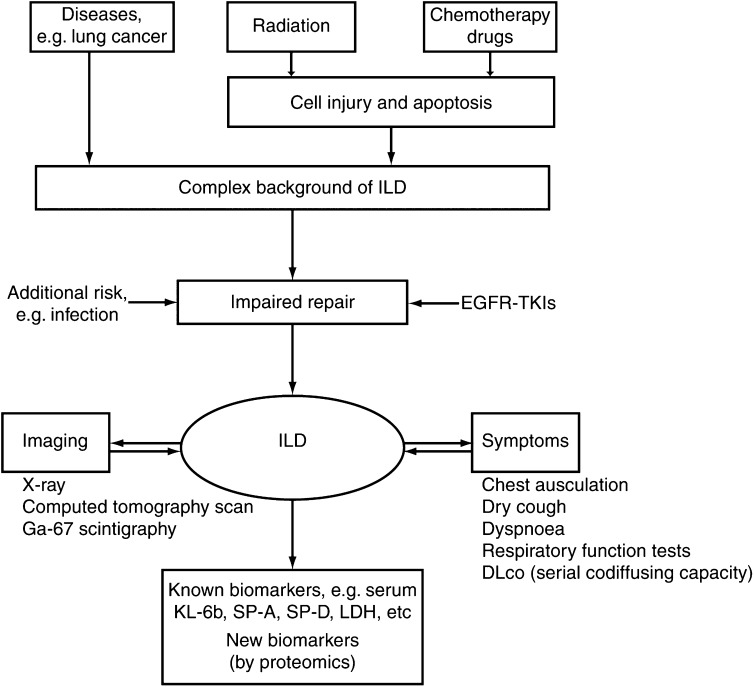
Drugs have been implicated in lung injury as a result of direct pharmacological action, persistence or metabolism in the tissue, or via the production of a reactive metabolite or metabolites. The result of this apparent drug-associated injury ranges from cellular dysfunction through to cell death (apoptosis) and alteration of repair mechanisms that are essential in replacing critical tissue elements and function. There is limited knowledge on how timing of drug administration or drug interactions may interfere with the repair mechanisms or modulate the expression of pulmonary toxicity. Chemotherapeutic drugs and novel agents, such as those targeting the epidermal growth factor receptor (EGFR), appear to affect both normal and neoplastic cells. However, unlike chemotherapy, where the actions are systemic and directly as a result of biotransformation or cell injury, it has been postulated that effects of EGFR-targeting agents are more likely to be focused on epithelia via a pharmacological effect. Furthermore, risk factors for the development of adverse pulmonary reactions, as well as biological markers indicating incipient toxicity, need to be prospectively identified. Proteomics, through the identification of >/=1000 proteins or peptides in blood samples, will hopefully identify candidates for this role.
Figures

References
-
- Abid SH, Malhotra V, Perry MC (2001) Radiation-induced and chemotherapy-induced pulmonary injury. Curr Opin Oncol 13: 242–248 - PubMed
-
- Ackerman AD, Fackler JC, Tuck-Muller CM, Tarpey MM, Freeman BA, Rogers MC (1988) Partial monosomy 21, diminished activity of superoxide dismutase, and pulmonary oxygen toxicity. N Engl J Med 318: 1666–1669 - PubMed
-
- Aida S, Tamai S, Sekiguchi S, Shimizu N (1994) Distribution of epidermal growth factor and epidermal growth factor receptor in human lung: immunohistochemical and immunoelectron-microscopic studies. Respiration 61: 161–166 - PubMed
-
- Anttila S, Hietanen E, Vainio H, Camus AM, Gelboin HV, Park SS, Heikkila L, Karjalainen A, Bartsch H (1991) Smoking and peripheral type of cancer are related to high levels of pulmonary cytochrome P450IA in lung cancer patients. Int J Cancer 47: 681–685 - PubMed
-
- Aviram G, Yu E, Tai P, Lefcoe MS (2001) Computed tomography to assess pulmonary injury associated with concurrent chemo-radiotherapy for inoperable non-small cell lung cancer. Can Assoc Radiol J 52: 385–391 - PubMed
Publication types
MeSH terms
Substances
LinkOut - more resources
Full Text Sources
Medical
Research Materials
Miscellaneous
