


Denitrification genes regulate Brucella virulence in mice
- PMID: 15342571
- PMCID: PMC515144
- DOI: 10.1128/JB.186.18.6025-6031.2004
Denitrification genes regulate Brucella virulence in mice
Abstract
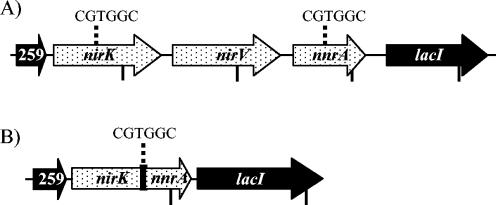
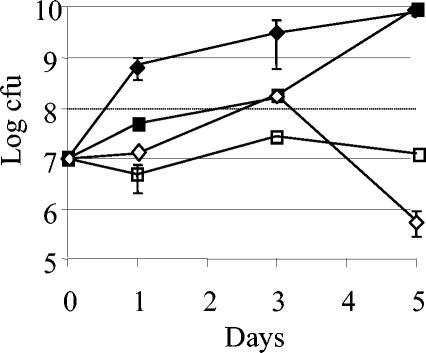
Brucella is the causative agent of the zoonotic disease brucellosis, which is endemic in many parts of the world. Genome sequencing of B. suis and B. melitensis revealed that both are complete denitrifiers. To learn more about the role of denitrification in these animal pathogens, a study of the role of denitrification in the closely related B. neotomae was undertaken. In contrast to B. suis and B. melitensis, it was found that B. neotomae is a partial denitrifier that can reduce nitrate to nitrite but no further. Examination of the B. neotomae genome showed that a deletion in the denitrification gene cluster resulted in complete loss of nirV and the partial deletion of nirK and nnrA. Even though the nor operon is intact, a norC-lacZ promoter fusion was not expressed in B. neotomae. However, the norC-lacZ fusion was expressed in the related denitrifier Agrobacterium tumefaciens, suggesting that the lack of expression in B. neotomae is due to inactivation of NnrA. A narK-lacZ promoter fusion was found to exhibit nitrate-dependent expression consistent with the partial denitrifier phenotype. Complementation of the deleted region in B. neotomae by using nirK, nirV, and nnrA from B. melitensis restored the ability of B. neotomae to reduce nitrite. There was a significant difference in the death of IRF-1-/- mice when infected with B. neotomae containing nirK, nirV, and nnrA and those infected with wild-type B. neotomae. The wild-type strain killed all the infected mice, whereas most of the mice infected with B. neotomae containing nirK, nirV, and nnrA survived.
Figures
References
-
- Bartnikas, T. B., Y. Wang, T. Bobo, A. Veselov, C. P. Scholes, and J. P. Shapleigh. 2002. Characterization of a member of the NnrR regulon in Rhodobacter sphaeroides 2.4.3 encoding a heme-copper protein. Microbiology 148:825-833. - PubMed
-
- Corbel, M. J. 1977. Isolation and partial characterization of a phage receptor from “Brucella neotomae” 5K33. Ann. Sclavo. 19:131-142. - PubMed
Publication types
MeSH terms
Substances
Grants and funding
LinkOut - more resources
Full Text Sources
Molecular Biology Databases
