


An SOS response induced by high pressure in Escherichia coli
- PMID: 15342583
- PMCID: PMC515162
- DOI: 10.1128/JB.186.18.6133-6141.2004
An SOS response induced by high pressure in Escherichia coli
Abstract
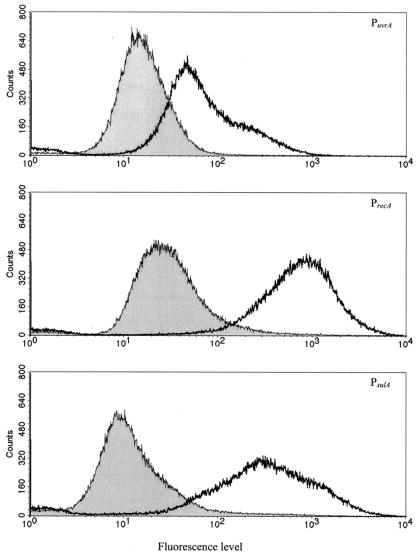
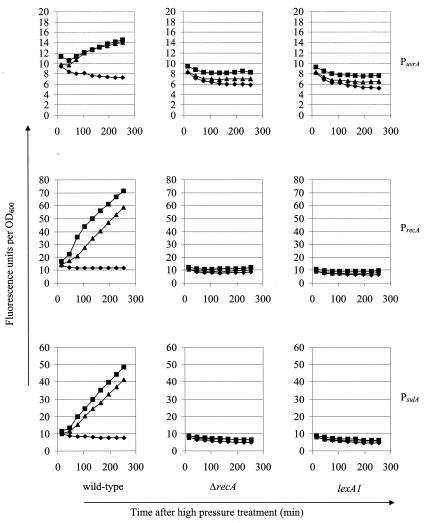
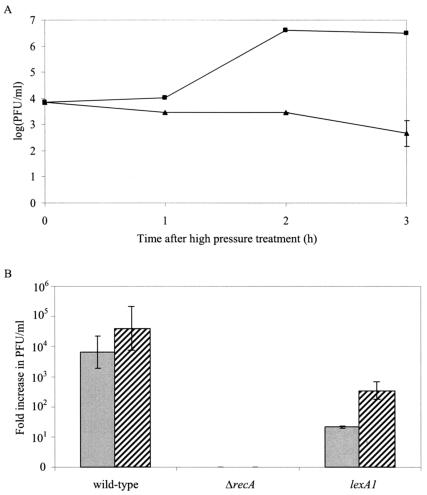
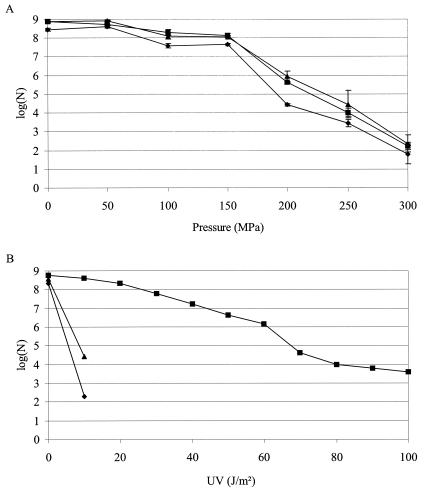
Although pressure is an important environmental parameter in microbial niches such as the deep sea and is furthermore used in food preservation to inactivate microorganisms, the fundamental understanding of its effects on bacteria remains fragmentary. Our group recently initiated differential fluorescence induction screening to search for pressure-induced Escherichia coli promoters and has already reported induction of the heat shock regulon. Here the screening was continued, and we report for the first time that pressure induces a bona fide SOS response in E. coli, characterized by the RecA and LexA-dependent expression of uvrA, recA, and sulA. Moreover, it was shown that pressure is capable of triggering lambda prophage induction in E. coli lysogens. The remnant lambdoid e14 element, however, could not be induced by pressure, as opposed to UV irradiation, indicating subtle differences between the pressure-induced and the classical SOS response. Furthermore, the pressure-induced SOS response seems not to be initiated by DNA damage, since DeltarecA and lexA1 (Ind-) mutants, which are intrinsically hypersensitive to DNA damage, were not sensitized or were only very slightly sensitized for pressure-mediated killing and since pressure treatment was not found to be mutagenic. In light of these findings, the current knowledge of pressure-mediated effects on bacteria is discussed.
Figures
References
-
- Abe, F., C. Kato, and K. Horikoshi. 1999. Pressure-regulated metabolism in microorganisms. Trends Microbiol. 7:447-453. - PubMed
-
- Balashov, S., and M. Z. Humayun. 2002. Mistranslation induced by streptomycin provokes a RecABC/RuvABC-dependent mutator phenotype in Escherichia coli cells. J. Mol. Biol. 315:513-527. - PubMed
-
- Balny, C., P. Masson, and K. Heremans. 2002. High pressure effects on biological macromolecules: from structural changes to alteration of cellular processes. Biochim. Biophys. Acta 1595:3-10. - PubMed
Publication types
MeSH terms
Substances
LinkOut - more resources
Full Text Sources
Other Literature Sources
