. 2004 Sep;186(18):6198-207.
doi: 10.1128/JB.186.18.6198-6207.2004.

Novel xylose dehydrogenase in the halophilic archaeon Haloarcula marismortui

Affiliations

Novel xylose dehydrogenase in the halophilic archaeon Haloarcula marismortui

Ulrike Johnsen et al. J Bacteriol. 2004 Sep.

Abstract

During growth of the halophilic archaeon Haloarcula marismortui on D-xylose, a specific D-xylose dehydrogenase was induced. The enzyme was purified to homogeneity. It constitutes a homotetramer of about 175 kDa and catalyzed the oxidation of xylose with both NADP+ and NAD+ as cosubstrates with 10-fold higher affinity for NADP+. In addition to D-xylose, D-ribose was oxidized at similar kinetic constants, whereas D-glucose was used with about 70-fold lower catalytic efficiency (kcat/Km). With the N-terminal amino acid sequence of the subunit, an open reading frame (ORF)-coding for a 39.9-kDA protein-was identified in the partially sequenced genome of H. marismortui. The function of the ORF as the gene designated xdh and coding for xylose dehydrogenase was proven by its functional overexpression in Escherichia coli. The recombinant enzyme was reactivated from inclusion bodies following solubilization in urea and refolding in the presence of salts, reduced and oxidized glutathione, and substrates. Xylose dehydrogenase showed the highest sequence similarity to glucose-fructose oxidoreductase from Zymomonas mobilis and other putative bacterial and archaeal oxidoreductases. Activities of xylose isomerase and xylulose kinase, the initial reactions of xylose catabolism of most bacteria, could not be detected in xylose-grown cells of H. marismortui, and the genes that encode them, xylA and xylB, were not found in the genome of H. marismortui. Thus, we propose that this first characterized archaeal xylose dehydrogenase catalyzes the initial step in xylose degradation by H. marismortui.


Figures
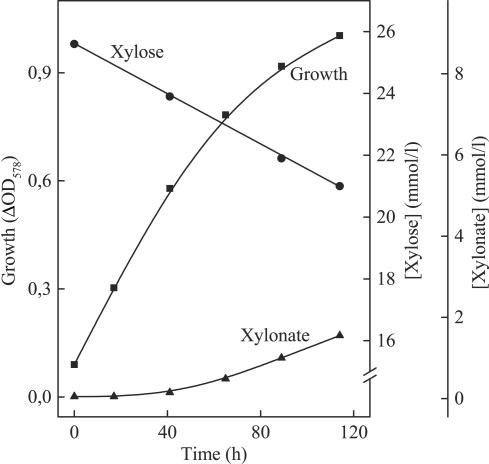
FIG. 1.
FIG. 1.
Growth of H. marismortui on 25 mM xylose and 0.05% yeast extract. Cultures were incubated at 37°C in 500-ml Erlenmeyer flasks filled with 50 ml of medium and shaken at 200 rpm. Growth (▪), xylose consumption (•), and xylonate formation (▴) were followed over time.
FIG. 2.
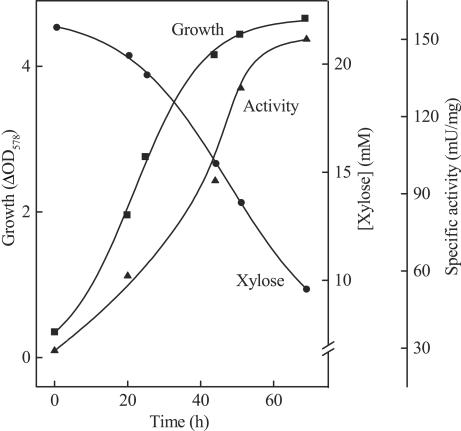
FIG. 2.
Induction of xylose dehydrogenase during growth of H. marismortui on xylose. A culture was incubated at 37°C in a 2,000-ml Erlenmeyer flask filled with 400 ml of medium containing xylose (25 mM), yeast extract (2.5 g/liter), and Casamino Acids (5 g/liter) and shaken at 200 rpm. Glucose-grown cells were used as the inoculum (10%). Growth (▪), xylose consumption (•), and the specific activity of xylose dehydrogenase (▴) were followed over time. Protein concentration was determined by the biuret method.
FIG. 3.
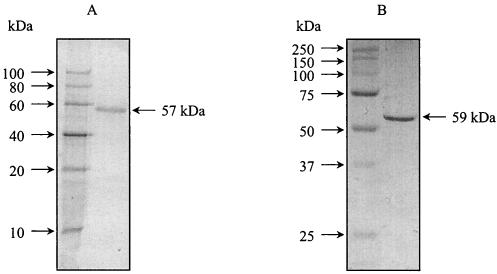
FIG. 3.
Purified xylose dehydrogenase from H. marismortui (A) and recombinant xylose dehydrogenase from transformed E. coli (B) as analyzed by SDS-PAGE. (A) Lanes: 1, molecular mass standards; 2, native enzyme purified from H. marismortui. (B) Lanes: 1, molecular mass standards; 2, recombinant enzyme purified from E. coli.
FIG. 4.
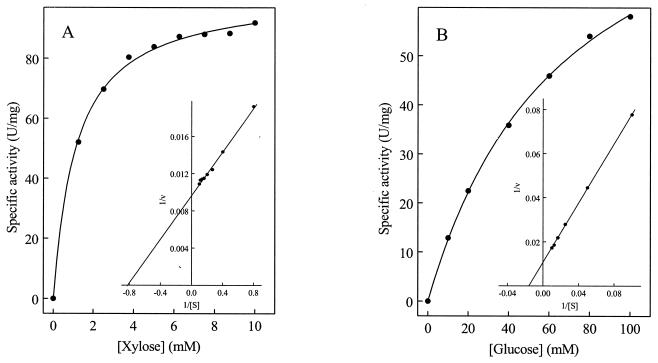
FIG. 4.
Rate dependence of xylose dehydrogenase purified from H. marismortui on the concentrations of xylose (A) and glucose (B). The inserts show double-reciprocal plots of the rates versus the corresponding substrate concentrations. The assay mixture contained 20 mM Tris-HCl (pH 8.3), 1.5 M KCl, 1 mM NADP+, various concentrations of xylose or glucose, and enzyme.
FIG. 5.
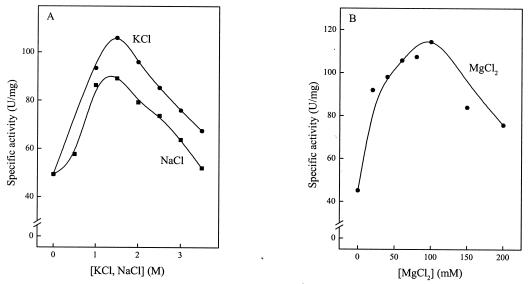
FIG. 5.
Effects of NaCl and KCl (A) and MgCl2 (B) on xylose dehydrogenase purified from H. marismortui. The assay mixture contained 20 mM Tris-HCl (pH 8.3), 1 mM NADP+, 10 mM xylose, enzyme, and the concentrations of NaCl, KCl, and MgCl2 indicated.
FIG. 6.
FIG. 6.
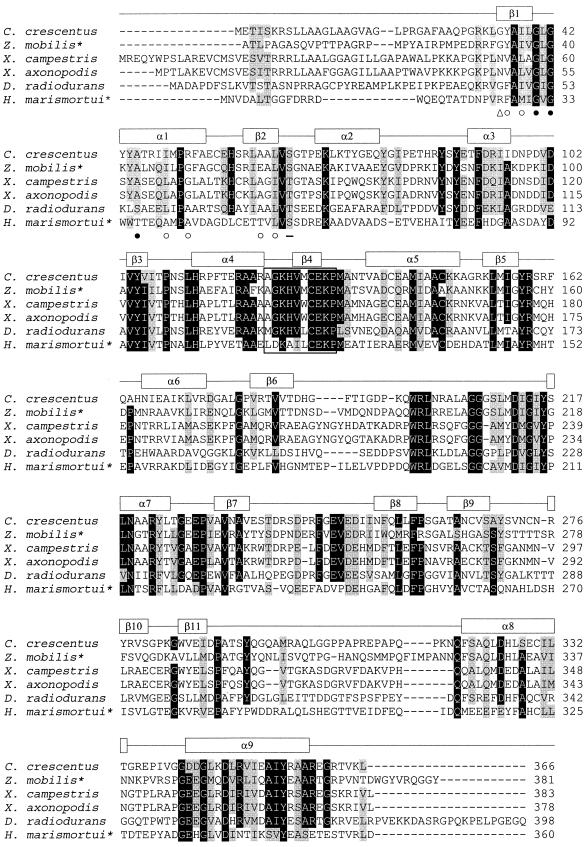
Multiple-sequence alignment of deduced amino acid sequences of the xylose dehydrogenase from H. marismortui, of GFOR from Z. mobilis, and of putative bacterial oxidoreductases. Characterized proteins are marked by asterisks. The alignment was generated by ClustalX with the Gonnet matrix (39). The predicted secondary structure of the xylose dehydrogenase from H. marismortui is shown above the sequences. Symbols denote residues of the Rossman fingerprint motif (16, 43): ▵, basic or hydrophilic; ○, small and hydrophobic; •, glycine; —, acid. National Center for Biotechnology Information accession numbers: C. crescentus, AAK23207; D. radiodurans, B75475; Xanthomonas axonopodis, AAM35776; X. campestris, AAM40130; Z. mobilis GFOR, 1H6DK.
FIG. 7.
FIG. 7.
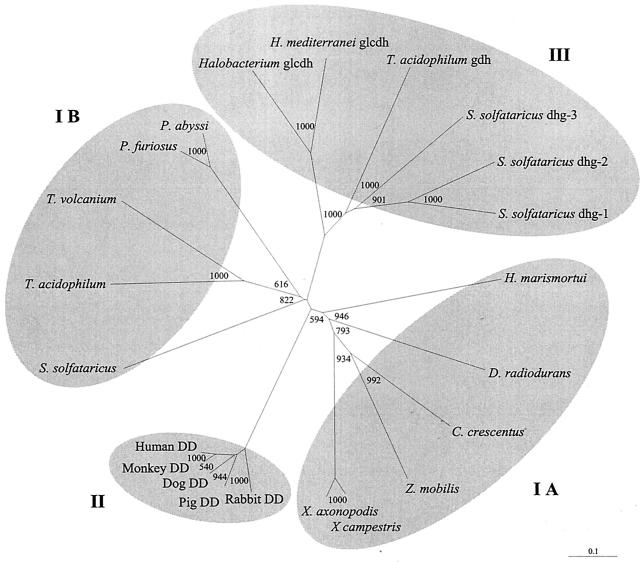
Phylogenetic relationships of the archaeal xylose dehydrogenase from H. marismortui, oxidoreductases and dehydrogenases from bacteria (IA) and archaea (IB), xylose dehydrogenases-dimeric DDs from eucarya (II), and glucose dehydrogenases from archaea (III). The numbers at the nodes are bootstrapping values according to neighbor joining (generated by using the neighbor-joining options of ClustalX). National Center for Biotechnology Information accession numbers: C. crescentus, AAK23207; D. radiodurans, B75475; dog DD, BAA83487; Halobacterium sp. NRC-1 glcdh, AAG18991; H. mediterranei glcdh, CAC4250; human DD, BAA83490; monkey DD, BAA83488; pig DD, BAA83486; Pyrococcus abyssi ORF PAB1139, B75025; P. furiosus ORF PF1919, AAL82043; rabbit DD, BAA83485; S. solfataricus ORF SSO3015, AAK43117; S. solfataricus dhg-1 (ORF SSO3003), AAK43106; S. solfataricus dhg-2 (ORF SSO3042), AAK43143; S. solfataricus dhg-3 (ORF SSO3204), AAK43301; Thermoplasma acidophilum ORF TA1182, CAC12307; T. acidophilum gdh, CAA42450; T. volcanium TVG1418453, BAB60511; X. campestris, AAM40130; X. axonopodis, AAM35776; Z. mobilis GFOR, 1H6DK.

References

    1. Aoki, S., S. Ishikura, Y. Asada, N. Usami, and A. Hara. 2001. Identity of dimeric dihydrodiol dehydrogenase as NADP+-dependent d-xylose dehydrogenase in pig liver. Chemico-Biol. Interact. 130-132:775-784. - PubMed
    1. Arimitsu, E., S. Aoki, S. Ishikura, K. Nakanishi, K. Matsuura, and A. Hara. 1999. Cloning and sequencing of the cDNA species for mammalian dimeric dihydrodiol dehydrogenases. Biochem. J. 342(Pt. 3):721-728. - PMC - PubMed
    1. Bhosale, S. H., M. B. Rao, and V. V. Deshpande. 1996. Molecular and industrial aspects of glucose isomerase. Microbiol. Rev. 60:280-300. - PMC - PubMed
    1. Biesterveld, S., M. D. Kok, C. Dijkema, A. J. B. Zehnder, and A. J. M. Stams. 1994. d-Xylose catabolism in Bacteriodes xylanolyticus X5-1. Arch. Microbiol. 161:521-527. - PubMed
    1. Bode, C., H. Goebell, and E. Stahler. 1968. Elimination of errors caused by turbidity in the determination of protein by the biuret method. Z. Klin. Chem. Klin. Biochem. 6:418-422. - PubMed

MeSH terms

LinkOut - more resources