. 2004 Sep 14;101(37):13613-7.
doi: 10.1073/pnas.0405454101. Epub 2004 Sep 1.

Proteasomal degradation of the FoxO1 transcriptional regulator in cells transformed by the P3k and Akt oncoproteins

Affiliations

Proteasomal degradation of the FoxO1 transcriptional regulator in cells transformed by the P3k and Akt oncoproteins

Masahiro Aoki et al. Proc Natl Acad Sci U S A. .

Abstract

The P3k oncoprotein [homolog of the catalytic subunit p110alpha of class 1A phosphoinositide 3-kinase (PI3K)] and its downstream effector Akt induce oncogenic transformation in cultures of chicken embryo fibroblasts (CEF). The winged helix transcription factor FoxO1 is a growth-attenuating and proapoptotic protein and serves as a substrate of Akt. Here we show that FoxO1 expression is constitutively suppressed in CEF transformed by P3k or Akt. The FoxO1 protein level is high in serum-starved normal CEF, but platelet-derived growth factor treatment induces rapid phosphorylation and disappearance of FoxO1. PI3K inhibitors or the proteasome inhibitor lactacystin interfere with this process. These data suggest that phosphorylation-dependent degradation of FoxO1 by means of proteasomes plays a role in oncogenic transformation by P3k and Akt. A dominant negative mutant of FoxO1 containing the repressor domain of the Drosophila Engrailed protein induces partial oncogenic transformation of CEF and interferes with FoxO1-dependent transcriptional activation. The FoxG1 oncoprotein also inhibits transcriptional activation by FoxO1. Inhibition of FoxO1, albeit by different mechanisms, appears to be a common denominator of the PI3K and FoxG1 oncogenic pathways.


Figures
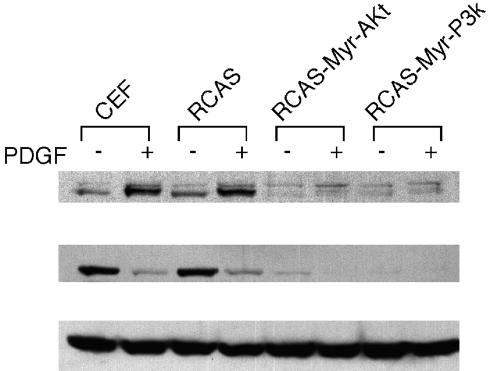
Fig. 1.
Fig. 1.
FoxO1 protein levels and phosphorylation in Akt/P3k-transformed CEF. Uninfected CEF, RCAS vector-infected CEF, and CEF transformed by myristoylated Akt (Myr-Akt) or myristoylated P3k (Myr-P3k) were serum-starved for 40 h and then stimulated or not with 50 ng/ml PDGF-BB for 15 min. Lysates were separated by 10% SDS/PAGE and transferred to a poly(vinylidene difluoride) membrane. The membrane was probed with anti-phospho-FoxO1 (Ser-256, Cell Signaling Technology) (Top). The same blot was stripped and probed with anti-FoxO1 (phosphorylation-independent, Cell Signaling Technology) (Middle) and with anti-α-tubulin Ab (ICN) (Bottom).
Fig. 2.
Fig. 2.
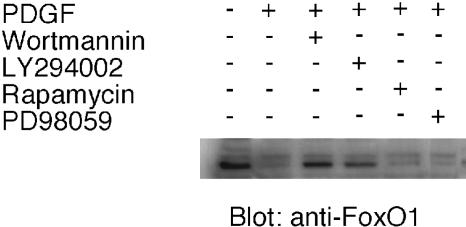
Effect of PI3K inhibitors on FoxO1 down-regulation. Uninfected CEF were serum-starved for 40 h, incubated with rapamycin (10 ng/ml), wortmannin (100 nM), LY294002 (20 μM), or the extracellular signal-regulated kinase inhibitor PD98059 (20 μM) for 30 min, and then stimulated with PDGF for 15 min. The membrane was probed with anti-FoxO1 Ab.
Fig. 3.
Fig. 3.
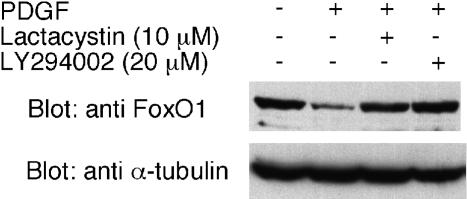
Effect of lactacystin on FoxO1 down-regulation. CEF were serum-starved for 40 h, incubated with lactacystin (10 μM) or LY294002 (20 μM) for 30 min, and then stimulated with PDGF for 15 min. The membrane was probed with anti-FoxO1 Ab or with anti-α-tubulin Ab for a loading control.
Fig. 4.
Fig. 4.
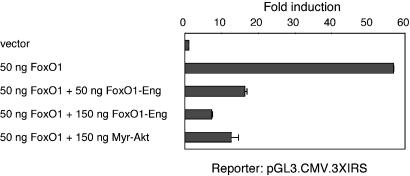
Effects of FoxO1-Eng fusion constructs on FoxO1-induced transcriptional activation in CEF. CEF were transfected with pGL3-CMV-3xIRS, the firefly luciferase reporter construct carrying three copies of the FoxO1-binding motif upstream of the CMV minimal promoter, together with FoxO1 constructs in the pcDNA3 vector as indicated. Data were calibrated for transfection efficiency by cotransfection of the Renilla luciferase reporter construct pRL-CMV.
Fig. 5.
Fig. 5.
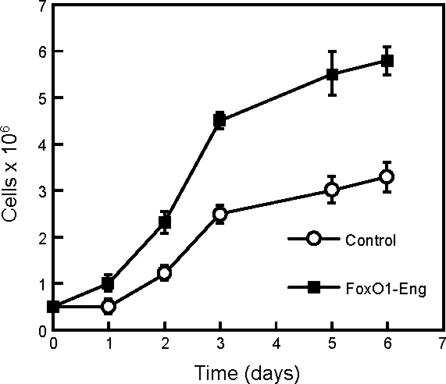
Growth curve of CEF expressing FoxO1-Eng. CEF transfected with RCAS vector alone or with RCAS-FoxO1-Eng were seeded at 5 × 10⁵ cells per 60-mm plate on day 0 and cultured in cloning medium (5). Cell numbers were counted at indicated times by using a Beckman Coulter counter.
Fig. 6.
Fig. 6.
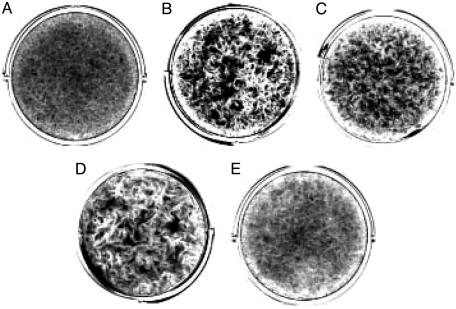
Tests for focus formation by the FoxO1-Eng constructs. CEF were transfected with 500 ng of DNA constructs by using the dimethyl sulfoxide/polybrene method. The cells were overlaid with nutrient agar for 21 days and then fixed and stained with crystal violet. (A) Empty RCAS vector. (B) RCAS FoxO1-Eng. (C) ASV31(FoxG1). (D) RCAS FoxO1(AA)-Eng. (E) RCAS FoxO1(AA)/H215R-Eng.
Fig. 7.
Fig. 7.
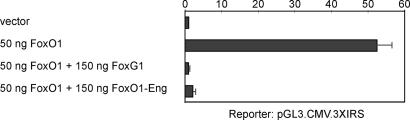
Effects of FoxG1 and FoxO1-Eng fusion constructs on FoxO1-induced transcriptional activation in CEF. CEF were transfected with pGL3-CMV-3xIRS, the firefly luciferase reporter construct carrying three copies of the FoxO1-binding motif upstream of the CMV minimal promoter, together with effector constructs in the pcDNA3 vector as indicated. Data were calibrated for transfection efficiency by cotransfection of the Renilla luciferase reporter construct pRL-CMV.

References

    1. Vivanco, I. & Sawyers, C. L. (2002) Nat. Rev. Cancer 2, 489–501. - PubMed
    1. Samuels, Y., Wang, Z., Bardelli, A., Silliman, N., Ptak, J., Szabo, S., Yan, H., Gazdar, A., Powell, S. M., Riggins, G. J., et al. (2004) Science 304, 554. - PubMed
    1. Chang, H. W., Aoki, M., Fruman, D., Auger, K. R., Bellacosa, A., Tsichlis, P. N., Cantley, L. C., Roberts, T. M. & Vogt, P. K. (1997) Science 276, 1848–1850. - PubMed
    1. Aoki, M., Schetter, C., Himly, M., Batista, O., Chang, H. W. & Vogt, P. K. (2000) J. Biol. Chem. 275, 6267–6275. - PubMed
    1. Aoki, M., Batista, O., Bellacosa, A., Tsichlis, P. & Vogt, P. K. (1998) Proc. Natl. Acad. Sci. USA 95, 14950–14955. - PMC - PubMed

Publication types

MeSH terms

LinkOut - more resources