


Developmental dental aberrations after the dioxin accident in Seveso
- PMID: 15345345
- PMCID: PMC1247522
- DOI: 10.1289/ehp.6920
Developmental dental aberrations after the dioxin accident in Seveso
Abstract
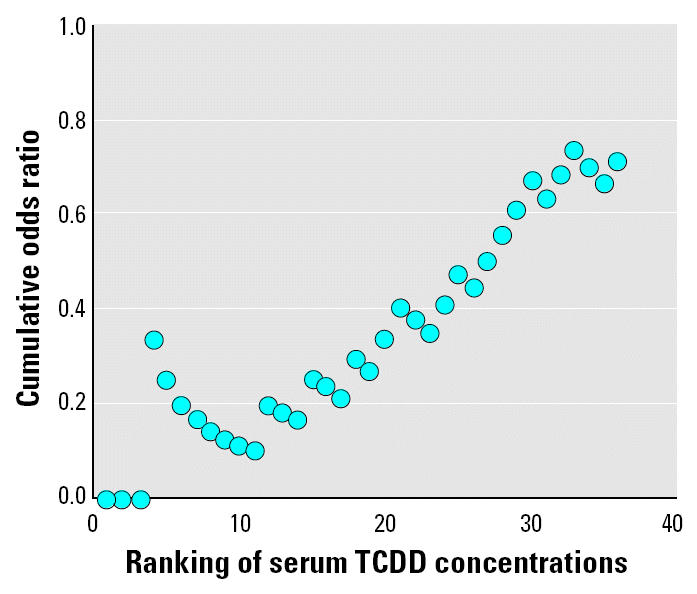
Children's developing teeth may be sensitive to environmental dioxins, and in animal studies developing teeth are one of the most sensitive targets of toxicity of 2,3,7,8-tetrachlorodibenzo-p-dioxin (TCDD). Twenty-five years after the dioxin accident in Seveso, Italy, 48 subjects from the contaminated areas (zones A and B) and in patches lightly contaminated (zone R) were recruited for the examination of dental and oral aberrations. Subjects were randomly invited from those exposed in their childhood and for whom frozen serum samples were available. The subjects were frequency matched with 65 subjects from the surrounding non-ABR zone for age, sex, and education. Concentrations of TCDD in previously analyzed plasma samples (zone ABR subjects only) ranged from 23 to 26,000 ng/kg in serum lipid. Ninety-three percent (25 of 27) of the subjects who had developmental enamel defects had been < 5 years of age at the time of the accident. The prevalence of defects in this age group was 42% (15 of 36) in zone ABR subjects and 26% (10 of 39) in zone non-ABR subjects, correlating with serum TCDD levels (p = 0.016). Hypodontia was seen in 12.5% (6 of 48) and 4.6% (3 of 65) of the zone ABR and non-ABR subjects, respectively, also correlating with serum TCDD level (p = 0.05). In conclusion, developmental dental aberrations were associated with childhood exposure to TCDD. In contrast, dental caries and periodontal disease, both infectious in nature, and oral pigmentation and salivary flow rate were not related to the exposure. The results support our hypothesis that dioxins can interfere with human organogenesis.
Figures
References
-
- Abbott BD, Birnbaum LS. TCDD alters medial epithelial cell differentiation during palatogenesis. Toxicol Appl Pharmacol. 1989;99:276–278. - PubMed
-
- Abbott BD, Birnbaum LS, Pratt RM. TCDD-induced hyperplasia of the ureteral epithelium produces hydronephrosis in murine fetuses. Teratology. 1987;35:329–334. - PubMed
-
- Akamine A, Hashiguchi I, Maeda K, Hara Y, Chinjiu N, Iwamoto Y, et al. Prevalence of periodontal disease in patients with Yusho. Fukuoka Ikagu Zasshi. 1985;76:248–252. - PubMed
-
- Alaluusua S, Lukinmaa P-L, Pohjanvirta R, Unkila M, Tuomisto J. Exposure to 2,3,7,8-tetrachlorodibenzo-para-dioxin leads to defective dentin formation and pulpal perforation in rat incisor tooth. Toxicology. 1993;81:1–13. - PubMed
-
- Alaluusua S, Lukinmaa P-L, Torppa J, Tuomisto J, Vartiainen T. Developing teeth as biomarker of dioxin exposure [Letter] Lancet. 1999;353:206. - PubMed
Publication types
MeSH terms
Substances
LinkOut - more resources
Full Text Sources
Medical