


Phage types and genotypes of shiga toxin-producing Escherichia coli O157:H7 isolates from humans and animals in spain: identification and characterization of two predominating phage types (PT2 and PT8)
- PMID: 15364983
- PMCID: PMC516362
- DOI: 10.1128/JCM.42.9.4007-4015.2004
Phage types and genotypes of shiga toxin-producing Escherichia coli O157:H7 isolates from humans and animals in spain: identification and characterization of two predominating phage types (PT2 and PT8)
Abstract
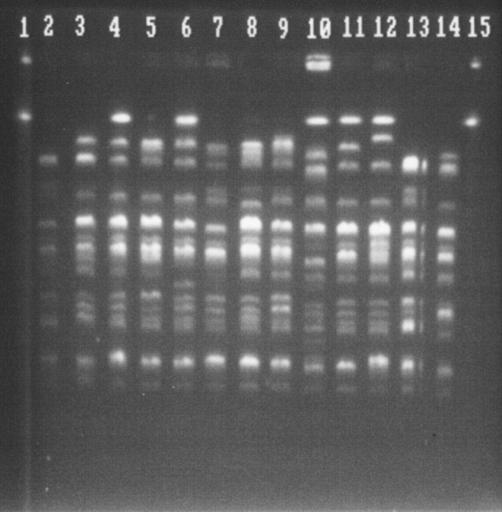
Phage typing and DNA macrorestriction fragment analysis by pulsed-field electrophoresis (PFGE) were used for the epidemiological subtyping of a collection of Shiga toxin-producing Escherichia coli (STEC) O157:H7 strains isolated in Spain between 1980 and 1999. Phage typing distinguished a total of 18 phage types among 171 strains isolated from different sources (67 humans, 82 bovines, 12 ovines, and 10 beef products). However, five phage types, phage type 2 (PT2; 42 strains), PT8 (33 strains), PT14 (14 strains), PT21/28 (11 strains), and PT54 (16 strains), accounted for 68% of the study isolates. PT2 and PT8 were the most frequently found among strains from both humans (51%) and bovines (46%). Interestingly, we detected a significant association between PT2 and PT14 and the presence of acute pathologies. A group of 108 of the 171 strains were analyzed by PFGE, and 53 distinct XbaI macrorestriction patterns were identified, with 38 strains exhibiting unique PFGE patterns. In contrast, phage typing identified 15 different phage types. A total of 66 phage type-PFGE subtype combinations were identified among the 108 strains. PFGE subtyping differentiated between unrelated strains that exhibited the same phage type. The most common phage type-PFGE pattern combinations were PT2-PFGE type 1 (1 human and 11 bovine strains), PT8-PFGE type 8 (2 human, 6 bovine, and 1 beef product strains), PT2-PFGE subtype 4A (1 human, 3 bovine, and 1 beef product strains). Nine (29%) of 31 human strains showed phage type-PFGE pattern combinations that were detected among the bovine strains included in this study, and 26 (38%) of 68 bovine strains produced phage type-PFGE pattern combinations observed among human strains included in this study, confirming that cattle are a major reservoir of strains pathogenic for humans. PT2 and PT8 strains formed two groups which differed from each other in their motilities, stx genotypes, PFGE patterns, and the severity of the illnesses that they caused.
Figures
References
-
- Ahmed, R., C. Bopp, A. Borcyzk, and S. Kasatiya. 1987. Phage typing scheme for Escherichia coli O157:H7. J. Infect. Dis. 155:806-809. - PubMed
-
- Ahmed, R., A. Ali, W. Demczuk, D. Woodward, C. Clark, R. Khakria, and F. Rodgers. 2001. Emergence of new molecular and phage typing variants of E. coli O157:H7 in Canada, p. 123. In G. Duffy, P. Garvey, J. Coia, Y. Wasteson, and D. A. McDowell (ed.), Verocytotoxigenic E. coli in Europe, vol. 5. Epidemiology of verocytotoxigenic E. coli. Concerted action CT98-3935. Teagasc, The National Food Centre, Dublin, Ireland.
-
- Allison, L., A. Stirrat, and F. M. Thomson-Carter. 1998. Genetic heterogeneity of Escherichia coli O157:H7 in Scotland and its utility in strain subtyping. Eur. J. Clin. Microbiol. Infect. Dis. 17:844-848. - PubMed
Publication types
MeSH terms
Substances
LinkOut - more resources
Full Text Sources
