


Definition of the Beijing/W lineage of Mycobacterium tuberculosis on the basis of genetic markers
- PMID: 15364987
- PMCID: PMC516354
- DOI: 10.1128/JCM.42.9.4040-4049.2004
Definition of the Beijing/W lineage of Mycobacterium tuberculosis on the basis of genetic markers
Abstract
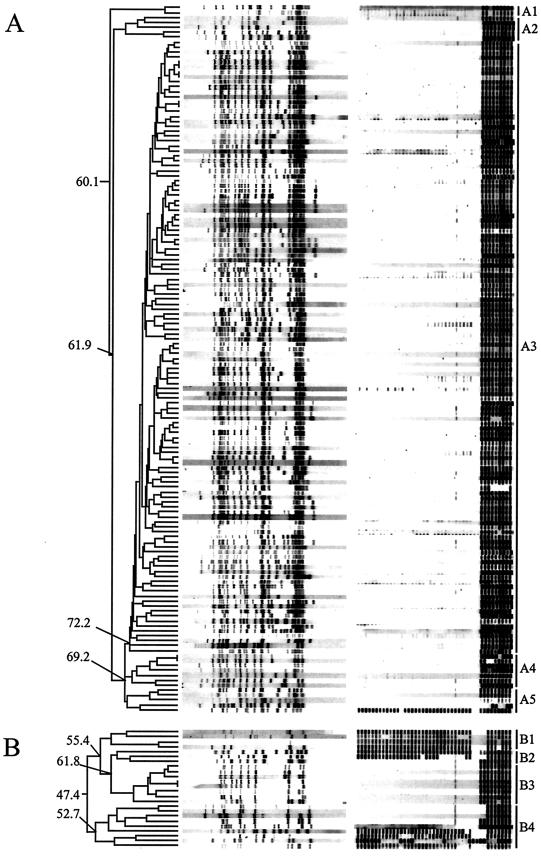
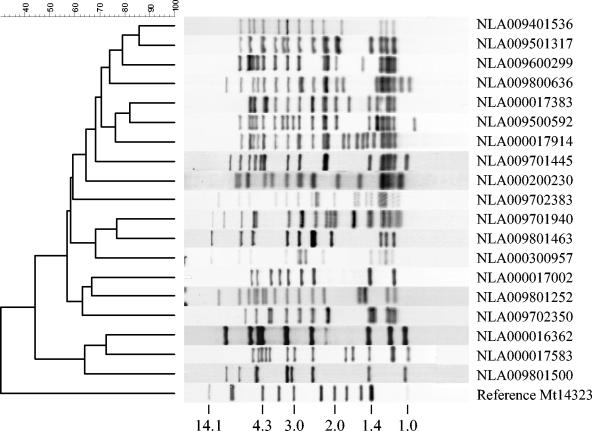
Mycobacterium tuberculosis Beijing genotype strains are highly prevalent in Asian countries and in the territory of the former Soviet Union. They are increasingly reported in other areas of the world and are frequently associated with tuberculosis outbreaks and drug resistance. Beijing genotype strains, including W strains, have been characterized by their highly similar multicopy IS6110 restriction fragment length polymorphism (RFLP) patterns, deletion of spacers 1 to 34 in the direct repeat region (Beijing spoligotype), and insertion of IS6110 in the genomic dnaA-dnaN locus. In this study the suitability and comparability of these three genetic markers to identify members of the Beijing lineage were evaluated. In a well-characterized collection of 1,020 M. tuberculosis isolates representative of the IS6110 RFLP genotypes found in The Netherlands, strains of two clades had spoligotypes characteristic of the Beijing lineage. A set of 19 Beijing reference RFLP patterns was selected to retrieve all Beijing strains from the Dutch database. These reference patterns gave a sensitivity of 98.1% and a specificity of 99.7% for identifying Beijing strains (defined by spoligotyping) in an international database of 1,084 strains. The usefulness of the reference patterns was also assessed with large DNA fingerprint databases in two other European countries and for identification strains from the W lineage found in the United States. A standardized definition for the identification of M. tuberculosis strains belonging to the Beijing/W lineage, as described in this work, will facilitate further studies on the spread and characterization of this widespread genotype family of M. tuberculosis strains.
Figures
References
-
- Bifani, P. J., B. Mathema, N. E. Kurepina, and B. N. Kreiswirth. 2002. Global dissemination of the Mycobacterium tuberculosis W-Beijing family strains. Trends Microbiol. 10:45-52. - PubMed
-
- Bifani, P. J., B. Mathema, Z. Liu, S. L. Moghazeh, B. Shopsin, B. Tempalski, J. Driscol, R. Frothingham, J. M. Musser, P. Alcabes, and B. N. Kreiswirth. 1999. Identification of a W variant outbreak of Mycobacterium tuberculosis via population-based molecular epidemiology. JAMA 282:2321-2327. - PubMed
-
- Bifani, P. J., B. B. Plikaytis, V. Kapur, K. Stockbauer, X. Pan, M. L. Lutfey, S. L. Moghazeh, W. Eisner, T. M. Daniel, M. H. Kaplan, J. T. Crawford, J. M. Musser, and B. N. Kreiswirth. 1996. Origin and interstate spread of a New York City multidrug-resistant Mycobacterium tuberculosis clone family. JAMA 275:452-457. - PubMed
Publication types
MeSH terms
Substances
LinkOut - more resources
Full Text Sources
Other Literature Sources
