


Use of an oligonucleotide array for laboratory diagnosis of bacteria responsible for acute upper respiratory infections
- PMID: 15365022
- PMCID: PMC516371
- DOI: 10.1128/JCM.42.9.4268-4274.2004
Use of an oligonucleotide array for laboratory diagnosis of bacteria responsible for acute upper respiratory infections
Abstract
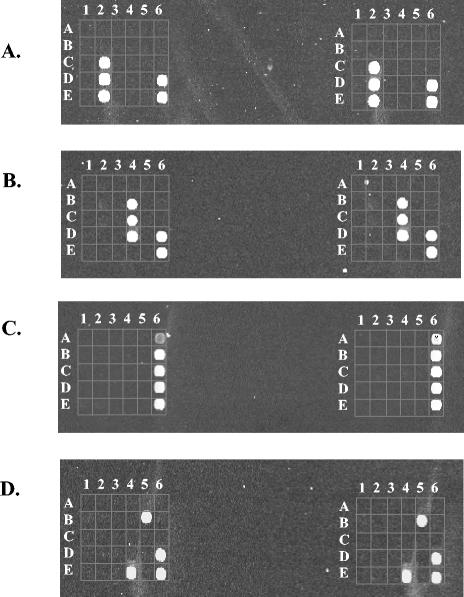
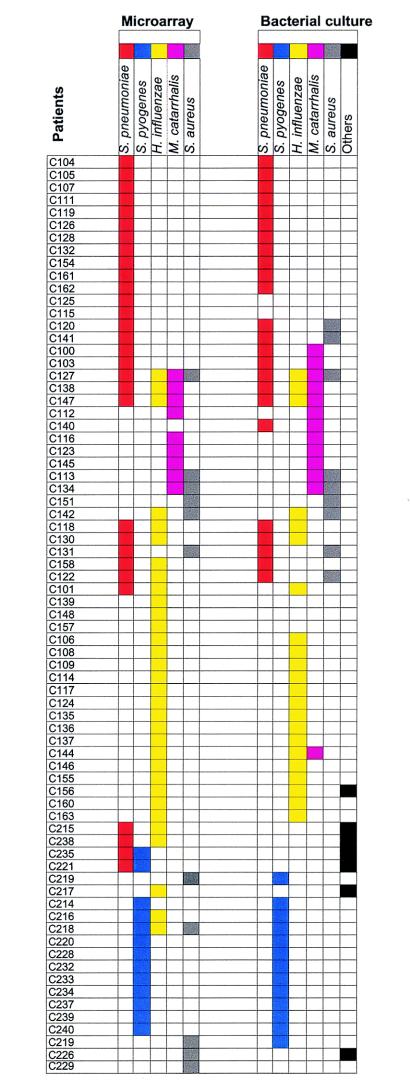
We developed a diagnostic array of oligonucleotide probes targeting species-specific variable regions of the genes encoding topoisomerases GyrB and ParE of respiratory bacterial pathogens. Suitable broad-range primer sequences were designed based on alignment of gyrB/parE sequences from nine different bacterial species. These species included Corynebacterium diphtheriae, Fusobacterium necrophorum, Haemophilus influenzae, Legionella pneumophila, Moraxella catarrhalis, Mycoplasma pneumoniae, Staphylococcus aureus, Streptococcus pneumoniae, and Streptococcus pyogenes. Specific probe sequences were selected by comparative analysis against the European Bioinformatics Database, as well as gyrB/parE sequences generated for this study. To verify specificity, at least six initial oligonucleotide probe sequences per bacterial species were tested by hybridization on a solid glass support using culture collection strains as templates. Finally, three oligonucleotide probes per bacterial species were utilized to examine 65 middle ear fluid and 29 throat swab samples. The sensitivities of the developed assay compared to classic culture from middle ear fluid samples for H. influenzae, M. catarrhalis, and S. pneumoniae were 96 (93 for culture), 73 (93 for culture), and 100% (78% for culture), respectively. No cross-reactivity with bacterial species belonging to the normal oral flora was observed when the 29 throat swab samples were studied. The sensitivity of the assay to detect S. pyogenes from these samples was 93% (80% for culture). These results provide a proof of concept for the diagnostic use of microarray technology based on broad-range topoisomerase gene amplification, followed by hybridization and specific detection of bacterial species.
Figures
References
-
- Bosshard, P. P., A. Kronenberg, R. Zbinden, C. Ruef, E. C. Böttger, and M. Altwegg. 2003. Etiologic diagnosis of infective endocarditis by broad-range polymerase chain reaction: a 3-year experience. Clin. Infect. Dis. 37:167-172. - PubMed
-
- Fendrick, A. M., S. Saint, I. Brook, M. R. Jacobs, S. Pelton, and S. Sethi. 2001. Diagnosis and treatment of upper respiratory tract infections in the primary care setting. Clin. Ther. 23:1683-1706. - PubMed
Publication types
MeSH terms
Substances
LinkOut - more resources
Full Text Sources
Other Literature Sources
Medical
Molecular Biology Databases
